#1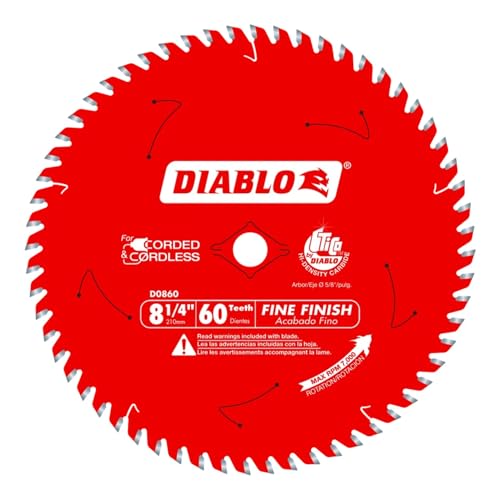
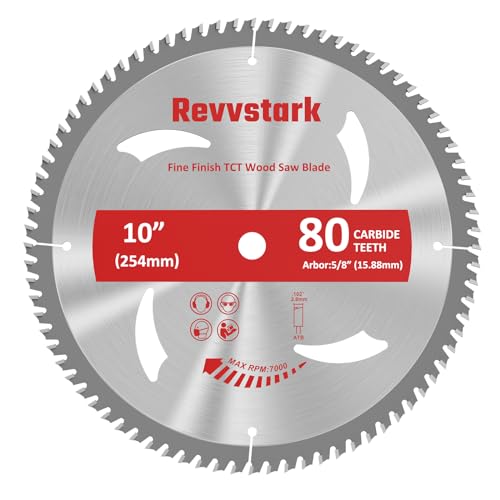
Diablo D0860XDiablo Fine Finish 60T ATB
Ranks first at 76 and lists anti-stick coating, vibration reduction and TiCo Hi-Density carbide.
- Tooth count
- 60
- Tooth grind
- Fine finish ATB
- Kerf width
- —
The right table saw blade depends on the cut. Tooth count sets finish quality: more teeth leave a smoother edge but cut slower. Tooth grind, carbide type and kerf width decide how cleanly and how easily the blade moves through wood. Blade diameter and arbor size must match your saw. We put 49 products on one spec sheet so you can compare tooth count, grind, kerf, weight and extras like anti-stick coating and vibration reduction, then pick the blade that suits your material.
Quick answer
Ranked from 49 table saw blades that met our standard, compared on tooth grind, tooth count, kerf width.
As an Amazon Associate I earn from qualifying purchases. Links to retailers on this site are affiliate links; we may earn a commission at no extra cost to you.
Ranks first at 76 and lists anti-stick coating, vibration reduction and TiCo Hi-Density carbide.
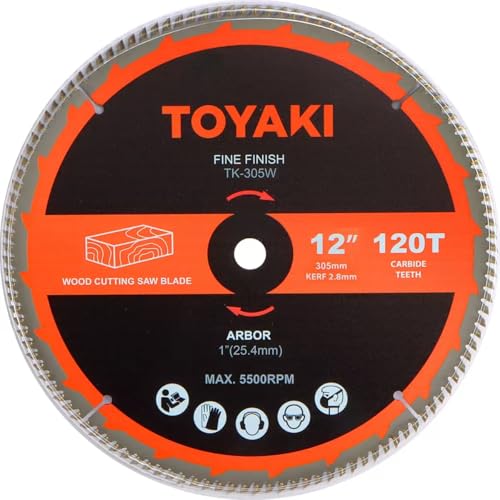
Its 120 teeth on a 12 in blade tie for the highest count on the page.
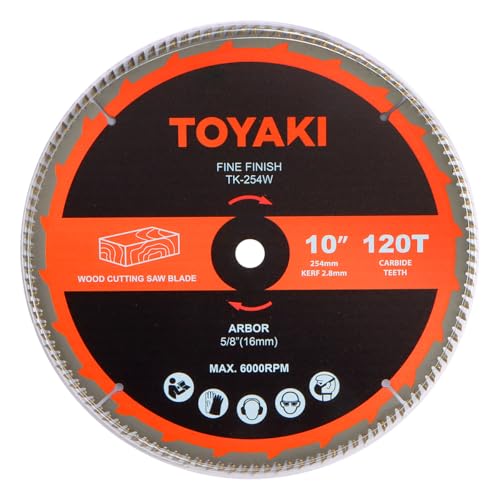
A 10 in blade with 120 teeth, tied for the highest tooth count listed.
| Spec | ||||||||||
|---|---|---|---|---|---|---|---|---|---|---|
| Best Scoreout of 100 | 76 | 75 | 74 | 71 | 69 | 69 | 68 | 67 | 67 | 66 |
| Blade diameterin | — | 12.00 in | 10.00 in | 10.00 in | 12.00 in | 12.00 in | 10.00 in | 12.00 in | 10.00 in | 10.00 in |
| Tooth count | 60 | 120 | 120 | 120 | 100 | 80 | 80 | 100 | 90 | 60 |
| Kerf widthin | — | — | — | — | 0.106 in | 0.118 in | — | 0.098 in | 0.087 in (best in row) | 0.087 in (best in row) |
| Tooth grind | Fine finish ATB | Fine finish ATB | Fine finish ATB | Fine finish ATB | Fine finish ATB | Fine finish ATB | — | Polished ASFG | Polished ASFG | Fine finish ATB |
| Carbide type | TiCo Hi-Density carbide | — | — | High-grade carbide | Carbide | Tungsten carbide | Tungsten carbide | Foxcarbide | FOXBC proprietary foxcarbide | Tungsten carbide |
| Anti-stick coating | Yes | — | — | — | — | — | — | — | — | — |
| Vibration reduction | Yes | Yes | Yes | — | Yes | Yes | — | — | — | Yes |
| Max RPMRPM | — | — | — | — | — | — | 7000 RPM | — | — | — |
| Weightlb | 1.03 lb (best in row) | 2.43 lb | 1.54 lb | 1.54 lb | 2.86 lb | 2.93 lb | 1.68 lb | 2.67 lb | 1.65 lb | — |
| Warrantyyr | — | — | — | — | — | — | — | — | — | — |
We reviewed 60 table saw blades and kept only the 49 that pass every check below. Those are ranked by a Best Score built from spec fit for this job, sales rank.
These reviews are based on specifications and listing information, not hands-on use. Each one explains what the numbers mean for cutting wood on a table saw.
Diablo's 60-tooth blade leads our spec ranking
The Diablo D0860X holds the top spot on our Best Score at 76. It has 60 teeth and a Fine finish ATB grind. Alternate top bevel teeth slice wood fibers cleanly, which helps on crosscuts in oak, pine and melamine, the materials the listing names. Sixty teeth is a middle count, so it should cut faster than the 100 and 120 tooth blades here while still leaving a smooth edge.
The carbide is TiCo Hi-Density, and the listing says it is meant to give chip-free cuts and longer wear. It also lists an anti-stick coating, called Perma-SHIELD, aimed at heat, gumming and corrosion. Pitch and resin build-up slows a cut and can burn wood, so a coating matters if you use the blade often. Vibration reduction comes from laser-cut stabilizer vents.
Weight is 1.031 lb. The listing describes a super thin-kerf design, but the data gives no kerf width, blade diameter or max RPM. Check the size and arbor against your saw before you order. That is the main gap in an otherwise complete spec sheet.
VerdictRanked #1 of the products we compared on our Best Score.
TOYAKI 12-in blade packs 120 teeth for smooth edges
The TOYAKI TK-305W is a 12 in blade with 120 teeth, which ties for the highest tooth count on the page. More teeth mean each one takes a smaller bite, so the edge comes out smoother. That suits fine work in hardwood and veneered stock. The trade-off is slower feed, because the blade removes less material per tooth.
It ranks second at 75 on our Best Score. The grind is Fine finish ATB, and vibration reduction is listed. Weight is 2.43 lb, which is lighter than the other 12 in blades here that list weight, such as the DEWALT at 2.86 lb. The listing says the arbor is 1 in, which fits many saws, but check yours.
The data does not give a kerf width, carbide type, max RPM or anti-stick coating. The listing also calls it a miter saw blade for wood and soft materials, so confirm it fits a table saw with enough blade height. Buyers who need carbide details should look at other models.
VerdictA strong finish blade on paper, held back by missing carbide and kerf details.
A 10-in, 120-tooth blade for the smoothest cuts
The TOYAKI TK-254W brings 120 teeth to a 10 in blade, the size most table saws use. That tooth count ties for the highest listed on the page. A high count suits sanded-quality edges on trim, plywood and hardwood, where tear-out matters more than speed.
It ranks third at 74 on our Best Score. The grind is Fine finish ATB and the listing mentions vibration reduction. Weight is 1.54 lb, lighter than the 10 in Revvstark at 1.68 lb and the FOXBC 90T at 1.65 lb. A lighter plate is easier to handle when changing blades, though weight alone says little about cut quality.
The listing gives a 16mm arbor, which is not the 5/8 in size common on 10 in table saw blades, so check your saw's arbor before buying. Kerf width, carbide type, max RPM and anti-stick coating are not published. The listing also frames it as a miter saw blade for wood and soft materials.
VerdictGood for fine finish work on paper, but confirm the arbor fit first.
DEWALT's 100-tooth blade lists kerf and carbide
The DEWALT DWA112100 is a 12 in blade with 100 teeth and a Fine finish ATB grind. It ranks fourth at 69 on our Best Score. The tooth count sits between the 80 tooth FOXBC and the 120 tooth TOYAKI blades, so expect a smooth edge with moderate feed speed.
Kerf width is 0.106 in. Kerf is the width of the slot the blade cuts, and a wider kerf removes more wood and asks more of the motor. It is narrower than the FOXBC 12 in 80T at 0.118 in but wider than the FOXBC 12 in 100T at 0.098 in. The carbide is listed only as Carbide, with no grade named.
The listing mentions a patented body slot design for low vibration, precision tensioning for stiffness and up to 3X life, though it does not say what that is measured against. Weight is 2.86 lb, heavier than the TOYAKI 12 in at 2.43 lb. Max RPM and anti-stick coating are not listed.
VerdictA sound finish blade with clearer kerf data than the TOYAKI models.
FOXBC 80-tooth blade aims at hardwood crosscuts
The FOXBC FOX1280X is a 12 in blade with 80 teeth and a Fine finish ATB grind. It ranks fifth at 69 on our Best Score. Eighty teeth is a practical middle count: smooth enough for crosscuts in hardwood and softwood, and faster than the 100 and 120 tooth blades in this group.
Kerf is 0.118 in, wider than the DEWALT at 0.106 in. A wider kerf makes a stiffer blade but removes more wood and needs more power. The carbide is listed as tungsten carbide, and the listing gives a 7° hook angle and a 1 in arbor. Hook angle is the tooth lean, and a low angle gives a gentler, more controlled bite.
Weight is 2.93 lb, the heaviest of the five reviewed blades. The listing names chip-free cuts in veneered plywood, melamine and MDF, and says the laser-cut vents reduce vibration and warp. Max RPM and anti-stick coating are not published, so check the blade's rating against your saw.
VerdictA reasonable all-round finish blade, with a wider kerf than the competition.
Best among the reviewed tools
Fewer teeth, around 24 to 40, cut faster and suit ripping along the grain. Higher counts, from 60 to 120, leave smoother edges for crosscuts and veneered panels. Pick by the material you cut most, not by the biggest number.
Blade diameter must match your saw, and the arbor hole must fit the shaft. Many 10 in blades use a 5/8 in arbor. Some listings give 16mm or 1 in instead, so confirm before you order.
Kerf is the width of the cut. Thin kerf blades, such as 0.087 in, remove less wood and ask less of smaller motors. Wider kerfs, up to 0.126 in on this page, tend to be stiffer. Not every listing publishes it.
Carbide teeth hold an edge longer than plain steel. An anti-stick coating helps resist pitch and heat build-up. Only some blades here list a coating, and some do not name a carbide grade, so compare those rows.
It depends on the cut. Around 24 to 40 teeth rip faster along the grain. Blades with 60 to 80 teeth suit general work and crosscuts. Counts of 100 to 120 give the smoothest finish but cut slower.
ATB stands for alternate top bevel. The teeth angle left and right in turn, which slices wood fibers cleanly. It is common on fine finish and crosscut blades and helps reduce tear-out in hardwood, plywood and melamine.
Some listings say a blade fits both, but check the arbor size, diameter and the maker's guidance first. Blades for crosscuts may use different tooth angles than ripping blades. When unsure, confirm with the maker.
A thin kerf blade cuts a narrower slot, so it removes less wood and needs less motor power. On this page, kerf widths run from 0.063 in to 0.126 in among the models that list it.
Your own selection is kept in the link, so friends see the same side-by-side.