Can a Table Saw Work as a Jointer?
Partly. With a straight-edge sled or jig, a table saw can give you a straight, glue-ready edge on a board. It cannot flatten a warped or cupped face, because the blade only cuts on a flat table and has nothing to reference a twisted board against. For flat faces, you need a jointer or a planer sled setup.
 CUTECH 401120HI-IFBest overall
 Jet JJ-6HHDXLongest 6 in tables
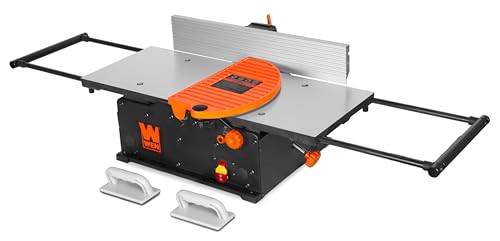 WEN JT1224HBest wide benchtop value
What a jointer does that a table saw does not
A jointer has two coplanar tables with a spinning cutterhead between them. You press a board onto the infeed table, push it across the cutterhead, and the outfeed table supports the freshly cut surface. Because the cut surface becomes the new reference, each pass removes high spots and leaves a flat face. Then you hold that flat face against the fence and cut an edge that is square to it.
A table saw works differently. The blade is fixed in height and the board rides on a flat top. That makes it very good at cutting parallel strips and square ends, but it cuts away from whatever edge or face is already against the fence or table. If that reference is crooked, the cut copies the crook.
So the real question is which job you need done. Straightening an edge is within reach of a table saw. Flattening a face is not.
How to joint an edge on a table saw
The usual approach is a simple shop-made sled or straight-line jig. The sled carries the rough board and gives the blade a stable, straight edge to cut against. The blade then trims the board to a straight line that matches the sled, and you flip the board to rip the other side parallel.
Here is the basic process:
- Build or buy a sled with a long, straight runner edge that slides against the rip fence, or a jig that rides in the miter slot.
- Secure the rough board to the sled with toggle clamps or stops, with the crooked edge slightly overhanging the cutting side.
- Set the blade just high enough to clear the board by a small margin.
- Run the sled past the blade in one steady pass, using push sticks to keep hands clear.
- Remove the board, flip it, and rip the second edge against the fence so both edges are parallel.
- Check the edges with a straightedge or by dry fitting two boards together before gluing.
Choose the blade for a clean edge
The blade matters more on a table saw than on a jointer, because the saw leaves the finished surface. A rip-tooth blade with a flat-top grind leaves a flatter, smoother edge than a general-purpose or crosscut blade, and it cuts with less strain in thick stock. If you are edge-gluing hardwood, see our best table saw blade for ripping hardwood comparison for ripping blades side by side.
For a broader look at tooth count and kerf, our best table saw blades page lists options for general work as well. Keep the blade sharp, since a dull blade burns the edge and increases kickback risk.
Why a table saw cannot flatten a face
A board that is cupped, bowed or twisted rocks on the saw table. If you rip it as is, the blade follows the board's shape and the problem comes along for the ride. Pressing it flat only springs back after the cut.
A jointer solves this because it shaves material from high spots until the whole face lies in one plane. The cut depth on the jointers we compare tops out at 1/8 in per pass on most models, with the Powermatic 60HH reaching 1/2 in, so you take light passes until the face is flat.
If you do not own a jointer, the common workarounds are a planer with a flattening sled, or a router sled. A table saw is not part of that process. It is best used after the face is flat, to rip the board to width and square an edge.
Table saw edge jointing vs a jointer
Here is how the two approaches compare on common tasks:
| Task | Table saw with a sled | Jointer |
|---|---|---|
| Straighten one edge | Yes, with a good sled and careful setup | Yes, and it is the machine's main job |
| Flatten a cupped or twisted face | No | Yes |
| Square an edge to a flat face | Only if the face is already flat | Yes, using the fence |
| Handle long boards | Limited by sled length and support | Limited by table length |
| Surface finish | Depends on the blade and feed rate | Smooth, especially with a spiral or helical head |
| Setup time per board | Longer, because of clamping the sled | Short once tables are set |
When a jointer is worth getting
If you build tabletops, panels or furniture from rough lumber, a jointer saves time and gives better results than an improvised sled. Cutting width sets the board size you can flatten, and models on our best jointer page range from 6 in to 12 in. Table length sets how long a board stays supported, from 23 in on the shortest to 73 in on the longest.
Space and weight matter too. Benchtop machines in that comparison run from about 21 lb to 112 lb. The VEVOR 6-inch benchtop weighs 21.16 lb and the WEN JT630H weighs 36.82 lb, so both suit a small shop. A heavy machine like the Powermatic 60HH at 489 lb gives long, stable tables but needs a permanent spot.
If you mostly work with plywood or buy pre-surfaced boards, a good table saw setup may be all you need. If you are shopping for the saw itself, our best table saw and best jobsite table saw pages cover the main options.
Safety notes
Edge jointing on a table saw puts the board close to the blade, so take extra care. Wear safety glasses and hearing protection every time, and add a dust mask when cutting hardwood.
Never freehand a crooked board against the fence. The board can bind between the blade and fence and kick back toward you.
- Keep the blade guard and riving knife in place whenever the sled design allows.
- Use push sticks and keep your hands out of the blade path.
- Unplug the saw before changing blades or adjusting the sled.
- Do not run very short or thin pieces through a sled setup.
- Stand to the side of the blade line, not directly behind the board.
Frequently asked questions
Can I use a table saw to flatten a board?
No. A table saw does not have a way to take down high spots on a face. Use a jointer, or a planer with a flattening sled.
Is a ripped edge good enough for glue-ups?
It can be, if the blade is sharp, the sled is straight and the board feeds steadily. Do a dry fit first and look for gaps along the joint.
Do I need a jointer if I already have a planer?
Not always. A planer makes the second face parallel to the first, but it does not make the first face flat on its own. A sled can work around that.
Which is better for beginners, a jointer or a table saw jig?
A table saw jig costs less effort to start, but a benchtop jointer is more direct and repeatable once you learn the setup. Pick based on how often you work with rough lumber.