#1
WORK SHARP WSGFS221Work Sharp Guided Field Sharpener
Lists five sharpening stages, the most on the page, plus built-in 20° and 25° guides.
- Sharpener type
- Guided manual
- Abrasive material
- Diamond and ceramic
- Sharpening stages
- 5
A good knife sharpener restores an edge without damaging the blade. Start with the type: pull-through models are quick, guided manual kits give you angle control, and electric units do the work for you. Then check the abrasive, the angle range, serrated support and how the sharpener stays steady. We put 15 products on one spec sheet, so you can compare stages, angles, grit, weight and warranty side by side. Where a maker does not publish a spec, we say so.
Quick answer
Ranked from 15 knife sharpeners that met our standard, compared on sharpener type, abrasive material, sharpening angle control.
As an Amazon Associate I earn from qualifying purchases. Links to retailers on this site are affiliate links; we may earn a commission at no extra cost to you.
Lists five sharpening stages, the most on the page, plus built-in 20° and 25° guides.

Diamond abrasives, a 15° to 20° range, and a listed resharpening time of about 10 seconds.
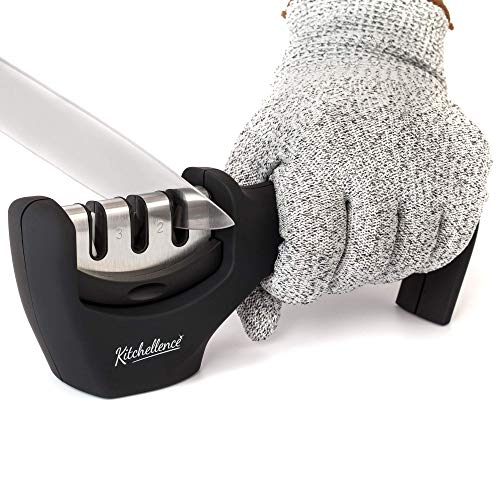
A three-slot pull-through with a cut-resistant glove and a non-slip base.
| Spec | ||||||||||
|---|---|---|---|---|---|---|---|---|---|---|
| Best Scoreout of 100 | 69 | 68 | 68 | 68 | 65 | 62 | 58 | 58 | 57 | 55 |
| Sharpener type | Guided manual | Electric (best in row) | Pull-through | Guided manual | Pull-through | Guided manual | Pull-through | Electric (best in row) | Pull-through | Pull-through |
| Abrasive material | Diamond and ceramic | Diamond | — | Diamond and ceramic | Diamond | Diamond and ceramic | — | — | — | — |
| Sharpening stages | 5 (best in row) | 3 | 3 | — | 4 | — | 4 | — | 3 | 3 |
| Sharpening angle | 20–25 | 15–20 | — | 15–30 | — | 14–24 | — | 20–25 | 20–20 | 12–24 |
| Adjustable angle | No | Yes (best in row) | — | Yes (best in row) | — | Yes (best in row) | — | — | No | Yes (best in row) |
| Works on serrated knives | Yes (best in row) | Yes (best in row) | — | Yes (best in row) | Yes (best in row) | — | — | Yes (best in row) | Yes (best in row) | No |
| Finest gritgrit | 600 grit | — | — | 600 grit | — | — | — | 6000 grit (best in row) | — | — |
| Weightlb | 0.29 lb | 4.19 lb | 0.40 lb | 3.00 lb | 0.68 lb | 0.55 lb | 0.33 lb | 0.07 lb (best in row) | 0.19 lb | 0.09 lb |
| Lengthin | 6.8 in | 10.0 in | 8.3 in | 4.6 in | 8.2 in | 10.6 in | 9.1 in | 7.0 in | 2.8 in (best in row) | 10.0 in |
| Non-slip base or grip | — | — | Yes | — | Yes | Yes | Yes | — | Yes | — |
| Cut-resistant glove included | — | — | Yes (best in row) | — | — | No | Yes (best in row) | — | No | — |
| Body material | Plastic | — | ABS plastic | — | ABS plastic | High-density ABS plastic frame | ABS plastic | — | — | ABS plastic |
| Warrantyyr | 3 years | 3 years | — | — | — | — | — | 3 years | 3 years | — |
We reviewed 20 knife sharpeners and kept only the 15 that pass every check below. Those are ranked by a Best Score built from spec fit for this job, sales rank.
These reviews are based on specifications and listing information. Each one covers a top-five sharpener and what its specs mean for restoring an edge.
A five-surface guided kit built for the field
The Work Sharp Guided Field Sharpener leads our ranking. It lists five sharpening stages, the most of any product on this page. The listing names coarse 220 and fine 600 grit diamond plates, ceramic rods and a leather strop. That mix lets you repair an edge first, then refine and polish it. It needs no power.
Angle control is built in. Two guides set 20° and 25°, and the angle is not adjustable. That suits hunting knives, pocket knives and most everyday blades. Guides keep the bevel steady from stroke to stroke. It will not reach the 15° edge that thin Japanese-style knives often use. The ceramic rods also handle serrations, and a hook groove helps with fish hooks.
It is small. The listing gives 4.6 oz, and the spec sheet shows 0.2875 lb and 6.75 in long. That is light enough for a pack. A broadhead wrench and lanyard hole add field use. The finest grit is 600, the lowest among models that list it, so expect a working edge rather than a mirror polish.
VerdictA compact, well-equipped guided kit for field and everyday knives, with fixed angles as its main limit.
An electric sharpener that converts edges to 15°
The Chef'sChoice 15XV EdgeSelect ranks second on our list and is the only electric model among the top five. This is a kitchen tool first. It uses diamond abrasives in three stages. The listing says it converts traditional 20° factory edges to a 15° Trizor XV edge. Its angle range is 15° to 20°.
Use is simple. Flexible spring guides set the angle automatically, and a single switch turns it on. The listing puts first-time sharpening at about 1 minute and resharpening at about 10 seconds. That speed helps if you sharpen often. Stages 1 and 2 sharpen and hone with diamond. Stage 3 polishes and helps serrated knives. Serrated blades are supported, which matters for bread knives.
It is the heaviest unit in this top five at 4.189 lb and 10 in long, so it needs counter space. The maker does not publish a finest grit or body material. It also runs on power, so it will not work in a camp or tackle box. Pick it for the kitchen counter, not the trail.
VerdictA strong kitchen pick that trades portability for speed and a 15° edge.
A simple three-slot pull-through with a safety glove
The Kitchellence 3-Stage kit ranks third. It is a pull-through sharpener, so you place the knife in a slot and pull it through. That keeps setup simple. The listing says a few pulls restore knives in seconds. It describes three slots: a diamond rod to repair, a slot to restore the V-shape, and a fine slot to polish.
Safety is its clearest edge. A cut-resistant glove is included, and the base is non-slip. Among the top five, it is the only model that lists a glove. The ergonomic handle suits right- and left-handed users. Pull-through designs are quick, though they offer less control than guided kits. These details matter if you are new to sharpening and want a steady hold.
It weighs 0.3968 lb, measures 8.3 in long and has an ABS plastic body. Among the top five it is the second lightest. The maker does not publish the sharpening angle, finest grit, warranty or serrated support. If you sharpen serrated knives or need a specific angle, confirm those details first.
VerdictA beginner-friendly pull-through with safety extras, held back by missing specs.
A guided kit with angles from 15° to 30°
The Work Sharp Precision Adjust Elite ranks fourth. It is a guided manual system with an adjustable angle from 15° to 30°. Fine angle control matters because the right bevel depends on the blade. The 30° top setting is the highest on this page. The listing ties angles to knife types: 15° for Japanese-style, 20° for Western kitchen knives, 25° for hunting blades and 30° for cleavers.
Abrasives are diamond and ceramic. The kit lists a 320-grit coarse diamond plate, a 600-grit fine diamond plate and a ceramic finishing rod. A dedicated conical ceramic rod handles serrated blades, and a tri-brasive attachment covers curved blades. The finest grit is 600, level with the lowest figure on this page.
It weighs 3 lb and measures 4.63 in long. That weight makes it a bench tool more than a pack item. The listing describes a clamp, set angle, sharpen routine, which suits beginners. The precision guide is meant to take the guesswork out of it. The maker does not publish a stage count, body material or warranty.
VerdictA flexible guided option for mixed knife collections, with a wide angle range.
Four slots, diamond rods, and serrated coverage
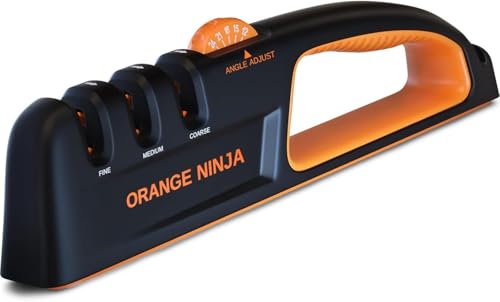
The Orange Ninja from Sharp Pebble ranks fifth. It is a pull-through sharpener with four slots, so it needs no power or setup. The listing names a coarse carbide slot to repair damaged edges, a medium diamond slot to sharpen, a fine slot to polish and a serrated slot. That is one more stage than the Kitchellence kit ranked above it. Diamond is the listed abrasive.
This is the only pull-through in the top five that lists serrated support, which suits bread and steak knives. That makes it handy for a mixed block of straight and serrated knives. The base is non-slip and the handle works for right- and left-handed users. The listing warns not to push the knife back and forth. Pull it through instead.
It weighs 0.68 lb, is 8.18 in long and has an ABS plastic body. The maker leaves out the sharpening angle, finest grit and warranty. Without an angle figure, you cannot match it to a specific edge, so treat it as a general-purpose maintenance tool for everyday knives. Quick passes are all it asks for.
VerdictA practical everyday pull-through that covers serrated knives but gives few angle details.
Best among the reviewed tools
Pull-through sharpeners are fastest and need little skill. Guided manual kits hold the angle for you and give finer control. Electric sharpeners do the work with a motor but take counter space. Match the type to how often you sharpen and how much control you want.
The angle sets how thin and sharp the edge is. Lower angles, such as 15°, suit thin kitchen knives. Higher angles, such as 25° or 30°, make tougher edges for hunting knives and cleavers. An adjustable angle covers more knives than a fixed one.
Diamond cuts steel fast and repairs dull edges. Ceramic hones and finishes. Grit sets the finish: lower numbers remove metal quickly, higher numbers polish. Only seven of the 15 products on this page list a finest grit, so check that spec before you decide.
Serrated blades need a rod or slot made for the teeth, so confirm the product lists serrated support. Straight-edge-only sharpeners are not made for them. Look for a non-slip base or grip, and a cut-resistant glove if you are new to sharpening.
Pull-through sharpeners are the simplest, since you pull the knife through slots with no angle setup. Guided kits are also beginner friendly because they hold the angle. On this page, the Kitchellence kit adds a cut-resistant glove and a non-slip base.
No. Some sharpeners are for straight edges only, such as the Sharp Pebble 3-Stage, which says it is not suitable for serrated knives. Look for a dedicated serrated slot or ceramic rod, as on the Orange Ninja and the Work Sharp Precision Adjust Elite.
Match the knife. The Work Sharp Precision Adjust Elite listing suggests 15° for Japanese-style knives, 20° for Western kitchen knives, 25° for hunting blades and 30° for cleavers. If your sharpener has a fixed angle, check that it fits your knives before you buy.
Electric models are faster and need less effort. The Chef'sChoice 15XV lists about 10 seconds to resharpen. Manual guided kits give more angle control and fit in a pack, and the Work Sharp Guided Field Sharpener weighs 0.2875 lb. Choose by how and where you sharpen.
Your own selection is kept in the link, so friends see the same side-by-side.