Why Does My Knife Sharpener Not Work? Causes and Fixes
Most sharpeners that seem broken are really mismatched or misused. The usual causes are the wrong angle for your knife, too much pressure or too few strokes, a worn or clogged abrasive, or a sharpener type that does not suit the blade. Check those four things in order and you will usually find the fix.
 WORK SHARP WSGFS221Best overall
 Chef's Choice 0101500Electric 15° edge converter
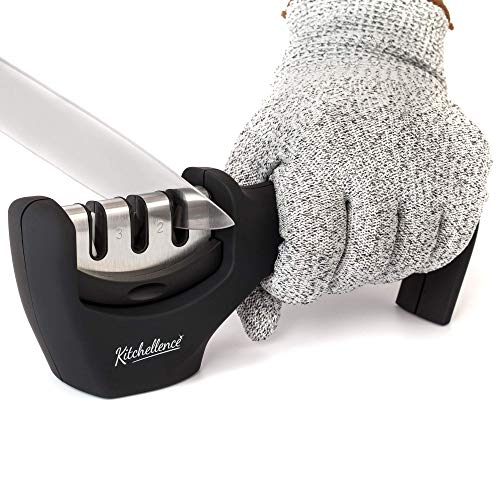 KITCHELLENCE KS37 PSafest for beginners
Start with the angle
The most common reason a knife stays dull is an angle mismatch. Every knife has a bevel, the narrow slope that forms the edge. If your sharpener grinds at a different angle than that bevel, it has to remove a lot of steel before it even touches the very edge. A few passes will not get there.
A quick test is to color the bevel with a permanent marker, then make three or four light strokes. If the marker disappears along the whole bevel, the angle matches. If it only vanishes at the top or bottom, the angle is off.
Angles vary by knife type. Lower angles such as 15° suit thin kitchen knives. Higher angles such as 25° or 30° make tougher edges for hunting knives and cleavers. A fixed-angle sharpener only works well on knives built for that angle. For example, the Work Sharp Guided Field Sharpener on our best knife sharpener page has built-in 20° and 25° guides and no adjustment, while the Work Sharp Precision Adjust Elite covers 15° to 30°.
Technique mistakes that undo the work
Sharpening is more about consistency than force. Pressing hard does not speed things up. It can chip a thin edge, wear the abrasive faster and make the angle wobble.
Pull-through sharpeners reward a steady motion. One listing on our page tells users not to push the knife back and forth, which is good advice for most slot sharpeners. Pull in one direction, from heel to tip, with the blade upright.
- Use light, even pressure and let the abrasive do the cutting.
- Keep the blade vertical in a pull-through slot, not tilted.
- Pull the full length of the edge, heel to tip, every stroke.
- Work through the stages in order, coarse first and fine last.
- Stop when you feel a slight burr or the marker is gone, then finish with the fine stage.
Worn, clogged or mismatched abrasives
Abrasives wear out. Metal dust can also clog the surface, so it glides instead of cutting. If your sharpener worked before and now does not, a worn or clogged surface is a likely cause. Check the maker's cleaning advice, since the right method depends on the material.
Grit matters too. Lower numbers remove metal quickly. Higher numbers polish. If you only use a fine stage on a badly dull knife, nothing much will happen. If you only use a coarse stage, the edge may feel rough. Diamond cuts steel fast and repairs dull edges, while ceramic hones and finishes.
Many of our listed products use staged systems for this reason. The Work Sharp Precision Adjust Elite has a 320-grit coarse diamond plate and a 600-grit fine diamond plate, plus a ceramic finishing rod. Note that only seven of the 15 products on our page list a finest grit, so check that spec if finish matters to you.
Why sharpeners seem to keep breaking
Pull-through sharpeners usually have plastic bodies and small abrasive parts. Forcing a thick or very hard blade through a narrow slot, or using one on knives it was not made for, can wear or crack parts. Electric units rely on motors and guides, so pushing a knife in roughly or running it longer than needed can strain them.
Serrated knives are another trap. A flat slot or plate is not made for the teeth. If you try to sharpen serrations with a straight-edge-only sharpener, you can damage both. The listing for one adjustable guided kit on our page says it does not suit serrated knives, while others list a dedicated serrated slot or rod.
Before you assume a defect, check the manual and the warranty. Several products on our page list a 3-year warranty, so a real fault may be covered.
Match the sharpener type to your knives
Your sharpener might be fine but wrong for the job. Our page groups products into three types: pull-through for speed and simplicity, guided manual for angle control, and electric for motor-driven convenience.
Here is how the types compare, using examples from our listed products.
| Type | Best for | Example from our page |
|---|---|---|
| Pull-through | Quick touch-ups, beginners | Kitchellence 3-slot kit, 8.3 in long, with non-slip base and cut-resistant glove |
| Pull-through with serrated slot | Mixed kitchen knives | Orange Ninja 4-stage, diamond abrasive, serrated compatible |
| Guided manual | Angle control, varied knives | Work Sharp Precision Adjust Elite, 15° to 30° |
| Electric | Hands-off sharpening, 15° conversion | Chef'sChoice 15XV, diamond, 15° to 20° range |
Is there a sharpener that actually works?
Yes, but the right one depends on your knives and habits. If your knives are thin Japanese-style or Western kitchen blades, look for a lower angle or an adjustable range. If you sharpen hunting knives, a higher angle matters more.
If you want minimal effort, the Chef'sChoice 15XV lists about 1 minute for first-time sharpening and about 10 seconds for resharpening. It is designed to convert 20° factory edges to 15° edges, so it is a specific tool for that goal. If you want control, a guided kit lets you set the angle and keep it steady.
You can compare stages, angles, grit, weight and warranty side by side on our best knife sharpener comparison. Where a maker does not publish a spec, we say so.
Safety notes
A dull knife is not safe, but a sharpening session has its own risks. Keep your fingers clear of the edge and the slot. A cut-resistant glove helps, and some kits include one. Use a non-slip base or put a damp cloth under the sharpener so it cannot slide.
With electric sharpeners, keep the unit dry, never put water near the motor, and unplug it before cleaning. Sharpening throws off fine metal dust, so wipe up afterward and wash your knife before cutting food. If you use a power grinder or any tool that throws sparks, wear eye protection.
Frequently asked questions
How do I know if my knife is actually sharp now?
Try slicing a ripe tomato or a sheet of paper. A sharp knife cuts cleanly with little pressure. If it slips or tears, the edge still needs work.
Can a knife be too damaged for a home sharpener?
Yes. Large chips or a bent tip may need a coarse stage and many passes, or a professional. A coarse diamond stage can often repair moderate damage.
Should I sharpen a knife before or after washing it?
Wash and dry it first so food residue does not clog the abrasive. Wipe it again after sharpening to remove metal dust.
How often should I sharpen my knives?
It depends on how much you cook and how hard your cutting surface is. Sharpen when the knife starts to slip or crush food. Light honing between sessions helps keep the edge.