How to Use a Knife Sharpening Rod
Hold the rod steady with its tip on a towel-lined counter, set the blade against it at about 15° to 20°, and sweep the edge down the rod from heel to tip. Use light pressure, alternate sides, and finish with a few feather-light strokes. A smooth steel rod realigns a slightly bent edge, while a ceramic or diamond rod removes a little metal and can bring back a duller edge.
 WORK SHARP WSGFS221Best overall
 Chef's Choice 0101500Electric 15° edge converter
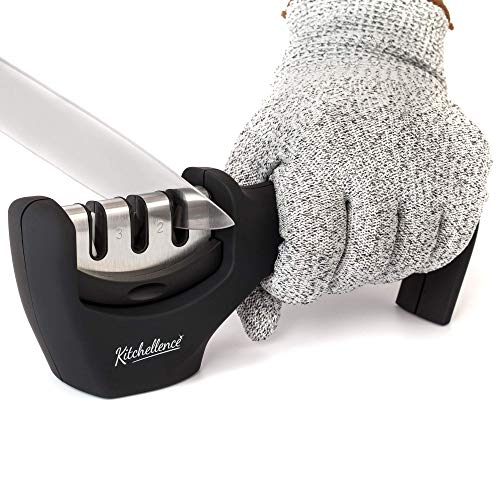 KITCHELLENCE KS37 PSafest for beginners
Know which kind of rod you have
People use the words sharpening rod, honing rod and sharpening steel for similar tools, but they do not all work the same way. A smooth steel rod mostly pushes a slightly bent edge back into line. A ceramic or diamond rod has an abrasive surface that actually shaves off a little steel.
That difference decides how you use it. A smooth rod is a maintenance tool you can reach for often. An abrasive rod is closer to a true sharpener, so use fewer strokes and lighter pressure. Check the packaging or listing if you are not sure what your rod is made of.
| Rod type | What it does | Best use |
|---|---|---|
| Smooth steel | Realigns a rolled or bent edge | Quick touch-ups between uses |
| Ceramic | Hones and lightly removes metal | Fine finishing and regular upkeep |
| Diamond | Removes metal faster | Edges that are noticeably dull |
Choose the angle and set up safely
Most Western kitchen knives are made with an edge near 20° per side. Many Japanese-style knives are thinner, around 15°. Our best knife sharpener page covers the same logic: lower angles suit thin kitchen blades, and higher angles such as 25° or 30° suit tougher blades like hunting knives and cleavers. Match your rod angle to the knife, and you will remove less steel.
One way to find 20° without a guide is to picture a right angle (90°), cut it in half (45°), then in half again, which is a little over 20°. Your blade should look only slightly tilted from the rod, not leaning far over.
Set up for safety before you start. Rods put your hand close to the edge, so take a moment to prepare.
- Use a stable work surface and set a damp towel or non-slip mat under the rod tip.
- Choose a rod with a hand guard, and keep your fingers behind it.
- Wear a cut-resistant glove on your holding hand if you are new to this.
- Wear eye protection when using a diamond or ceramic rod, since fine metal dust can fly up.
- Never run your thumb along the edge to test it. Test on paper or a tomato instead.
Step-by-step: the vertical method
The vertical method is the easiest to control, because the rod stays still and your knife does the moving. It is also safer than waving a rod in the air.
- Plant the rod tip on the towel-covered counter and hold the handle with the rod pointing straight up.
- Place the heel of the blade (the part nearest the handle) against the top of the rod at your chosen angle.
- Sweep the blade down the rod and across it, pulling the knife toward you so the tip finishes near the bottom of the rod.
- Switch to the other side of the blade and repeat on the other side of the rod.
- Alternate sides for 5 to 8 strokes each, keeping pressure light and the angle the same.
- Wipe the blade with a clean cloth and test it on a sheet of paper or a ripe tomato.
Common mistakes to avoid
Pressing hard is the most common error. On a smooth steel rod it can bend the edge the wrong way. On a diamond or ceramic rod it removes more metal than you need. Let the weight of the knife do most of the work.
Changing the angle mid-stroke is the second mistake. If your wrist rolls, you end up rounding the edge instead of keeping it crisp. Go slowly for the first few sessions and watch the blade against the rod. Short, steady strokes beat fast, sloppy ones.
Another habit to drop is sawing back and forth. Use a single sweep from heel to tip, one side at a time. If you move the tip of the blade along the rod while keeping the rod still, you cover the whole edge without extra effort.
Finally, do not skip cleaning. Abrasive rods can load up with metal, which reduces how well they cut. Wipe the rod with a damp cloth after use, and follow the maker's instructions for deeper cleaning.
When a rod is not enough
A rod keeps a decent edge in shape, but it cannot repair serious damage. If your knife has chips, a flat spot, or an edge that will not bite paper even after careful stroking, you need a tool that removes more metal. That might be a pull-through sharpener, a guided kit or an electric model.
If you want built-in angle control, a guided manual kit is a good next step. For example, the Work Sharp Guided Field Sharpener lists built-in 20° and 25° angle guides, five sharpening stages, and ceramic rods along with diamond plates. The Work Sharp Precision Adjust Elite lists an adjustable 15° to 30° range and a dedicated conical ceramic rod for serrated blades.
Serrated knives need special care. A flat rod will not reach into the scallops, so you need a tapered or conical rod and you sharpen only the beveled side of each tooth. Check that any rod or kit you buy lists serrated support. If you are comparing options, our best knife sharpener page puts angles, stages, grit and warranty side by side.
Keep a simple routine
Hone lightly before or after you cook, and only sharpen with abrasives when the edge stops responding. A short routine, done regularly, saves you from heavy sharpening later.
Store your rod where it will not get knocked around, and keep the tip protected. Check the handle and guard for cracks from time to time. A loose handle can be a safety problem, so replace the rod if it wobbles.
Frequently asked questions
How often should I use a sharpening rod?
With a smooth honing rod, a few light strokes before cooking is a common habit. With a diamond or ceramic rod, use it only when the edge feels dull, since it removes metal.
Can I use a rod on a serrated knife?
Only a tapered or conical rod fits the teeth. A flat rod will not reach the scallops. Sharpen the beveled side of each tooth and do not grind the flat side.
Why is my knife still dull after using a rod?
A smooth rod cannot restore an edge that has worn away or chipped. If a few careful rounds do not help, switch to a sharpener that removes metal.
Should I use oil or water on the rod?
Most rods are used dry. Follow the maker's instructions, and wipe the rod and blade clean afterward.
Is the technique different for left-handed users?
No. Use the same vertical method and angle, but hold the rod in your right hand and the knife in your left, then mirror the motion.