What Size Knife Sharpener Do You Need?
For most home cooks, the size that matters most is the sharpening angle, not the physical size of the tool. Match the angle to your knives (about 15° for Japanese-style, 20° for Western kitchen knives, 25° or more for hunting knives and cleavers), then pick a body length and weight that fit your storage and how you work.
 WORK SHARP WSGFS221Best overall
 Chef's Choice 0101500Electric 15° edge converter
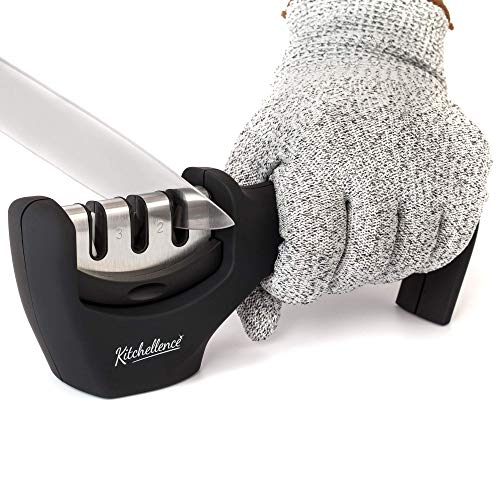 KITCHELLENCE KS37 PSafest for beginners
First, which kind of size do you mean?
People ask about sharpener size in a few different ways, and each one has a different answer. Some mean the angle, some mean the grit, and some mean how big the tool is on the counter or in a drawer.
Sorting these out first keeps you from buying a compact sharpener that cannot reach the angle your knives need, or a large one you will never take out of the cupboard.
- Angle size: how steep the edge is, measured in degrees.
- Grit size: how coarse or fine the abrasive is.
- Body size: the length and weight of the sharpener itself.
- Stone size: the length and width of a whetstone or plate, which sets how much blade it can touch at once.
Start with the angle your knives need
The angle sets how thin and sharp the edge is. Lower angles cut more easily but are more delicate. Higher angles are tougher and hold up to hard use. If you sharpen at the wrong angle, you spend time grinding metal off without getting a clean edge.
Our best knife sharpener page lists the angle range for each model, so you can check that a sharpener covers the angle your knives were made at. If you are not sure, 20° is a common starting point for Western kitchen knives.
| Knife type | Typical angle |
|---|---|
| Japanese-style kitchen knives | 15° |
| Western kitchen knives | 20° |
| Hunting blades | 25° |
| Cleavers | 30° |
Fixed angle or adjustable angle
A fixed-angle sharpener is simple, but it only works well for knives made close to that angle. For example, the Work Sharp Guided Field Sharpener has built-in 20° and 25° guides and is not adjustable. That suits a small set of kitchen and field knives.
An adjustable model covers more ground. The Work Sharp Precision Adjust Elite runs from 15° to 30°, and the RazorSharp Knife and Scissor Sharpener runs from 14° to 24°. The Chef'sChoice 15XV EdgeSelect is an electric unit with a 15° to 20° range, built to convert 20° factory edges to 15°.
If your block holds both thin Japanese blades and a heavy cleaver, an adjustable range saves you from owning two sharpeners.
Body size: length and weight
Physical size matters for storage and for how stable the sharpener feels. Heavier units tend to sit still on the counter. Light ones are easier to carry but need a steady hand and a non-slip base.
Here is how a few products on our page compare, using the published specs.
| Sharpener | Type | Length | Weight |
|---|---|---|---|
| Work Sharp Guided Field Sharpener | Guided manual | 6.75 in | 0.2875 lb |
| Kitchellence 3-Stage Kit | Pull-through | 8.3 in | 0.3968 lb |
| Orange Ninja 4-Stage | Pull-through | 8.18 in | 0.68 lb |
| RazorSharp Knife and Scissor | Guided manual | 10.63 in | 0.55 lb |
| Chef'sChoice 15XV EdgeSelect | Electric | 10 in | 4.189 lb |
| Work Sharp Precision Adjust Elite | Guided manual | 4.63 in | 3 lb |
What about whetstone size?
If you are asking about a whetstone, the physical size works differently. The stone should be long enough that you can sweep the whole edge across it without hanging off the end. A longer, wider stone makes it easier to keep a steady angle on a big chef's knife or a long slicer.
Smaller stones and plates are fine for pocket knives and paring knives, and they are easier to store. We do not list whetstone dimensions on our comparison page, so check the maker's listing for exact measurements before you buy.
Grit is the other size to think about. Lower numbers remove metal quickly and repair damage. Higher numbers polish the edge. Diamond cuts steel fast, and ceramic hones and finishes. Only seven of the 15 products on our page list a finest grit, so look for that spec if the finish matters to you. The Work Sharp Guided Field Sharpener lists a 600 grit maximum, with a coarse 220 plate and a fine 600 plate.
Match the sharpener to how you use it
Once you know your angle and rough size limits, narrow the choice by type and habits.
Pull-through models are quick and need little skill, but they usually offer no angle choice. Guided manual kits hold the angle for you and give finer control. Electric sharpeners do the work with a motor but need counter space.
- Mostly kitchen knives at 20°: a pull-through or a fixed 20° guide can be enough.
- A mix of thin and thick blades: choose an adjustable angle range.
- Bread knives or steak knives with teeth: confirm serrated support in the listing. One page pick is straight blades only, so read the notes.
- Limited storage or camping: look at length and weight first.
- Frequent sharpening with little effort: an electric model suits that, if you have the space.
Safety notes
Sharpening is safer than it looks, but a slipping blade is still a real risk. Use a sharpener with a non-slip base or grip, and keep your free hand clear of the blade path. A cut-resistant glove helps if you are new to it. The Kitchellence kit and one other pull-through on our page include one.
Electric sharpeners need a dry spot near an outlet, and you should keep cords and liquids apart. Sharpening can throw off fine metal dust, so wear safety glasses if you work on a stone or plate with sparks or grit flying. Always follow the maker's instructions.
Frequently asked questions
Can one sharpener handle all my knives?
Only if its angle range covers them. An adjustable model that spans 15° to 30° can handle thin kitchen knives and tougher hunting blades, while a fixed 20° tool covers fewer.
How do I find out my knife's angle?
Check the maker's website or the box. Japanese-style knives are often around 15°, and most Western kitchen knives are around 20°. If you cannot find it, start at 20° and adjust.
Does a longer sharpener sharpen longer knives?
Not necessarily. Slot and guide design matter more than body length. For stones, a longer surface does help with long blades, because you can make full sweeps.
Do I need a serrated slot?
Only if you own serrated knives. Serrated blades need a rod or slot made for the teeth, so confirm support in the product listing.