#1
DEASOMIYE JD-04DEASOMIYE Digital IR Thermometer Gun JD-04
50:1 ratio, dual laser and high/low alarms.
- Top temperature
- 1,500 °C
- Distance-to-spot ratio
- 50 :1
- Accuracy
- —
HVAC technicians use infrared thermometers to check supply and return vent temperatures, find hot motors and electrical connections, and trace ducts, all without touching the surface. The key specs are the distance-to-spot ratio, which decides how small an area you measure from a distance, adjustable emissivity for shiny metal surfaces, a quick response time and a backlit screen for attics and crawl spaces. Very high top temperatures matter less for HVAC than for furnaces and kilns. We put 20 infrared thermometers on one spec sheet so you can compare them side by side.
Quick answer
Ranked from 20 infrared thermometers that met our standard, compared on max temperature range, distance-to-spot ratio, accuracy.
As an Amazon Associate I earn from qualifying purchases. Links to retailers on this site are affiliate links; we may earn a commission at no extra cost to you.
50:1 ratio, dual laser and high/low alarms.

0.25 s reading with adjustable emissivity.
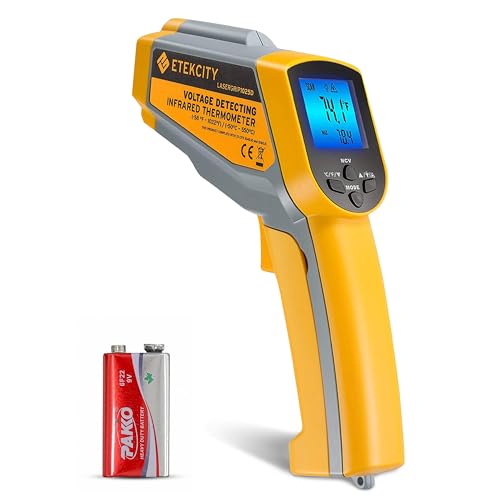
Etekcity 1025D with adjustable emissivity.
| Spec | ||||||||||
|---|---|---|---|---|---|---|---|---|---|---|
| Best Scoreout of 100 | 68 | 66 | 49 | 45 | 41 | 41 | 39 | 35 | 35 | 33 |
| Temperature range°C | -50–1,500 (best in row) | -40–1,500 (best in row) | -50–550 | -50–600 | -30–400 | -50–600 | -50–550 | -50–550 | -50–800 | -40–650 |
| Distance-to-spot ratio:1 | 50 :1 (best in row) | 50 :1 (best in row) | 12 :1 | — | 12 :1 | — | 12 :1 | 16 :1 | 12 :1 | 20 :1 |
| Accuracy% | — | — | — | — | — | — | 1.5 % | 1.5 % | 1.5 % | — |
| Adjustable emissivity | — | Yes | Yes | Yes | Yes | Yes | Yes | Yes | Yes | Yes |
| Response times | — | 0.25 s (best in row) | 0.50 s | 0.50 s | — | — | 0.50 s | 0.50 s | 0.50 s | — |
| Laser targeting | Dual laser (best in row) | Dual laser (best in row) | Dual laser (best in row) | — | Dual laser (best in row) | — | Single dot | Dual laser (best in row) | — | Dual laser (best in row) |
| Min/Max/Avg readings | Yes | — | — | — | Yes | Yes | Yes | Yes | — | Yes |
| Backlit display | Yes | Yes | — | Yes | Yes | Yes | Yes | — | Yes | Yes |
| Display resolution°C | — | — | — | 0.1 °C | — | 0.1 °C | — | — | — | — |
| Weightlb | — | 0.71 lb | 0.53 lb | — | 0.66 lb | — | 0.28 lb | 0.11 lb (best in row) | 0.35 lb | 0.46 lb |
| Battery type | 9V | 2 x 1.5V AA batteries | 9V battery | 2 AAA | — | 2 x 1.5V AAA | — | — | — | — |
| Warrantyyears | — | — | — | Lifetime* (best in row) | — | — | 3 years | 3 years | 2 years | — |
We reviewed 42 infrared thermometers and kept only the 20 that pass every check below. Those are ranked by a Best Score built from spec fit for this job, sales rank.
These reviews are based on each thermometer's published specifications and listing information, in the order of our ranking.
DEASOMIYE JD-04 with a 50:1 spot ratio
The DEASOMIYE JD-04 leads our ranking. Its 50:1 distance-to-spot ratio is tied for the best on this page, so from 50 in away it reads a spot about 1 in across. That matters in HVAC work, where you often measure a vent on a high ceiling or a condenser coil from a distance instead of climbing a ladder.
It measures from -50 to 1500 °C, or -58 to 2732 °F, which covers everything from frozen evaporator lines to furnace heat exchangers. Dual lasers mark the measuring area, and min, max and average readings help when you scan along a duct or across a coil.
High and low temperature alarms flag readings outside the range you set, which is useful for spotting a failing motor or a weak supply air temperature. A large backlit LCD reads clearly in dark attics, and it runs on a 9V battery. For HVAC technicians and homeowners, it is the best choice here.
VerdictThe best infrared thermometer for HVAC on this page.
VEVOR IR05, fast and adjustable
Second in our ranking, the VEVOR IR05 matches the leader's 50:1 distance-to-spot ratio and wide range of -40 to 1500 °C. Its response time of 0.25 s is the quickest listed on this page, which helps when you sweep along a duct or scan a row of breakers.
It adds adjustable emissivity from 0.10 to 1.00. Shiny surfaces such as bare copper lines and sheet metal ducts reflect infrared and read low, so being able to adjust emissivity, or apply tape and set it to match, gives more accurate readings on HVAC equipment.
Dual lasers, a backlit color screen and two AA batteries make it practical for long service days. At 0.71 lb it is the heaviest here, though still light. For technicians who want speed and accuracy on mixed surfaces, it is an excellent choice. Hold it square to the surface and compare readings at the same distance for consistent results across a job. It suits daily service work.
VerdictThe fastest reader on this page.
Etekcity Lasergrip 1025D, a popular value pick
The Etekcity Lasergrip 1025D ranks third. It reads from -50 to 550 °C, or -58 to 1022 °F, which covers HVAC work comfortably, though not the extreme heat of the top two.
Its distance-to-spot ratio is 12:1, so you need to stand closer than with the 50:1 models to measure a small area. It has adjustable emissivity from 0.1 to 1.0 and dual lasers, with a response time under 500 ms.
Etekcity warns it is not for measuring people or animals. It weighs 0.53 lb and runs on an included 9V battery. Backlight and alarms are not listed in our data. For homeowners who want a simple, adjustable tool for checking vents, it is good value. Stand close to small targets such as vent louvers, since a wider spot also reads the surrounding wall. Set emissivity for the surface, or put matte tape on shiny metal, and take readings from the same distance each time so you can compare them fairly. Replace the 9V battery yearly.
VerdictA reliable value pick.
Kizen LP300 with a lifetime warranty
Fourth in our ranking, the Kizen LP300 reads from -50 to 600 °C, or -58 to 1,112 °F, with a display resolution of 0.1 degree and adjustable emissivity. Kizen markets it for cooking as well as residential and industrial use.
You scan the target, press the trigger and release for an immediate reading, with a response time of 0.5 s. A large backlit LCD helps in low light, and it runs on two AAA batteries, which are included.
Its lifetime warranty is the only one listed on this page. Our data does not list its distance-to-spot ratio or laser type, which are important for HVAC. For buyers who value long warranty cover, it is a sensible choice. For HVAC, stand close to small targets until you know its spot size, and use the emissivity setting or matte tape on shiny ducts and copper. Compare supply and return readings at the same distance so the difference is meaningful, and change the batteries when the screen dims.
VerdictThe best-backed thermometer here.
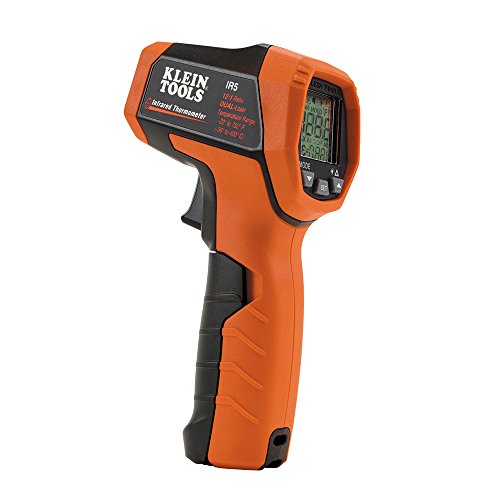
Klein Tools IR5 from a trade brand
The Klein Tools IR5 completes our top five. Klein is a brand many electricians and HVAC techs already carry, and this thermometer measures from -30 to 400 °C, or -22 to 752 °F, the narrowest range on this page, but enough for HVAC and electrical checks.
It has a 12:1 distance-to-spot ratio, dual laser targeting, auto scan, and max, min, average and difference readings. The difference reading is handy for comparing supply and return air temperatures across a coil.
High and low alarms, a backlit display, auto power off and adjustable emissivity from 0.1 to 1.0 are included, and it weighs 0.66 lb. For techs who want a trade brand with useful HVAC features, it is a good pick. Stand close to small targets because of the 12:1 ratio, and use matte tape on shiny ducts. Measure supply and return grilles from the same distance so the difference reading tells you how well the system is cooling or heating. Turn on the alarms when hunting for hot breakers or motors.
VerdictA practical trade-brand pick.
Best among the reviewed tools
Higher ratios measure smaller spots from farther away. Thermometers here range from 10:1 to 50:1.
Shiny metal reads low. Adjustable emissivity, or a piece of tape on the surface, gives more accurate readings on ducts and copper.
HVAC rarely needs more than a few hundred degrees. A fast response helps when scanning ducts and coils.
Backlight, alarms and min, max and difference readings save time on service calls.
No. It measures surface temperature. For air, measure a vent grille or use a probe thermometer.
12:1 works for close checks. Higher ratios, such as 50:1, help with high ceilings and equipment out of reach.
Shiny surfaces reflect infrared. Adjust emissivity or put matte tape on the spot and measure the tape.
Yes, for surface temperatures of ducts and housings. Follow safety guidance around gas appliances.
Your own selection is kept in the link, so friends see the same side-by-side.