Do Infrared Thermometers Measure Air Temperature?
No. An infrared thermometer measures the temperature of a surface, not the air moving past it. For air temperature, such as what is blowing out of a vent, you need a contact probe or a digital thermometer placed in the airstream. An infrared thermometer is still very useful in HVAC work for checking the surfaces around the air.
 DEASOMIYE JD-04Best overall
 VEVOR IR05Fastest response
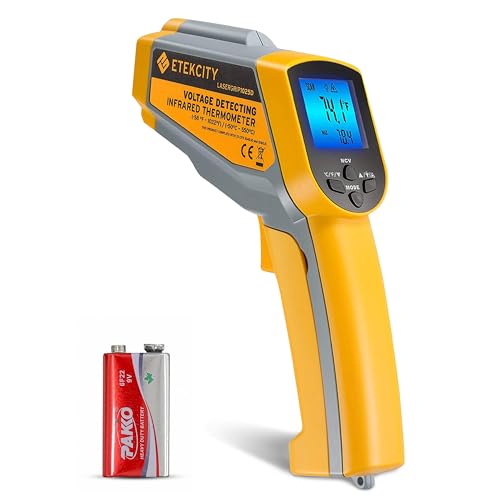 Etekcity lasergrip 1025DBest value classic
What an infrared thermometer actually reads
An infrared thermometer collects the infrared energy given off by an object and converts it to a temperature. A lot of collected energy means a high reading. A little means a low reading. The lens aims at a spot on a solid surface, and the laser dot only shows you where that spot is.
Air is a poor target. It is thin and mostly transparent to infrared, so it gives off very little energy for the sensor to collect. When you point the gun at open air, it usually reads whatever is behind it, such as a wall, a ceiling or the far side of the room.
Why pointing it at a vent gives the wrong answer
It is tempting to aim the laser at a vent and read the number as the supply air temperature. What you are really measuring is the metal or plastic grille. That surface is warmed or cooled by the air, but it also picks up heat from the room, from sunlight and from the duct behind it. It lags behind changes in the airflow, too.
Shiny surfaces add another problem. Bare metal gives off less infrared than it reflects, so it often reads lower than its true temperature. Adjustable emissivity, or a piece of tape on the surface, helps with this.
The result is a reading that can sit several degrees away from the real air temperature. That is fine for spotting a trend or a problem. It is not fine for a precise calculation.
What infrared thermometers are good for in HVAC
Used on surfaces, an infrared thermometer is a fast, safe way to scan equipment and ductwork without touching anything. That is why technicians keep one in the bag. Our best infrared thermometer for HVAC page compares models built for this kind of work.
- Compare supply and return vent surfaces to see if a room is getting conditioned air.
- Trace a duct to find a section that is unusually hot or cold, which can point to a leak or missing insulation.
- Check motors, bearings and capacitors for overheating from a safe distance.
- Look at electrical connections and breaker panels for hot spots.
- Scan coils, line sets and pipes for uneven temperatures.
How to measure air temperature the right way
For true air temperature, put a sensor in the air. A digital probe thermometer is the usual tool. Insert the probe into the supply duct or hold it in the airflow at the vent, and wait for the number to settle. Take a return air reading the same way.
Here is a simple routine for checking how much your system is cooling or heating the air:
- Run the system for several minutes so it reaches steady operation.
- Place a probe in the return air path and let the reading settle.
- Place a second probe in the supply air, as close to the equipment as you can reach safely.
- Subtract one number from the other to get the temperature difference.
- Use the infrared thermometer afterward to find where along the ducts the temperature changes.
| Task | Infrared thermometer | Contact probe |
|---|---|---|
| Supply air temperature | Not reliable | Yes |
| Return air temperature | Not reliable | Yes |
| Vent grille surface | Yes | Possible |
| Hot motor or connection | Yes | Not recommended |
| Duct surface scan | Yes | Slow |
Specs that matter if you buy one for HVAC
If you want an infrared thermometer for surface checks, a few specs make a real difference. The distance-to-spot ratio tells you how small an area you read from a given distance. Higher ratios read smaller spots from farther away. The VEVOR IR05, for example, lists a 50:1 ratio, while the Etekcity Lasergrip 1025D lists 12:1.
Adjustable emissivity matters for shiny ducts and copper. The VEVOR IR05 and Etekcity 1025D both list it. Response time helps when you are scanning: the VEVOR IR05 lists 0.25 seconds and the Etekcity 1025D lists 0.5 seconds.
A backlit screen helps in attics and crawl spaces, and min, max and alarm functions save time on service calls. HVAC work rarely needs more than a few hundred degrees, so a very high top temperature is less important than the features above.
Safety notes
Never point a laser at anyone's eyes, including your own, and keep it away from pets. Infrared thermometers are for objects, not for measuring body temperature.
Turn off power before opening panels or reaching into equipment. A thermometer lets you scan live electrical parts from a distance, but it does not make it safe to touch them. Take care in attics and on ladders, where heat and footing are real hazards, and wear eye protection near blowers and sharp ductwork.
Frequently asked questions
Can I use an infrared thermometer for room temperature?
You can point it at a wall or floor to learn the surface temperature, which often sits near the room temperature. It is a rough guide at best. A regular room thermometer is the better tool.
Why does my reading change with distance?
The spot it reads gets larger as you move away. If the spot is bigger than your target, the reading mixes in the background. A higher distance-to-spot ratio helps, but getting closer is the simplest fix.
Does the laser dot measure the temperature?
No. The laser only shows where the sensor is aimed. The temperature comes from the infrared energy the sensor collects from the whole spot.
Can I check duct leaks with one?
It can point you toward suspect areas, since a leaking or uninsulated section may show a different surface temperature. It will not confirm a leak, so follow up with a closer inspection.