What Size Infrared Thermometer Do You Need for HVAC?
For most HVAC work, pick an infrared thermometer with a distance-to-spot ratio of at least 12:1. Choose 30:1 or higher if you often measure small targets from a distance, such as wiring, a compressor or a high ceiling vent. Temperature range matters less, because HVAC readings rarely go past a few hundred degrees.
 DEASOMIYE JD-04Best overall
 VEVOR IR05Fastest response
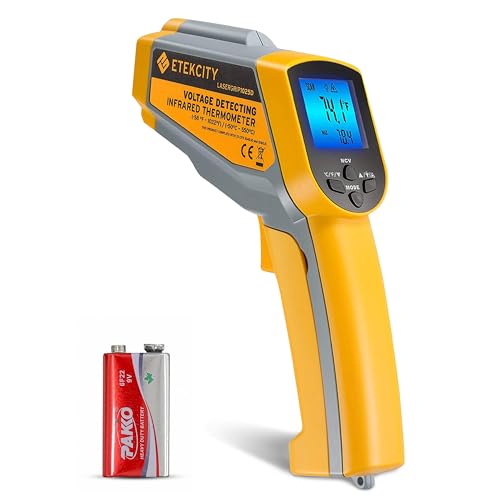 Etekcity lasergrip 1025DBest value classic
What "size" means for an infrared thermometer
Infrared thermometers do not come in sizes the way ladders or filters do. When people ask what size they need, the spec that answers it is the distance-to-spot ratio, often written as 12:1 or 50:1. It tells you how wide an area the thermometer averages at a given distance.
A 12:1 ratio means that from 12 inches away, the unit reads a spot about 1 inch across. From 24 inches, the spot is about 2 inches. A 50:1 ratio reads that same 1-inch spot from 50 inches away. A higher ratio lets you stay farther back without the reading blending in the cooler or hotter surfaces around your target.
This matters in HVAC because many targets are small or hard to reach. A breaker lug, a capacitor terminal or a section of copper line is narrow. If your spot is wider than the target, you get an average of the target and the background, and the number is wrong.
Spot size by distance
The table below uses simple arithmetic: distance divided by ratio. It shows why a higher ratio helps once you move beyond arm's length.
The listed products on our comparison page range from 12:1 to 50:1. The Etekcity Lasergrip 1025D and Klein Tools IR5 are both 12:1, while the DEASOMIYE JD-04 and VEVOR IR05 are both 50:1.
| Distance to target | 12:1 spot size | 50:1 spot size |
|---|---|---|
| 12 in | 1.0 in | 0.24 in |
| 36 in | 3.0 in | 0.72 in |
| 60 in | 5.0 in | 1.2 in |
| 120 in | 10 in | 2.4 in |
Matching the ratio to the HVAC job
Think about what you measure most often and how close you can safely get. The goal is a spot smaller than the target at the distance you will actually stand.
For a typical supply or return vent, a 12:1 unit works well. Hold it a foot or two from the grille or the duct boot and the spot stays small enough to read the air stream's surface or the register face. For a whole room, an infrared thermometer only reads surfaces, so it will not give you the air temperature. Use it for walls, ceilings and floors, and use a probe thermometer for air.
- Supply and return vents, close range: 12:1 is enough.
- Ducts in an attic or crawl space: 12:1 works if you can reach, and a higher ratio helps when access is tight.
- Electrical connections, contactors and motors: choose a higher ratio so you can stay back from live equipment.
- High ceiling diffusers or rooftop units: a high ratio such as 50:1 keeps the spot small from the ground or a ladder base.
- Coils and refrigerant lines: any ratio works, but the spot must be smaller than the line, so get close or pick a higher ratio.
Other specs that matter more than top temperature
Many infrared thermometers advertise ranges up to 1500 °C (2732 °F), and the DEASOMIYE JD-04 and VEVOR IR05 both list that. That is built for furnaces, kilns and forging. HVAC rarely needs it. The Klein Tools IR5 lists -30 °C to 400 °C (-22 °F to 752 °F), which already covers nearly everything on a service call.
Adjustable emissivity is the spec worth checking next. Shiny metal such as bare copper or galvanized duct reflects infrared energy and reads low. Models with adjustable emissivity, such as the VEVOR IR05, Etekcity 1025D and Klein Tools IR5, let you correct for this. If yours does not have it, put a piece of tape or a dab of flat paint on the surface and measure that instead.
Response time and display help on the job too. The VEVOR IR05 lists a 0.25 second response, which suits scanning along a duct run. A backlight makes the screen readable in dim attics and crawl spaces. Min, max and average readings, which the DEASOMIYE JD-04 and Klein Tools IR5 list, save notes on a long call. You can compare these side by side on our best infrared thermometer for hvac page.
Physical size, weight and batteries
Handheld size matters if you carry the tool in a pouch all day. Among the listed models, the VEVOR IR05 weighs 0.71 lb, the Klein Tools IR5 weighs 0.66 lb and the Etekcity 1025D weighs 0.53 lb. The TempPro TP450 is the lightest at 0.11 lb.
Batteries are worth a look as well. The DEASOMIYE JD-04 and Etekcity 1025D use a 9V battery. The VEVOR IR05 uses two AA batteries, and the Kizen LP300 uses two AAA batteries. Pick a type you already stock in the truck or toolbox.
If you want to see how these specs line up for your own work, our HVAC infrared thermometer comparison puts them in one table.
Safety and accuracy notes
Most infrared thermometers use a Class 2 laser. Never point the beam at anyone's eyes, including your own reflection in a shiny surface.
Use the long reach of a high ratio to keep your distance from live electrical panels, but do not treat the thermometer as a voltage tester. Turn off power and follow lockout rules before you open equipment. Use a stable ladder and watch your footing when you aim at high vents.
These tools are for objects and surfaces only. The listings say they are not for measuring people or animals, so do not use them as a fever thermometer.
Frequently asked questions
Can an infrared thermometer measure air temperature in a room?
No. It reads surface temperature. To check the air coming from a vent, use a probe-style thermometer in the air stream and use the infrared unit for surfaces like duct skin or walls.
Is a 50:1 ratio always better than 12:1?
Not always. A higher ratio gives a smaller spot at distance, but for close-up vent or duct checks a 12:1 unit is enough. A higher ratio helps most with small or hard-to-reach targets.
Why do my readings on copper pipe look too low?
Bare copper is shiny and reflects infrared energy, so it reads low. Adjust the emissivity if your model allows it, or apply tape to the pipe and measure the tape.
Do I need a dual laser?
It is not required. Dual lasers help you see the edges of the measured spot, which makes aiming easier at longer range.