Are Infrared Thermometers Accurate for HVAC Readings?
Yes, for surface temperatures an infrared thermometer is accurate enough for most HVAC checks, as long as you account for surface shine, distance and spot size. It does not measure air temperature, so a reading taken at a vent is not the same as the air coming out of it. Use it to find hot spots, trace ducts and screen components, and confirm air temperatures with a probe.
 DEASOMIYE JD-04Best overall
 VEVOR IR05Fastest response
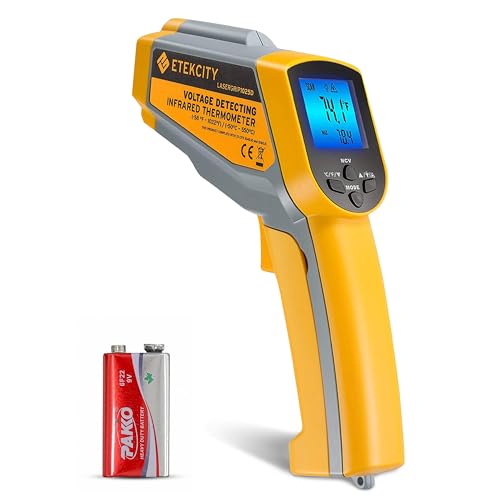 Etekcity lasergrip 1025DBest value classic
What an infrared thermometer actually measures
An infrared thermometer reads the infrared energy given off by a surface and converts it to a temperature. It never touches the target, and it never samples the air around the target. That one fact explains most of the accuracy complaints you will hear.
When you point the tool at a supply register, you learn how warm the metal or plastic of that register is. The air moving past it may be a few degrees different, especially right after the system starts. For quick screening that is fine. For a number you will write on a service report as air temperature, it is the wrong tool.
Where infrared readings are reliable in HVAC work
Surface checks are where these tools earn their place. They are fast, they keep your hands away from hot or energized parts, and they let you scan a lot of equipment in a few minutes.
Good uses include:
- Comparing temperatures along a duct run to spot a leak, a disconnected section or missing insulation.
- Checking motors, bearings and belts for abnormal heat compared with similar equipment nearby.
- Looking at electrical connections and breakers for a connection running hotter than its neighbors.
- Checking the temperature of refrigerant lines, coils and condensate pans as a quick screen.
- Comparing one vent against another to see which rooms are getting less airflow.
Where they mislead you
The most common problem is shiny metal. Bare copper, aluminum and galvanized ductwork reflect infrared energy from the surroundings, so the tool can read lower than the true surface temperature. This is why adjustable emissivity matters. Emissivity is a setting that tells the thermometer how well a surface gives off infrared energy. A dull, painted or taped surface behaves very differently from a polished one.
The second problem is spot size. The thermometer averages everything inside its measuring spot. If the spot is bigger than your target, such as a small wire lug or a thin refrigerant line, the reading blends in the cooler background and comes out wrong.
Other common causes of bad readings:
- Reading through glass or clear plastic, which blocks infrared energy.
- Steam, dust or condensation on the target surface or lens.
- A thermometer that has not adjusted to a big temperature change, such as moving from a hot attic to a cool truck.
- Aiming at an angle instead of straight at the surface.
Which specs affect accuracy most
Published specs tell you how well a model handles these problems. Our best infrared thermometer for hvac page puts them on one sheet, and the key ones are distance-to-spot ratio, adjustable emissivity and response time.
A higher distance-to-spot ratio means a smaller measuring spot at the same distance, so you can aim at small targets from farther away. Of the models we list, the DEASOMIYE JD-04 and the VEVOR IR05 are both 50:1, while the Etekcity Lasergrip 1025D and Klein Tools IR5 are both 12:1.
Display resolution is not the same as accuracy. The Kizen LP300 shows 0.1 degree resolution, but that describes how finely the screen displays a number, not how close the number is to the true temperature. Always check the manufacturer's stated accuracy as well.
| Model | Distance-to-spot | Adjustable emissivity | Response time |
|---|---|---|---|
| DEASOMIYE JD-04 | 50:1 | Not listed | Not listed |
| VEVOR IR05 | 50:1 | Yes, 0.10 to 1.00 | 0.25 s |
| Etekcity Lasergrip 1025D | 12:1 | Yes, 0.1 to 1.0 | 0.5 s |
| Kizen LP300 | Not listed | Yes, 0.1 to 1.0 | 0.5 s |
| Klein Tools IR5 | 12:1 | Yes, 0.1 to 1.0 | Not listed |
How to get more accurate readings
Good technique closes most of the gap between a basic reading and a trustworthy one. Follow these steps on each job:
- Clean the surface and wipe the thermometer lens if it is dusty or fogged.
- Put a small piece of masking or electrical tape on shiny metal, wait a moment for it to match the surface, then measure the tape.
- Set the emissivity if your model allows it, or rely on the tape method if it does not.
- Stand close enough that the measuring spot is smaller than the target. The Etekcity listing, for example, suggests about 14.17 inches for best accuracy on that model.
- Aim straight at the surface, not at a sharp angle.
- Take two or three readings in slightly different spots and compare them.
- For air temperature, use a probe in the airstream instead of a vent surface.
Which infrared thermometer is the most accurate?
No single model is the most accurate for every job, and we compare published specifications rather than lab results, so we cannot rank true accuracy. What the specs can show is which tools are built to avoid the common errors.
For small or hard-to-reach targets, a 50:1 ratio helps keep the spot small from a distance. For shiny ducts and copper, adjustable emissivity is the feature to look for, and the VEVOR IR05 lists both along with a 0.25 s response time. If you want a trade brand with min, max, average and alarm functions, the Klein Tools IR5 lists those with adjustable emissivity at 12:1.
Compare each tool's stated accuracy and measurement range against what you need. HVAC work rarely needs very high top temperatures, so a wide range matters less than spot size and emissivity control.
Safety notes
Never aim a laser at anyone's eyes, including your own, and keep it away from pets and passersby. Treat it as a laser product, even though the class is low.
An infrared thermometer lets you check electrical gear from a distance, but it does not make live panels safe. Do not open energized panels unless you are qualified and equipped to do so. In attics and crawl spaces, watch your footing, use a stable ladder and be careful around heat and sharp edges.
Frequently asked questions
Can I use an infrared thermometer to measure air temperature from a vent?
Not reliably. It reads the vent surface, not the moving air. Use a probe thermometer in the airstream for a true air reading.
Why does my reading change when I move closer or farther?
The measuring spot grows with distance. If the spot is larger than the target, the thermometer averages in the background, which changes the number.
Do I need adjustable emissivity for HVAC work?
It helps a lot on bare copper and galvanized ducts. If your thermometer lacks it, putting tape on the surface gives a more dependable reading.
Can I measure a person's temperature with these tools?
No. The models we list are made for objects and surfaces, and their listings say they are not suitable for people or animals.