#1
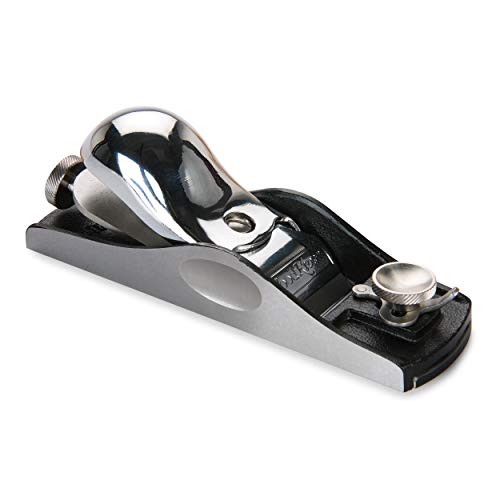
Jorgensen 70700Jorgensen No.101 Mini Block Plane
Shortest at 3.54 in, with an O1 tool steel blade and a ductile iron body.
- Blade width
- —
- Weight
- 0.6 lb
- Body material
- Ductile iron
The best hand plane depends on the job. Block planes trim edges and end grain in one hand. Bench planes smooth whole boards. Japanese planes cut on the pull stroke. Blade steel, body material, mouth adjustment and depth control all change how clean the shavings are and how easy setup is. We put 8 products on one spec sheet so you can compare length, weight, blade width and adjustment features side by side.
Quick answer
Ranked from 8 hand planes that met our standard, compared on blade steel, body material, adjustable mouth.
As an Amazon Associate I earn from qualifying purchases. Links to retailers on this site are affiliate links; we may earn a commission at no extra cost to you.
Shortest at 3.54 in, with an O1 tool steel blade and a ductile iron body.

Low angle design with an adjustable mouth and an O1 tool steel blade.
Also compared here; see its full specs in the table.
| Spec | ||||||||
|---|---|---|---|---|---|---|---|---|
| Best Scoreout of 100 | 75 | 72 | 44 | 49 | 36 | 52 | 30 | 35 |
| Plane type | Mini block plane | Low angle block plane | Low angle block plane | Japanese kanna smoothing plane | Block plane | Japanese kanna block plane | Japanese double-blade mini block plane | Block plane |
| Lengthin | 3.5 in | 6.3 in | 7.0 in | 9.5 in (best in row) | 7.0 in | 9.4 in | 5.9 in | 6.3 in |
| Weightlb | 0.6 lb | 1.5 lb | 2.0 lb | 1.5 lb | 1.6 lb | 1.4 lb | 0.5 lb (best in row) | 0.9 lb |
| Blade widthin | — | — | 1.63 in | 1.97 in (best in row) | 1.63 in | 1.97 in (best in row) | 1.60 in | 1.63 in |
| Blade material | O1 tool steel (best in row) | O1 tool steel (best in row) | High-carbon steel | High-carbon steel | Steel alloy | — | High-carbon steel | Steel alloy |
| Body material | Ductile iron (best in row) | Ductile iron (best in row) | — | Wood | Cast iron | Wood | Wood | — |
| Bed angle | 20° bed (45° effective) | — | 12° | — | — | — | — | 21° |
| Adjustable mouth | — | Yes | Yes | — | — | — | — | Yes |
| Depth adjuster | — | — | — | — | — | Manual tap | — | — |
| Lateral blade adjustment | — | — | — | — | — | — | — | — |
| Warrantyyears | — | — | — | — | — | — | — | — |
We reviewed 22 hand planes and kept only the 8 that pass every check below. Those are ranked by a Best Score built from spec fit for this job, sales rank.
These reviews are based on specifications and listing information. Each one covers what the specs mean for general hand planing.
Small, light block plane that leads our ranking
The Jorgensen No.101 is a mini block plane, 3.54 in long and 0.55 lb. That makes it the shortest plane on this page. For trimming, deburring and small edge cleanup, a tool this size works in tight spots and is easy to control with one hand. It leads our ranking on spec score.
The blade is O1 tool steel and the body is ductile iron. O1 steel takes a sharp edge, and the listing says it can be sharpened repeatedly. The bed angle is 20°, which gives a 45° effective cutting angle. The listing also says the body is drop-tested, which matters for a tool that lives in a toolbox.
Depth is set with a knob. The maker does not publish a blade width or a mouth adjustment for this model, so check the listing if you need a wide cut. It is a detail tool, not a smoothing plane for large panels. If you want a plane for edges and small fixes, this is the fit.
VerdictA light, compact block plane for detail work that earns the top spot on our spec sheet.
Low angle block plane with an adjustable mouth
Ranking second, the Jorgensen No.60-1/2 is a low angle block plane. It is 6.25 in long and weighs 1.48 lb. That is longer than the mini No.101, so the sole gives more reference length when you trim an edge or end grain. It is still a compact tool.
The mouth is adjustable. A narrow mouth helps reduce tear-out on fine cuts, and a wider mouth passes thicker shavings. The blade is O1 tool steel and the body is ductile iron, the same materials as the No.101. The maker does not publish a bed angle number or a blade width for this model.
Depth is set with a knob, according to the listing. The lever cap is zinc alloy and the other parts are stainless steel. For a first block plane that you want to tune, the adjustable mouth is the feature that sets this model apart from the No.101. Check the sole for flatness when it arrives, as with any new plane.
VerdictA well-equipped block plane that adds mouth control to the same steel and iron as our top pick.
Pull-stroke Japanese plane for smoothing, with a learning curve
The KAKURI kanna is a Japanese smoothing plane, so it cuts on the pull stroke instead of the push. It is 9.5 in long and 1.46 lb, with a 1.97 in blade. That is lighter than both No. 4 bench planes here. Buyers expecting a Western plane with screws should know this is a different tool.
The blade is high-carbon steel laminated with soft iron, with a chip breaker that the listing says reduces splitting. The body is wood. The specs list no depth adjuster. The listing says you fine-tune the blade with a hammer before use, which takes some practice.
The 9.5 in body is large and meant for two hands, so the listing says it covers larger surfaces in one pass. The specs list no mouth adjuster. For a buyer who wants easy setup, a Western bench plane or block plane is the simpler start. Ranked fifth, it suits a woodworker ready to learn the style.
VerdictA real kanna for smoothing, best for woodworkers who accept hammer tuning, not for first-time easy setup.
Best among the reviewed tools
Block planes handle trimming, chamfers and end grain. Bench planes like the No. 4 smooth whole boards. Japanese kanna planes cut on the pull stroke and suit people who want to learn that method. Match the type to your main job before comparing other specs.
O1 tool steel takes a sharp edge and can be resharpened. High-carbon steel does the same job in Japanese planes. Cast iron and ductile iron add mass, which steadies the cut. Wood bodies are lighter. Some makers do not publish blade steel, so check the listing.
An adjustable mouth lets you set the opening for fine or thick shavings. A depth knob or geared adjuster moves the blade in small steps. Tap-set Japanese planes have neither, so setup takes more time and skill. Easy setup usually means screws or a knob.
Length runs from 3.54 in to 10 in on this page, and weight from 0.49 lb to 3.82 lb. A short, light plane is easier to carry and control. A long, heavy one smooths flat and stays steady. Pick the size that fits your projects.
A plane with a depth knob or screw adjusters is easier to set up than a tap-set Japanese plane. The Jorgensen planes use a depth knob, and the Amazon Basics planes use screws or a geared knob. Pick a block plane for small jobs and a No. 4 for boards.
A block plane is short and works with one hand. It trims edges, end grain and small parts. A bench plane like the No. 4 is longer, uses two hands and smooths whole boards. On this page the block planes are 3.54 in and 6.25 in long, and the No. 4 planes are 9.8 in and 10 in.
Japanese kanna planes cut on the pull stroke and have wood bodies. They have no screw adjusters, so you set the blade by tapping with a hammer. The two 50 mm models have 1.97 in blades and a chip breaker for less tear-out.
Extra weight keeps the plane steady and can reduce chatter, so heavier cast iron planes suit smoothing boards. Lighter planes are easier to carry and control for trimming. Here, weight ranges from 0.49 lb to 3.82 lb, so match it to the task.
Your own selection is kept in the link, so friends see the same side-by-side.


