Why Does My Hand Plane Chatter or Leave Lines?
Most chatter, skipping and lines come from a dull or badly set blade, a blade that sticks out too far, or a loose blade and cap. Less often the cause is a wide mouth, a sole that is not flat, or tricky grain. Start by sharpening, retracting the blade for a lighter cut and tightening everything, then work down the list below.
 Jorgensen 70700Best overall
 Jorgensen PJ-70710Adjustable mouth block plane
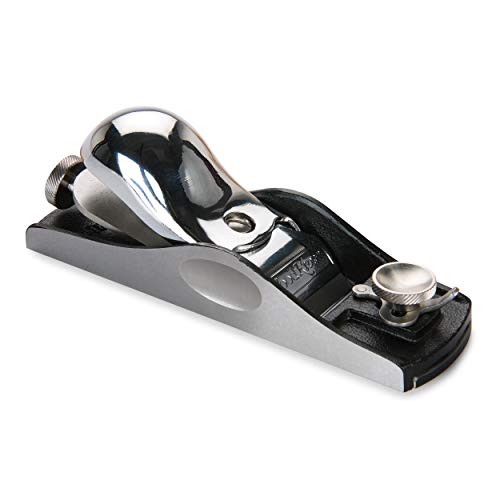 WOODRIVER 151125WWOODRIVER 151125W
Quick answer: what each symptom usually means
Chatter, skipping and lines look alike but often have different causes. Chatter is a rhythmic vibration that leaves evenly spaced ripples. Skipping means the plane cuts in some spots and glides over others. Lines are straight ridges that run along the board.
Matching the symptom to the likely cause saves time. The table below is a starting point, not a diagnosis of your exact plane.
| Symptom | Most likely cause | First fix |
|---|---|---|
| Ripples or buzzing, plane bounces | Blade set too deep, or blade or cap not seated firmly | Retract the blade and retighten the lever cap |
| Plane skips and cuts in patches | Dull edge, shallow setting, or a sole that is not flat | Sharpen, then advance the blade slightly |
| Thin straight lines along the board | Nick in the edge or sharp blade corners digging in | Re-grind or re-hone the edge and ease the corners |
| Rough, torn patches | Planing against the grain or a mouth that is too open | Reverse direction and close the mouth |
| Wide shallow tracks | Blade edge not square or not parallel to the sole | Re-hone square and re-set the blade evenly |
Start with the blade: sharpness and projection
A dull edge crushes fibers instead of slicing them. The plane then needs more force, and that force makes it bounce or skip. If your shavings are powdery or ragged, sharpen first before changing anything else.
Projection matters just as much. A blade set too deep takes a thick shaving, and the body flexes and vibrates under the load. A good smoothing setting should give thin, see-through shavings that curl out in one piece.
Use this order when you set the blade:
- Retract the blade fully so it sits below the sole.
- Sight down the sole from the front and advance the blade until a thin line of steel just shows.
- Check that the line is even across the width. Adjust sideways if one corner sticks out more.
- Take a test pass on scrap and advance in tiny steps until you get a continuous shaving.
Check the bedding, lever cap and chipbreaker
A blade that can move even a hair will chatter. Make sure the blade sits flat against the bed and the lever cap is tight. Wipe off dust or shavings trapped under the blade, since a small chip can rock the whole assembly.
On bench planes, the cap iron (the extra plate on top of the blade) should sit close to the cutting edge on tough or swirly grain. Set too far back, it does little. Set so tight that it leaves a gap against the blade, it can catch shavings and cause clogging and skipping. Remove it and check that its mating surface is flat and clean.
Japanese pull-stroke planes work differently. Our best hand plane page notes that tap-set planes such as the SUIZAN kanna have no adjusting screws, so you set the blade by tapping with a hammer. That takes skill, and an unevenly seated blade is a common source of chatter. Wear eye protection when you tap, and keep the chipbreaker close to the edge, as the maker describes.
Look at the mouth, the sole and the plane's mass
The mouth is the opening in front of the blade. A wide mouth leaves the wood unsupported just ahead of the edge, so fibers lift and tear. Closing the mouth for fine work gives cleaner surfaces. Planes with an adjustable mouth let you do this, such as the Jorgensen low angle block plane and the Amazon Basics No. 4 adjustable bench plane that appear on our comparison page.
The sole must be flat. If it has a hollow or a rocked toe, the plane skips across the board. Check it against a reliable straightedge, and clean off rust and pitch before blaming the blade. Wax on the sole also reduces drag.
Mass plays a role too. Cast iron and ductile iron add weight that damps vibration. Among the products compared, the Amazon Basics No. 4 smoothing plane is listed at 3.82 lb and 10 in long, while the Jorgensen No.101 mini block plane is 0.55 lb and 3.54 in. A small, light plane is handy for trimming, but it has less mass to absorb vibration, so it asks for lighter cuts and a steadier hand.
Technique and wood problems
Sometimes the plane is fine and the cause is how it is used. Heavy downward pressure at the start or end of a stroke rounds the ends and can make the plane dip. Press on the front knob at the start, and shift pressure to the back as you finish.
Grain direction is the other big factor. Planing against rising grain lifts fibers and leaves rough lines. Read the grain on the board edge, and plane in the direction that the fibers slope up toward you. On swirly or interlocked wood, take thinner shavings, close the mouth, and consider skewing the plane a little.
Hold the work firmly. A board that moves or flexes will chatter no matter how good the plane is. Clamp it or use a bench stop, and keep your hands behind the cutting edge.
Picking a plane that is easier to set up
If you keep fighting setup, the plane itself may be part of the problem. Features such as a depth knob and an adjustable mouth make small corrections quicker. On our comparison page, the Amazon Basics No. 4 smoothing plane uses a geared knob for depth, and the Jorgensen No.60-1/2 offers both a knob and an adjustable mouth.
Blade steel also matters. O1 tool steel, used in both Jorgensen planes, takes a sharp edge and can be resharpened. Some makers do not publish blade steel, so check the listing before you decide. You can compare lengths, weights and adjustment features in our best hand plane comparison and match them to your main job.
Remember that a sharp, well-tuned inexpensive plane can beat a neglected one. Tuning skills matter as much as the model.
Safety notes
Hand plane blades are very sharp, so keep fingers clear of the edge and never test sharpness with your thumb across it. Retract the blade before setting the plane down, and rest it on its side.
Wear safety glasses when sharpening, tapping a blade with a hammer or planing brittle wood. Secure the workpiece so it cannot slip toward you.
Frequently asked questions
Can a dull blade cause chatter even if it is set shallow?
Yes. A dull edge needs more force to cut, and the plane can bounce or skip. Sharpen it before adjusting anything else.
Why does my plane cut well at first, then start to skip?
The edge may have dulled, or a shaving may be clogged under the cap iron or in the mouth. Clear the mouth, check the blade for a nick, and resharpen if needed.
Does a heavier plane chatter less?
Often it does, because extra mass damps vibration. Weight does not fix a dull blade, a loose cap or a sole that is not flat, so check those too.
Do block planes chatter more than bench planes?
They can with heavy cuts, since they are shorter and lighter. Light settings, a sharp edge and a closed mouth help a lot.