Jointer vs Hand Plane: Which Flattens Wood Better?
For most shops that flatten a lot of boards, a jointer flattens wood faster and more repeatably. A hand plane flattens just as well in skilled hands and handles boards too wide, too short or too awkward for a jointer. The better tool depends on your volume, your space and how much you enjoy hand work.
 CUTECH 401120HI-IFBest overall
 Jet JJ-6HHDXLongest 6 in tables
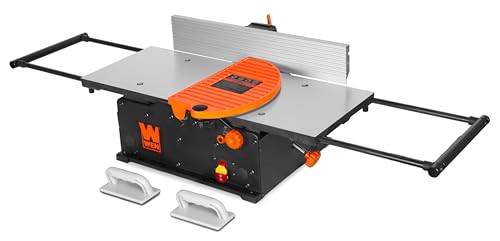 WEN JT1224HBest wide benchtop value
How each tool flattens a board
Both tools work the same way: they shave off the high spots until the face sits on one flat plane. The difference is where the flat reference comes from.
A jointer uses two long, coplanar tables with a spinning cutterhead between them. You push the board across, and the outfeed table supports the freshly cut surface while the infeed table drops by the depth of cut. Over a few passes, the face becomes flat and the machine can then square an edge to it.
A hand plane uses its own sole as the reference. A longer plane bridges dips and shaves only the high spots, so it tends to flatten rather than follow the curve of the board. You check progress with a straightedge and winding sticks, then keep planing until the board matches.
Note that people searching for a hand planer sometimes mean an electric handheld planer. Those are fast at removing material, but they are not a flattening tool in the same sense, because the cut depends on how steadily you hold them.
Where a jointer wins
A jointer is built for repeatable work. Once the tables are set parallel, every pass removes a consistent amount, and you can flatten a face and square an edge in minutes. If you are milling a stack of boards for a cabinet or a tabletop, that consistency saves real time.
Width and table length set what the machine can do. On our best jointer page, cutting widths run from 6 in to 12 in, and table lengths run from 23 in to 73 in. A 12 in machine such as the CUTECH 12-Inch Spiral Benchtop Jointer can flatten a wide board in one piece. The Powermatic 60HH has 73 in tables, which keep long boards supported through the cut.
- Fast, repeatable stock removal
- Edges squared to the face in the same setup
- Spiral and helical heads leave a clean finish in tricky grain
- Maximum depth of cut ranges from 1/8 in on most models to 1/2 in on the Powermatic 60HH
Where a hand plane wins
A hand plane works on boards a jointer cannot take. A tabletop glued up from several boards, a board wider than your machine, or a short offcut that would be unsafe on a jointer can all be flattened by hand.
Hand planes also give you more control. You can take a single light pass to remove one high corner, work with the grain to avoid tear-out, and stop the moment the board is flat. A jointer removes material across the full width of the cut, so a board with a localized high spot may lose more wood than you intended.
Hand planes are quiet, need no dust collector and take up almost no space. If you work in an apartment or a small garage, those points can outweigh the speed of a machine. Our best hand plane page compares options if you want to see what is available.
Side by side comparison
This table summarizes the practical differences. The jointer details come from the specs on our comparison page.
| Factor | Jointer | Hand plane |
|---|---|---|
| Speed | Fast, repeatable passes | Slower, depends on skill |
| Board width | Limited by cutterhead, 6 in to 12 in on our list | Limited by your reach and effort |
| Short or small stock | Poor fit, needs enough length to stay supported | Works well with a secure hold |
| Space needed | Benchtop models weigh about 21 lb to 112 lb, stationary models hundreds of pounds | A bench and a small shelf |
| Noise and dust | Loud, needs dust collection | Quiet, shavings only |
| Learning curve | Setup of tables and technique | Sharpening, tuning and technique |
| Finish quality | Spiral or helical heads reduce tear-out | Excellent when the blade is sharp and well set |
Jointer specs that affect flatness
If you decide on a jointer, a few specs matter more than the rest for flattening.
Table length is the biggest one. Longer infeed and outfeed tables support a long board throughout the pass, so the cut stays straight. The JET JJ-6HHDX has 56 in cast iron tables on a 6 in machine, while the WEN JT630H has 30 in tables and the VEVOR 6-Inch Benchtop Jointer has 23 in. A short-table machine is fine for shorter boards, but long boards are harder to keep flat.
Cutterhead type affects the surface. Spiral and helical heads use many small inserts set at an angle. They run quieter and leave a smoother surface in difficult grain than straight knives. Carbide inserts also last longer than HSS.
Stability counts too. Heavy stationary machines stay put, while light benchtop models are easier to move but need a solid bench.
Safety notes
A jointer's cutterhead is exposed during the cut, so keep it respectful. Use push blocks, never pass your hands over the cutterhead, and keep the guard in place. Do not joint stock that is too short to control. The JET JJ-6HHDX listing, for example, calls for work stock at least 8 in long, 3/4 in wide and 1/4 in thick.
Wear eye protection and hearing protection, since jointers are loud. Connect a dust collector and unplug the machine before changing inserts or knives. Check the circuit requirement for your model, because some larger machines recommend a dedicated circuit.
With hand planes, the main risks are cuts from sharp blades and a board that slips. Clamp the work firmly, keep your off hand behind the blade, and wear eye protection when you sharpen or use a mallet to adjust.
Which should you choose
Pick based on how you work rather than which tool sounds better.
Many woodworkers end up using both: a jointer for the bulk of the flattening, then a hand plane to fine-tune a wide panel or smooth a surface after glue-up.
- Choose a jointer if you mill many boards, want fast results and have room and a dust collector.
- Choose a hand plane if you work in a small or shared space, handle wide or short stock, or like quiet hand work.
- Choose both if you build furniture regularly and want speed plus control.
Frequently asked questions
Is a jointer the same as a joiner?
No. In the US, a jointer is the machine that flattens a face and squares an edge. Joiner is mostly a British word for a person who builds with wood, such as doors, windows and stairs.
Can a hand plane do what a jointer does?
Yes, with practice. A hand plane can flatten a face and square an edge. It takes longer, but it handles stock that is too wide or too short for a jointer.
Do I still need a thickness planer?
If you want both faces parallel, yes. A jointer or hand plane makes one face flat, and a planer then makes the opposite face parallel to it.
Is a benchtop jointer flat enough for furniture?
It can be, as long as the tables are set parallel and the board fits within the table length. Longer tables make long boards easier to keep straight.