What Is a Hand Plane and How Does It Work?
A hand plane is a manual woodworking tool with a sharp blade set in a flat-bottomed body. You push or pull it along wood, and the blade shaves off a thin layer to smooth, flatten or trim the surface. The sole rides on the wood while the blade sticks out a tiny, adjustable amount, so each pass removes a controlled shaving.
 Jorgensen 70700Best overall
 Jorgensen PJ-70710Adjustable mouth block plane
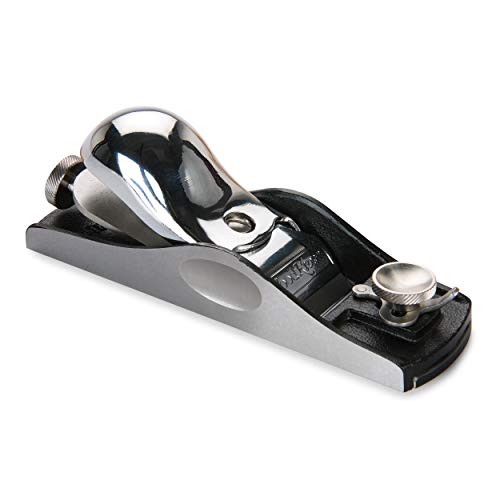 WOODRIVER 151125WWOODRIVER 151125W
How a hand plane works
Think of a hand plane as a chisel held at a fixed angle inside a guide. The flat bottom, called the sole, rests on the wood. A narrow slot in the sole, called the mouth, lets the blade poke through by a fraction of a millimeter.
When you slide the plane forward, the blade lifts a thin shaving that curls up through the mouth. Because the sole rides over the high spots first, the plane gradually levels them. That is why a plane can flatten a board or smooth a rough surface better than sanding alone.
The depth of cut comes from how far the blade extends. A tiny extension gives fine, wispy shavings and a smooth surface. A larger one removes wood faster but leaves a rougher finish and can tear the grain.
The parts that matter
Most planes share the same basic parts, and knowing them makes setup much easier.
- Blade (iron): the cutting edge. It needs to be sharp, and it can be resharpened many times.
- Sole: the flat base that guides the cut. A flat sole gives flat results.
- Mouth: the opening in front of the blade. A tighter mouth supports the wood and helps reduce tear-out.
- Depth adjuster: a knob, gear or screw that moves the blade in small steps. Some Japanese planes have none, and you set the blade by tapping.
- Lever cap and chipbreaker: these hold the blade in place, and a chipbreaker also helps curl the shaving so the wood splits less.
- Handles or grip: the parts you hold to push or pull the plane straight.
What a hand plane is used for
People reach for a hand plane any time a surface needs small, controlled changes. A plane trims a door that sticks, removes saw marks, and flattens a warped board. It can also straighten an edge so two boards meet cleanly.
It also does detail work. You can knock the sharp corner off an edge, cut a small chamfer, or shave end grain flush after a joint is cut. Smaller planes handle these quick jobs in one hand, while longer planes smooth wide boards.
Many woodworkers like planes because they are quiet and make shavings instead of fine dust. They also give a smooth surface straight from the tool, with no cord or motor involved.
Main types of hand planes
The right plane depends on the job. Our best hand plane comparison sorts products by type so you can see how length, weight and blade details differ. Here is how the main types compare, with examples from the specs we compare.
The table below shows the broad differences.
| Type | How it cuts | Best for | Example from our comparison |
|---|---|---|---|
| Block plane | Pushed, often one-handed | Trimming, chamfers, end grain | Jorgensen No.101 mini block plane, 3.54 in long, 0.55 lb |
| Low angle block plane | Pushed, with an adjustable mouth | Fine trimming and end grain | Jorgensen No.60-1/2, 6.25 in long, 1.48 lb |
| Bench plane (No. 4) | Pushed with two hands | Smoothing whole boards | Amazon Basics No. 4 models, 9.8 in and 10 in long |
| Japanese kanna | Pulled toward you | Smoothing, flattening, chamfering | KAKURI 50mm, 9.5 in long, 1.46 lb |
How to set up and use a plane
Setup takes a few minutes, and it is worth doing carefully. Exact steps vary by model, so check the manual that comes with yours.
A basic routine for a pushed plane looks like this:
- Make sure the blade is sharp and the sole is clean.
- Retract the blade so it sits just below the sole, then set it in place under the lever cap.
- Sight along the sole and advance the blade until you see a thin, even line of steel across the mouth.
- Make a test pass on scrap wood. Adjust the depth until you get a thin, full-width shaving.
- Clamp your workpiece firmly, then plane in the direction where the grain rises toward you so the surface does not tear.
- Use steady, even pressure. Press down on the front at the start of the stroke and on the back at the end.
Push stroke versus pull stroke
Western planes cut on the push stroke. You hold the handles, lean your body weight into the tool and glide it forward. Models with a depth knob or geared adjuster, like the geared knob on the Amazon Basics No.4 smoothing plane in our lineup, let you change the cut in small steps without removing the blade.
Japanese kanna planes cut on the pull stroke. They suit people who want to learn that method, and they usually have a wood body and a blade you set by tapping. For example, the SUIZAN kanna in our data has no adjusting screws, so you tap the blade to extend it and tap the body to retract it. That takes more time and skill at first, but many users enjoy the traditional approach.
If you are not sure where to start, our hand plane comparison page puts length, weight, blade width and adjustment features in one place.
Safety and care
A plane blade is a real cutting edge, so treat it with respect. Keep your fingers behind and beside the blade, never in front of it, and keep both hands on the tool while working.
Clamp the wood so it cannot slide. A moving board is a common cause of slips. Wear safety glasses, since a chip or a slipped tool can send debris toward your face.
When you are done, retract the blade so the edge is not exposed, and set the plane on its side or on a block so the edge does not touch the bench. A dull blade needs more force and slips more easily, so keep it sharp. Wipe metal bodies and keep them dry to prevent rust.
Frequently asked questions
Is a hand planer the same as an electric planer?
No. A hand plane is pushed or pulled by you and has no motor. An electric planer uses a spinning cutterhead and needs power, so it removes wood much faster but needs more care with cords, guards and hearing protection.
How often does a plane blade need sharpening?
It depends on the wood and how much you plane. When shavings turn thick, ragged or stop forming, or the plane needs more force, the edge is dull. Resharpen on a whetstone or with other sharpening gear, then reset the blade depth.
Can a hand plane cut end grain?
Yes, but it works best with a sharp blade and a low cutting angle. Block planes are made for this. Take light cuts and support the far edge, or the wood may split as the blade exits.
What does a chipbreaker do?
A chipbreaker sits close behind the cutting edge and bends the shaving as it forms. This helps stop the wood fibers from lifting and splitting ahead of the blade, which gives a cleaner surface.