What Size Block Plane Do You Need?
For most people, a standard block plane around 6 inches long is the best all-round size. A mini block plane near 3.5 inches suits small trim work, detail cuts and a tool apron. Choose by the size of your workpieces and how much control you want in one hand.
 Jorgensen 70700Best overall
 Jorgensen PJ-70710Adjustable mouth block plane
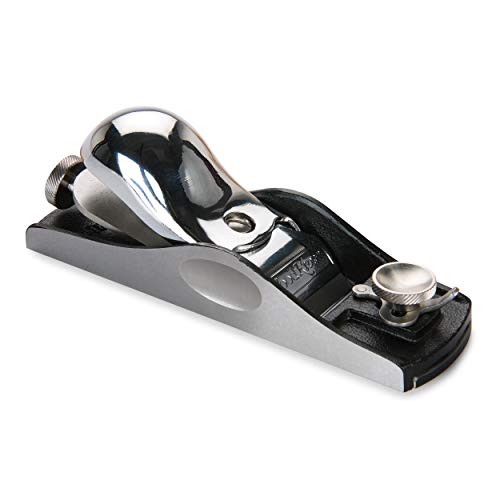 WOODRIVER 151125WWOODRIVER 151125W
The quick size breakdown
Block planes come in two practical sizes. Mini planes fit in the palm and handle small, delicate work. Standard planes are longer, so they ride flatter over an edge and give you more to grip.
Here is how two block planes from our comparison line up, with a bench plane added so you can see how much bigger the next step up is.
| Plane | Type | Length | Weight | Mouth |
|---|---|---|---|---|
| Jorgensen No.101 | Mini block plane | 3.54 in | 0.55 lb | Not listed as adjustable |
| Jorgensen No.60-1/2 | Low angle block plane | 6.25 in | 1.48 lb | Adjustable |
| Amazon Basics No. 4 (DS-WPAMZ001) | Bench plane, for comparison | 9.8 in | 2.66 lb | Adjustable |
When a mini block plane is enough
A mini block plane works well if your jobs are small. Think of easing a sharp corner, knocking down a tiny chamfer, cleaning up a glue squeeze-out line or fitting a small piece of trim. At 3.54 in and 0.55 lb, the Jorgensen No.101 is easy to hold with just your fingertips and thumb.
Its blade is O1 tool steel in a ductile iron body, and its bed angle is listed as 20°, giving a 45° effective cutting angle. That is a typical setup for general trimming.
The tradeoff is length. A short sole follows the surface it sits on, so it can dip on a long edge and leave a slight hollow. For a short edge or a small chamfer, that rarely matters.
When to step up to a standard size
If you plan to trim door edges, square up cabinet parts or clean up the end grain of a board, a longer plane is easier to steer. The Jorgensen No.60-1/2 is 6.25 in long and weighs 1.48 lb. The extra length gives a longer flat reference on the wood, and the extra weight steadies the cut.
It is also a low angle design with an adjustable mouth. Tightening the mouth helps with fine shavings and cleaner end grain. Opening it up lets thicker shavings pass through. A mini plane gives you less room to make those changes.
If you can own only one block plane and your work is mixed, the standard size is usually the safer choice. You can still do small trim work with it, though it feels bulkier in tight spots.
Matching size to the job
Use these pointers to narrow it down:
- Small chamfers, deburring and detail work: a mini block plane.
- Trimming edges and fitting parts: a standard block plane.
- End grain on boards: a standard low angle plane with an adjustable mouth.
- Carrying a plane in an apron or small toolbag: a mini.
- Smoothing a whole board face: not a block plane at all, see the next section.
When a block plane is the wrong size tool
Block planes are made for edges, ends and small surfaces. If you want to smooth wide boards or tabletops, you need a longer bench plane. The No. 4 smoothing planes on our list, at 9.8 in and 10 in, both carry a 2 in wide blade and weigh between 2.66 lb and 3.82 lb. That length and mass help flatten a broad surface.
Japanese kanna planes are another path. The KAKURI at 9.5 in and the SUIZAN at 9.45 in both use a 1.97 in blade and cut on the pull stroke. They are not block planes in the Western sense, and the tap-set versions take more time to adjust. They suit people who want to learn that method.
To see how block planes, bench planes and kanna compare on length, weight and blade width, look at our best hand plane comparison. It puts each model on one spec sheet.
How to decide in four steps
Work through these in order:
- List the three jobs you do most, such as trimming doors, chamfering or end grain.
- Think about the longest edge you plan to plane. For long edges, lean toward the standard size.
- Decide whether you want an adjustable mouth. It matters most for end grain and fine shavings.
- Check weight. A lighter plane is easier to carry and control with one hand, and a heavier one is steadier.
Safety notes
Block plane blades are very sharp, and the Jorgensen listings specifically advise paying attention to the blade when working. Keep your fingers behind the blade and never rest a hand in front of the cutting edge.
Clamp small workpieces rather than holding them in your free hand, especially when planing end grain. A piece that slips toward the blade is how most cuts happen.
Wear safety glasses when planing hardwood or when chips can fly. When you resharpen the blade, take the same care and store it with the edge protected. For more help weighing weight and blade features, our hand plane comparison lists each plane's materials and adjustment options.
Frequently asked questions
What size hand plane should a beginner buy first?
Most beginners do well with a standard block plane for trimming, since it handles edges and end grain. If you mainly want to smooth wide boards, a No. 4 bench plane is the better first choice.
Is a low angle block plane better for end grain?
A low angle design cuts end grain more easily, because the blade meets the fibers at a shallower angle. Pairing it with an adjustable mouth, as on the Jorgensen No.60-1/2, lets you tighten the opening for finer shavings.
Can I use a mini block plane for everything?
You can do a lot with one, but a short sole struggles on long edges and makes it harder to keep a flat line. Keep it for small chamfers and detail work.
Does blade material matter when choosing a size?
Not for size, but it affects sharpness and upkeep. O1 tool steel, used in both Jorgensen block planes here, takes a sharp edge and can be resharpened.