#1
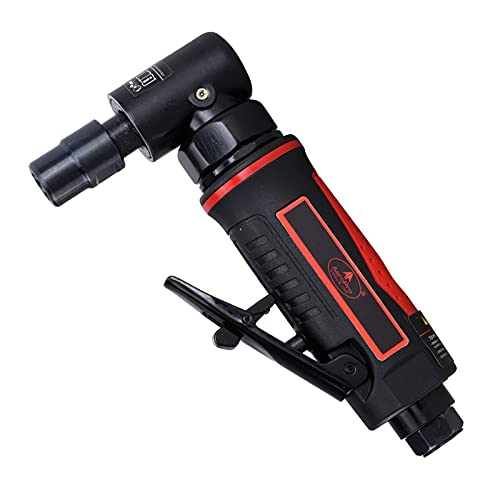
NEIKO 10649ANEIKO Micro Air Die Grinder
- Max free speed
- 54000 RPM
- Weight
- 0.25 lb
- Motor power
- —
An air die grinder is a small, fast tool for deburring, porting, polishing and shaping metal in places a big grinder cannot reach. The specs that matter are free speed, motor power, weight in the hand, collet size and safety features like a lock-off throttle. A straight head reaches into holes; a right-angle head works in tight corners. We put 22 die grinders on one spec sheet so you can compare them side by side.
Quick answer
Ranked from 22 die grinders that met our standard, compared on max RPM, power output, and weight.
As an Amazon Associate I earn from qualifying purchases. Links to retailers on this site are affiliate links; we may earn a commission at no extra cost to you.

470 W, 27000 RPM straight grinder with a speed regulator and safety lever.

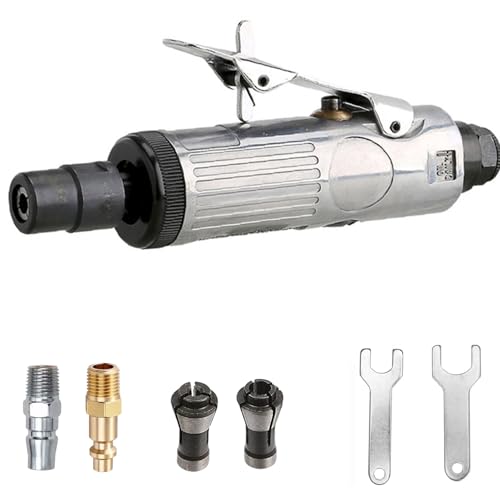
0.72 lb straight grinder at 25000 RPM with two collets.
| Spec | ||||||||||
|---|---|---|---|---|---|---|---|---|---|---|
| Best Scoreout of 100 | 71 | 65 | 63 | 59 | 54 | 53 | 53 | 52 | 51 | 50 |
| Max free speedRPM | 54000 RPM (best in row) | 27000 RPM | 25000 RPM | 27000 RPM | 25000 RPM | 21000 RPM | 20000 RPM | 25000 RPM | 28000 RPM | 18000 RPM |
| Motor powerW | — | 470 W | — | 246 W | — | 186 W | — | — | 186 W | 559 W (best in row) |
| Weightlb | 0.25 lb (best in row) | 1.26 lb | 0.72 lb | 1.41 lb | 1.00 lb | 1.02 lb | 1.00 lb | 0.77 lb | 0.69 lb | 1.80 lb |
| Air consumptioncfm | — | 26.0 cfm | 3.0 cfm (best in row) | — | 3.9 cfm | 6.0 cfm | 3.0 cfm (best in row) | — | 6.0 cfm | 4.1 cfm |
| Operating pressurepsi | 90 psi | 90 psi | 90 psi | — | 90 psi | — | 90 psi | 90 psi | — | — |
| Head type | pencil | Straight | straight | — | 90-degree | — | — | — | — | — |
| Collet sizes | 1/8 in (3 mm) | 1/4 in (6.4 mm) and 6 mm | 1/4 inch and 1/8 inch collets | 1/4" collet | 1/4 inch and 1/8 inch | 1/4" collet | 1/4 in | 1/4 inch (6MM) and 1/8 inch (3MM) | 1/4" collet | 1/4-in. Erickson-style collet |
| Included accessories | — | — | — | 3 | — | — | 4 (best in row) | — | — | — |
| Built-in speed regulator | Yes | Yes | — | — | Yes | — | — | — | — | Yes |
| Safety throttle lock | — | Yes | Yes | Yes | — | Yes | Yes | Yes | Yes | — |
| Rear exhaust | — | Yes (best in row) | Yes (best in row) | Yes (best in row) | Yes (best in row) | No | Yes (best in row) | Yes (best in row) | No | Yes (best in row) |
| Warrantyyr | — | — | — | — | — | — | — | — | — | — |
We reviewed 52 die grinders and kept only the 22 that pass every check below. Those are ranked by a Best Score built from spec fit for this job, sales rank.
These reviews are based on each grinder's published specifications and listing information, in the order of our Best Score.
Most powerful straight grinder in our top five
The Chicago Pneumatic CP872 leads our Best Score at 79. Its 470 W motor, also listed as 0.63 HP, is the strongest in our top five, and it runs at 27000 RPM free speed. More power means the grinder holds its speed when you lean on a carbide burr, instead of bogging down.
It is a straight grinder 6.6 in long and weighing 1.26 lb, so it fits in the hand for long sessions. A contoured safety lever and a built-in air regulator help you control speed, which matters when you switch between polishing and heavy stock removal.
The collet takes 1/4 in and 6 mm shanks, which covers most burrs and mounted stones sold in the US and abroad. Exhaust leaves from the rear, away from the work. It runs at 90 psi. Chicago Pneumatic lists grinding, polishing, deburring, die contouring, light chamfering and molding among its jobs.
VerdictThe most capable all-round die grinder on this page.
Very light WORKPRO grinder with two collets
Second with a Best Score of 74, the WORKPRO W182004A is a light straight grinder at 0.72 lb. It reaches 25000 RPM and comes with a 1/4 in collet and a 1/8 in collet, so it takes both standard burrs and the small-shank bits used for fine detail work.
Air consumption is listed at 3 cfm at 90 psi, which is easy for a small home compressor to supply. A rear exhaust keeps air out of your face and lowers noise, and an air inlet filter keeps debris out of the motor. A safety lock helps prevent accidental starts.
Motor power is not published, so it is hard to compare its grunt against the Chicago Pneumatic or Ingersoll Rand models. For hobby work, small fabrication and cleaning up welds on a budget, its weight and dual collets make it an easy tool to live with. The compressor is not included.
VerdictA light, easy-to-run grinder that suits home shops and small compressors.
Ingersoll Rand straight grinder at 27000 RPM
The Ingersoll Rand 3107G ranks third with a Best Score of 72. It has a 0.33 hp motor, listed as 246 W, and runs at 27000 RPM, matching the Chicago Pneumatic on speed. Ingersoll Rand aims it at automotive and fabrication work.
A self-locking throttle keeps the grinder off until you deliberately press it, which is a sensible safety feature on a tool that spins this fast. Precision ball bearings support long-term reliability, and the rear exhaust directs air away from the work.
It weighs 1.41 lb, the heaviest in our top five, and takes a 1/4 in collet. The listing counts 3 included accessories. Air consumption and operating pressure are not published in our data. It is a solid, conventional straight grinder from a brand many shops already trust.
VerdictA dependable shop grinder with good speed and a sensible safety throttle.
Right-angle kit for tight corners and surface prep
Fourth with a Best Score of 67, the KJE kit is the first right-angle grinder in our ranking. Its 90-degree head reaches into corners, behind brackets and along surfaces where a straight grinder will not fit. That makes it popular for gasket removal and surface prep with small sanding discs.
Our spec sheet records 25000 RPM, while another line of the listing mentions 20,000 RPM, so expect a top speed somewhere in that range. It weighs 1 lb, has a speed regulator, takes 1/4 in and 1/8 in collets, and uses 3.9 cfm at 90 psi.
The kit includes 29 sanding discs, a base and an air connection, so you can start sanding straight away. The aluminum alloy body is described as low-vibration. Motor power is not published. For general fabrication, a straight grinder is still the more flexible first tool.
VerdictA ready-to-use right-angle kit for sanding and surface prep in awkward spots.
Fastest and lightest grinder on the page
The Ingersoll Rand 307B scores 66 and holds two records here. It has the highest free speed on the page at 28000 RPM and the lowest weight at 0.69 lb. High speed suits small carbide burrs, which cut best when they spin fast.
Its motor is small, rated at 0.25 hp or 186 W, the lowest power on this page alongside the 301B. That means it is better at fine deburring, engraving-style work and light polishing than at heavy stock removal, where it may slow under load.
Like the other Ingersoll Rand models, it has a self-locking throttle and ball-bearing construction in an aluminum housing. It takes a 1/4 in collet and uses 6 cfm of air. Unlike most grinders here, it does not have a rear exhaust, so air leaves near your hand.
VerdictA tiny, very fast grinder for precision work rather than heavy grinding.
Best among the reviewed tools
Straight grinders reach into holes, ports and slots and are the most flexible first tool. Right-angle grinders reach into corners and run small sanding discs for surface prep. Many shops end up owning one of each.
Small carbide burrs cut best at high speed, and the grinders here run between 18000 and 28000 RPM. Motor power, from 186 W to 559 W where listed, decides whether the grinder holds that speed under load.
Die grinders use air continuously. Compare the grinder's air consumption at 90 psi with what your compressor delivers. Low-consumption grinders around 3 to 4 cfm suit small home compressors.
A 1/4 in collet takes most burrs; a 1/8 in collet adds fine detail bits. A lock-off or self-locking throttle prevents accidental starts, and a rear exhaust keeps air and oil mist out of your face.
Die grinders are used for deburring, grinding welds, porting engine heads, polishing, cleaning surfaces and shaping metal in tight spaces. They take small burrs, stones and sanding discs that larger grinders cannot use.
It depends on the model. Grinders here list from about 3 cfm to much higher figures at 90 psi. Check the cfm rating against your compressor so the grinder can run at full speed.
A straight grinder is better for reaching into holes and for most deburring. A right-angle grinder is better for surface prep and working in corners. If you can only buy one, start with a straight grinder.
Most air die grinders run between about 20000 and 28000 RPM. Higher speed helps small carbide burrs cut cleanly. Pair speed with enough motor power so the tool does not slow down under load.
Your own selection is kept in the link, so friends see the same side-by-side.