How Long Do Die Grinder Bits for Metal Last?
There is no single number of hours or jobs for a carbide die grinder bit, because life depends on the metal, the speed, the pressure and how clean you keep the teeth. A good tungsten carbide burr used with light pressure on mild steel can outlast many cheaper bits, while the same burr can be ruined quickly by hardened steel, heat or a bent shank. Judge a bit by how it cuts, not by the calendar.
 BLENCEE Burr14-10Best overall
 Sworker 5TC635Best long-reach set
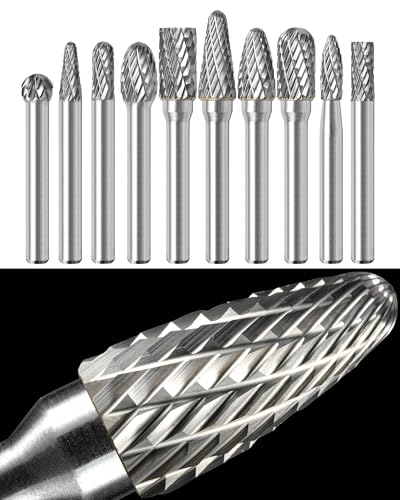 Sworker CBS-5Best mixed head sizes
What actually decides how long a bit lasts
Manufacturers do not publish a standard lifespan for burrs, and the specs we compare do not include one either. What you can count on is a handful of factors that decide whether a bit lasts a short while or a long time.
The biggest factor is the material being cut. Mild steel and aluminum are gentle on teeth. Stainless steel, hardened steel and cast iron with a hard skin or sand inclusions wear teeth faster. Casting scale and welding slag act like an abrasive, so the first pass over a rough surface does more damage than later passes.
The second factor is how you use the tool. Too much pressure, too little speed and long continuous contact in one spot all generate heat or chip teeth. Light pressure and steady movement let each tooth cut instead of rub.
Why carbide outlasts other bit materials
Tungsten carbide is much harder than the steel used in basic rotary bits, so it keeps a sharp edge far longer when cutting metal. That is why our best die grinder bits for metal page focuses on carbide burrs with a double cut pattern.
Carbide is hard but also brittle. It resists dulling, yet it can chip or snap if it is dropped, bounced off the work or flexed. So the usual way a carbide burr dies is damage, not slow wear. A burr that is chipped or bent is finished even if most of the teeth still look sharp.
Double cut teeth help here too. The crossed pattern breaks chips into smaller pieces and spreads the load across more edges. Several listings in our data describe double cut designs as giving a smoother finish with less vibration, and less vibration is easier on both the burr and the tool.
What the product data tells us (and what it doesn't)
The sets we compare are all tungsten carbide on 1/4 in (6.35 mm) shanks, so material and shank size do not separate them much. The differences are in the compatible materials the sellers list, the cut type and the head sizes. None of these figures is a lifespan rating, so treat them as hints about suitability.
Warranty and replacement language from sellers is a claim in a listing, not something we have verified. It may be worth reading, but it says nothing about how many hours a burr will cut.
| Set | Cut type | Listed materials | Detail from the listing |
|---|---|---|---|
| BLENCEE 10-piece | Double cut | Steel, aluminum, plastic | Heat-treated YG8X carbide, 10 head shapes |
| Sworker 5-piece long | Double cut | Cast iron, steel, aluminum | 158 mm overall length, heads up to 10 mm |
| HIDOTOL 10-piece | Double cut | Metal, stainless and hardened steel, wood, jade, marble | 7 head shape types |
| BOOLY 14-piece | Double cut | Wood, concrete, hardened steel, cast iron | Rated to 45000 rpm, 10 head shapes |
Signs a bit is worn or damaged
You do not need to guess. A burr tells you when it is done, and replacing it at that point saves time and protects your grinder.
- It needs more pressure than it used to for the same cut.
- It skates or chatters across the surface instead of biting in.
- The teeth look shiny, rounded or smeared with melted metal.
- Chips are visibly missing from the head, or a flute looks broken.
- The burr wobbles or vibrates, which can point to a bent shank.
- The workpiece gets hot or discolored much sooner than before.
How to get more life from each bit
Most of the habits that extend life are simple. They also tend to give a cleaner finish, so you gain twice.
Start with the right burr for the job. Our best die grinder and best air die grinder pages can help you match the tool and speed range to your work, since a burr only performs well when the grinder holds speed under load.
- Use double cut burrs on steel and iron, and keep single cut for fast stock removal where finish matters less.
- Run at moderate to high speed with light pressure. Let the teeth do the cutting.
- Keep the burr moving. Dwelling in one spot builds heat and loads the flutes.
- Keep a long burr in contact with the work when starting and stopping. One long-reach listing warns that doing otherwise can bend the shank.
- Clear clogged flutes with a stiff brush. Packed teeth cut poorly and overheat.
- Store burrs in their case so the heads do not knock together.
- Do not pry or lever with the burr, and avoid dropping it on concrete.
Safety notes
Wear safety glasses or a face shield every time. A chipped carbide burr can throw sharp fragments, and grinding sprays hot sparks and metal chips. Add hearing protection, since die grinders are loud, and gloves that will not catch in a spinning bit.
Secure the workpiece so it cannot spin or jump. Never exceed the maximum rpm marked on the burr or the grinder. Check that the shank is fully seated in the collet and that it matches the collet size. Unplug an electric grinder or disconnect the air supply before changing bits.
If you also cut metal with discs, see our best angle grinder disc for cutting metal page, because cutting discs have their own guard and handling rules.
Frequently asked questions
Do double cut burrs last longer than single cut?
Not automatically. Double cut burrs spread the work over more teeth and run smoother on steel, which helps durability. Single cut burrs remove material faster but leave a rougher surface. Technique matters more than cut type.
Can I sharpen a dull carbide burr?
Not in any practical way at home. The teeth are tiny and carbide is very hard, so a dull or chipped burr is normally replaced.
Why did my new burr dull so quickly?
Common causes are excess pressure, low speed, heat buildup, cutting hardened or scaled metal, or clogged flutes. Check these before blaming the burr.
Will a bigger set make my bits last longer?
No. A larger set gives you more shapes, so each burr gets used less often. Each burr still wears based on how you use it.
Is it safe to keep using a burr with one chipped tooth?
It is better to replace it. A chipped head cuts unevenly, vibrates and can shed more carbide while running.