What Size Die Grinder Bits for Metal Grinding?
For most metal grinding, use 1/4 in (6.35 mm) shank double cut tungsten carbide burrs with heads between 6 mm and 10 mm. The shank must match your grinder's collet, and the head size and shape should match the job: smaller heads for detail and tight spots, larger heads for faster stock removal.
 BLENCEE Burr14-10Best overall
 Sworker 5TC635Best long-reach set
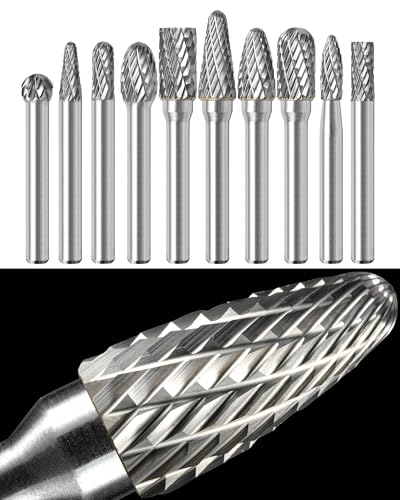 Sworker CBS-5Best mixed head sizes
Two sizes matter: shank and head
When people ask about bit size, they usually mean two different measurements. The shank is the smooth round end that goes into the collet. The head is the cutting part, and its diameter and length decide what the bit can reach and how fast it removes metal.
The shank has to match your tool exactly. A bit that is too thin will not clamp safely, and one that is too thick will not fit at all. The head is more flexible, and you will usually want a few sizes on hand.
Shank size: 1/4 in is the standard
Most die grinders, both air and electric, use a 1/4 in (6.35 mm) collet. Every burr set on our best die grinder bits for metal page uses a 1/4 in shank, except one set made for rotary tools.
Smaller rotary tools often take 1/8 in shanks. Some tools also use 3/32 in or 6 mm collets. A 6 mm collet is close to 1/4 in but not the same, and at least two of the listed sets (BLENCEE and Sworker) say they do not fit 6 mm collets. Check your grinder's manual or the collet itself before you buy.
- 1/4 in (6.35 mm): standard for full-size air and electric die grinders.
- 1/8 in: common on rotary tools and small detail grinders.
- 3/32 in: found on some small precision tools.
- 6 mm: close to 1/4 in but not interchangeable, so confirm the collet size first.
Head size and shape for grinding metal
For general metal grinding, deburring and weld cleanup, heads around 6 mm to 10 mm cover most work. The 10-piece Sworker set on our comparison page includes 6 mm, 8 mm and 10 mm heads, which is a practical spread for one toolbox.
Smaller heads get into corners and narrow slots. Larger heads cover more surface per pass and remove material faster, but they cannot reach tight areas. If you need to go deep into a bore or port, look at length as well as diameter. The Sworker 5-piece long set has 8 mm and 10 mm heads on bits that are 158 mm (6.22 in) long overall.
Shape matters as much as size. Cylinders flatten and square off edges, balls hollow out curves, trees and flames reach into corners, and cones chamfer holes.
| Job | Head size to start with | Useful shape |
|---|---|---|
| Deburring and edge cleanup | 6 mm to 8 mm | Cylinder or cone |
| Weld cleanup | 8 mm to 10 mm | Cylinder or tree |
| Rounding and hollowing | 6 mm to 10 mm | Ball |
| Porting and deep bores | 8 mm to 10 mm, long shank | Long cylinder or tree |
| Chamfering holes | 6 mm to 8 mm | Cone |
Cut type and material
For steel and iron, choose tungsten carbide with a double cut pattern. Double cut teeth make small chips and a smoother finish. Single cut burrs remove material faster but leave long chips and a rougher surface, so they suit softer metals and heavy stock removal.
Most listed sets are rated for steel, and several also cover cast iron or aluminum. Aluminum can clog fine teeth, so a lighter touch and a burr made for soft metal help. Check the listing of any set for the metals it names.
Cutting metal and metal roofing
A burr grinds and shapes metal rather than slicing through it. If you need to cut sheet or bar, a thin cut-off wheel is the usual tool, and our best angle grinder disc for cutting metal page covers the discs used with a larger grinder. Use only wheels rated for your tool's speed and made for that tool.
For metal roofing, a die grinder is a finishing tool, not the main cutter. Shears or a nibbler make the cuts, and a small carbide burr can then clean up burrs on cut edges. Be careful with sparks and hot metal dust, since both can damage coatings and leave rust spots. Sweep up all filings from the roof.
Working on a roof also means heights. Use proper fall protection, keep cords and air hoses clear of your footing, and never use a grinder with one hand while holding a ladder.
Using the bits safely
Carbide is hard but brittle, and a spinning burr throws sparks and fragments. Follow these steps every time:
- Wear safety glasses or a face shield, and use hearing protection. Add a dust mask when grinding.
- Unplug an electric grinder or disconnect the air line before changing bits.
- Seat the shank fully in the collet and tighten it properly.
- Clamp the workpiece so it cannot move.
- Keep long burrs touching the work when starting and stopping, as the Sworker long set warns, to avoid bending the shank.
- Stay within the bit's rated speed. The 14-piece BOOLY kit lists 45000 rpm, and your grinder should not exceed the rating of the bit.
- Use light pressure and let the teeth cut.
Choosing a grinder to match
Your bits are only as useful as the tool driving them. If you are still choosing, compare our best die grinder picks for electric models, or look at the best air die grinder page if you already have a compressor. Either way, confirm the collet size first, so every 1/4 in bit you buy will fit.
Frequently asked questions
Can I use 1/8 in bits in a 1/4 in die grinder?
Only with a proper collet reducer or the correct 1/8 in collet. Never wrap material around a thin shank to make it fit, because it can slip or break.
Are longer bits better?
Only when you need reach. Longer bits flex more and can bend if they lose contact with the work at speed, so use the shortest bit that reaches the area.
How many shapes do I need?
A set with around 10 shapes covers most metalwork. If you only do one job, such as deburring, one or two shapes may be enough.
Do carbide burrs work on hardened steel?
Some listings, such as the HIDOTOL set, name hardened steel as a compatible material. Check the product details and use lower pressure.