#1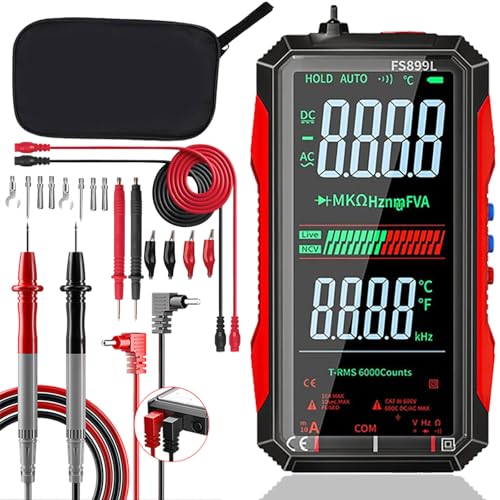
ZMIWNIED F899LZMIWNIED FS899L multimeter
Lists a 10nF-60mF capacitance range with a CAT III 1000V rating and 6000 counts.
- Display counts
- 6000 counts
- Safety rating
- CAT III 1000V
- Max current
- 10 A
For capacitor testing, a multimeter needs a capacitance function with a range wide enough for small and large parts. Display counts set the resolution. A safety rating matters because capacitors sit in live equipment. True RMS and fuse protection help on AC circuits. We put 26 products on one spec sheet and ranked them by specs. Many listings leave out the capacitance range, so we flag where the data is missing. Read the numbers, then pick the meter that fits your bench.
Quick answer
Ranked from 26 multimeters that met our standard, compared on Capacitance measurement range, counts resolution, CAT safety rating.
As an Amazon Associate I earn from qualifying purchases. Links to retailers on this site are affiliate links; we may earn a commission at no extra cost to you.
Lists a 10nF-60mF capacitance range with a CAT III 1000V rating and 6000 counts.
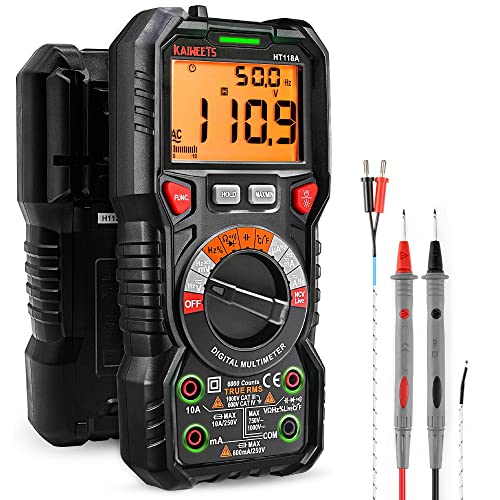
Measures up to 1000V DC and 750V AC, with thermistor and double ceramic fuse protection.
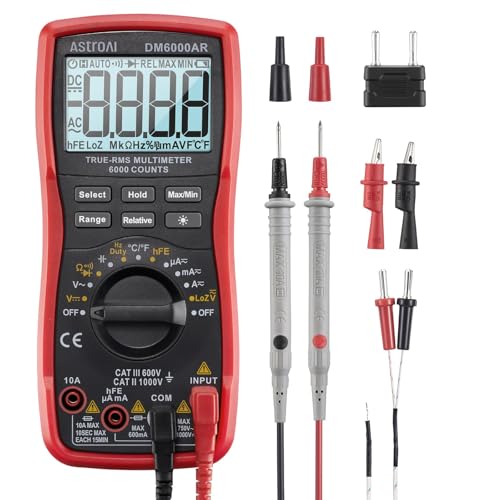
Lists capacitance, True RMS and 6000 counts, but no safety rating in our data.
| Spec | ||||||||||
|---|---|---|---|---|---|---|---|---|---|---|
| Best Scoreout of 100 | 80 | 77 | 75 | 74 | 73 | 70 | 68 | 67 | 66 | 66 |
| Display countscounts | 6000 counts (best in row) | 6000 counts (best in row) | 6000 counts (best in row) | 6000 counts (best in row) | 6000 counts (best in row) | 6000 counts (best in row) | — | 6000 counts (best in row) | — | 4000 counts |
| Ranging | Auto-ranging | Auto-ranging | Auto-ranging | Auto-ranging | Auto-ranging | Auto-ranging | Auto-ranging | Auto-ranging | Auto-ranging | Auto-ranging |
| True RMS | Yes | Yes | Yes | Yes | Yes | Yes | Yes | Yes | Yes | Yes |
| Safety rating | CAT III 1000V (best in row) | CAT III 1000V (best in row) | — | CAT III 1000V (best in row) | CAT III 1000V (best in row) | CAT III 600V | — | CAT III 600V | CAT III 1000V (best in row) | CAT III 600V |
| Max AC/DC voltageV | 600 V | — | — | 600 V | — | — | 600 V | — | 1000 V (best in row) | 600 V |
| Max currentA | 10 A | 10 A | — | 10 A | — | — | 10 A | — | 10 A | 10 A |
| Max resistanceMΩ | 60 MΩ (best in row) | 60 MΩ (best in row) | — | 60 MΩ (best in row) | — | — | 50 MΩ | — | — | 40 MΩ |
| Capacitance measurement | Yes | Yes | Yes | Yes | Yes | Yes | Yes | Yes | Yes | Yes |
| Temperature measurement | Yes | Yes | Yes | Yes | Yes | Yes | Yes | Yes | Yes | — |
| Non-contact voltage detection | Yes | Yes | — | Yes | Yes | Yes | — | Yes | Yes | Yes |
| Battery test mode | — | — | — | — | — | — | — | Yes | — | Yes |
| Backlit display | Yes | Yes | Yes | Yes | — | Yes | Yes | Yes | — | Yes |
| Weightlb | — | 1.21 lb | 1.17 lb | — | — | 1.21 lb | 0.91 lb | 0.66 lb | 1.40 lb | 0.48 lb (best in row) |
We reviewed 58 multimeters and kept only the 26 that pass every check below. Those are ranked by a Best Score built from spec fit for this job, sales rank.
These reviews are based on specifications and listing information only. They cover the five top-ranked meters for capacitor testing.
Leads our ranking with wide capacitance range
The F899L leads our ranking for capacitance testing. Its listing gives a capacitance range of 10nF-60mF. That covers small signal capacitors at the low end and large motor or bank capacitors at the high end. A 6000-count display gives usable resolution across those ranges, and auto-ranging picks the scale for you.
Safety is solid for work near live circuits. The meter is listed at CAT III 1000V, and the listing also cites CAT IV 600V. Double fuses protect the current inputs. Max voltage is 600V and max current is 10A. True RMS reads AC signals correctly, which matters on AC circuits around the capacitor you are checking.
The 4.8-in backlit screen and built-in torch help in tight panels. Data hold freezes a reading for awkward angles. It recharges over USB-C in 2 hours for up to 8 hours of use. The maker does not publish a weight. It also includes a 20-piece accessory set with alligator clips. Always discharge a capacitor before you connect the leads.
VerdictIt is the best match for capacitor work, with a listed 10nF-60mF range and strong safety ratings.
Rated for 1000V DC with a protective case
The HT118A is a capable capacitor meter with one gap. It lists capacitance measurement, but the listing gives no capacitance range. You cannot confirm the smallest or largest value it reads. It has 6000 counts, auto-ranging and True RMS, which covers the basics for everyday bench work. Ask the seller for the range if you work with very small or very large capacitors.
Safety is a strength. The meter carries CAT III 1000V, and the listing adds CAT IV 600V. It measures up to 1000V DC and 750V AC, with 10A current and 60 MΩ resistance. A double ceramic fuse and thermistor protection circuit guard the inputs. High voltage protection is active on all ranges.
It weighs 1.21 lb and has a 2.9-in backlit display, a kickstand and a silicone case. It runs on batteries, and the package includes a thermocouple for temperature. After-sale service is listed at 36 months. It also has non-contact voltage detection with sound and light alarms.
VerdictA safe, well-protected meter, but its capacitance limits are unpublished, so it ranks behind the leader for this job.
A simple capacitance meter with limited safety data
The DM6000AR lists capacitance and temperature measurement. It has 6000 counts, auto-ranging and True RMS. That gives it the same display resolution as the top-ranked meters. Capacitance range is not in the listing, so the data does not show how small or large a capacitor it can read.
Safety is the weak point for this job. Our data lists no safety rating. The listing mentions a double ceramic fuse, with F600mA/250V and F10A/250V fuse tubes. Those protect against overload, but they are not a category rating. For work near live circuits, a rated meter is the better pick.
It weighs 1.17 lb. It has a large backlit LCD, data hold, a kickstand and auto shut-off. The listing points to automotive and household troubleshooting. It does not list non-contact voltage detection or a maximum voltage, so it is a plainer tool than the leaders. Use it for low-energy bench checks, not for service panels or mains work.
VerdictIt covers basic capacitor checks, but missing safety data makes it a weaker pick near live circuits.
Matches the leader on specs, ranks fourth
This FS899L listing carries the same spec set as the one that leads our ranking. You get 6000 counts, auto-ranging, True RMS and a capacitance function. The listing states a capacitance span from 10nF to 60mF. For electronics repair, that low end suits small ceramic and film parts, while the top end suits large electrolytics.
On safety, it shows CAT III 1000V in the data, and the listing adds CAT IV 600V. Max voltage is 600V, max current is 10A and max resistance is 60 MΩ. Double fuses and overload safeguards are listed. Those figures suit panel and appliance work, as long as the capacitor is discharged first.
Extras include non-contact voltage detection, ambient temperature, frequency and a backlit 4.8-in screen. A USB-C port recharges it, and the listing cites 8 hours of use per charge. The kit adds 20 accessory pieces. No weight is published, so check size before you buy if you carry it in a tool bag or small case.
VerdictIt matches the top meter on paper, so choose it only if the leading listing is not available.
Same capacitance tool, with thinner spec data
The FS899L-1 lists capacitance, True RMS, auto-ranging and 6000 counts. Its safety rating is CAT III 1000V, and the listing adds CAT IV 600V. Unlike the other FS899L listings, it gives no capacitance range in the text. The text only says it measures capacitance with 6000-count resolution. That makes it harder to match to small or large capacitors.
The data also leaves out max voltage, max current, max resistance and a backlight flag. The listing describes a 4.8-in color screen and a built-in flashlight. The listing says it reads well in dim spaces, but the spec sheet does not confirm a backlight. Weight is not published either.
Other features include non-contact voltage detection, temperature, frequency and continuity. It charges over USB-C in 2 hours. A pair of insulated alligator clips snaps onto the test leads for hands-free checks. Those clips help when you watch a capacitor reading drift over time, since your hands stay free.
VerdictIt ranks fifth because the listing documents less than the other FS899L models, so confirm the details first.
Best among the reviewed tools
Look for a stated range, such as 10nF-60mF on the FS899L listings. A low floor helps with small capacitors. A high ceiling covers large ones. If a listing gives no range, ask the seller before you buy, because the data cannot confirm it.
Display counts set how finely a meter shows a value. Most meters here list 6000 counts, and one lists 4000. More counts help you see small differences in a capacitor reading. Auto-ranging picks the scale, which saves time when you do not know the value.
Capacitors can hold a charge in live equipment. Choose a meter with a stated category rating, such as CAT III 1000V. Fuse protection on the current inputs also matters. Always discharge a capacitor before you test it, and never rely on the meter alone for safety.
True RMS reads AC waveforms that are not clean sine waves, which is common around motor and appliance circuits. Pair it with temperature or frequency modes if you troubleshoot HVAC. A backlit screen and data hold make readings easier in tight spaces.
Often not reliably. Other components in parallel can skew the reading, and a charged capacitor is a shock risk. Power the circuit off and discharge the capacitor first. For a clean reading, remove at least one leg of the capacitor from the board.
It depends on the part. Small electronics parts sit at the nanofarad level, while motor run capacitors are much larger. The FS899L listings state 10nF-60mF, which spans both. Several other meters here list capacitance but do not publish a range.
The capacitance reading itself does not depend on True RMS. True RMS matters for AC voltage and current checks around the capacitor. All five top-ranked meters list True RMS, so it does not separate them for this job.
Look for a stated category rating. Four of the five top-ranked meters list CAT III 1000V, and the AstroAI DM6000AR lists none in our data. A rating shows the meter was built for work near distribution circuits.
Your own selection is kept in the link, so friends see the same side-by-side.


