What Size Multimeter Do You Need for Capacitor Testing?
For capacitor testing, the size that matters is the capacitance range, not the body of the meter. Look for a meter with a capacitance mode that spans roughly 10nF up to tens of millifarads, at least 6000 counts, and a stated CAT safety rating. Any compact or full-size meter works if those numbers fit the part you are checking.
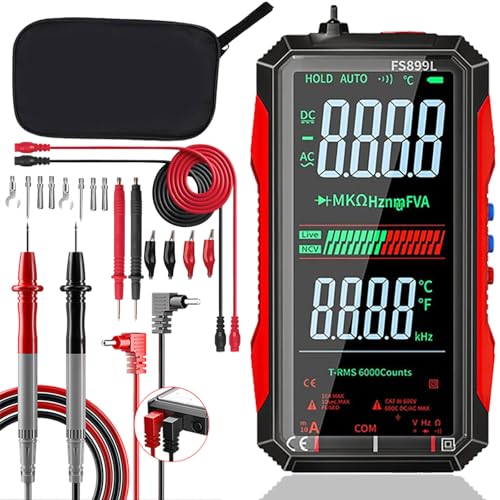 ZMIWNIED F899LBest overall
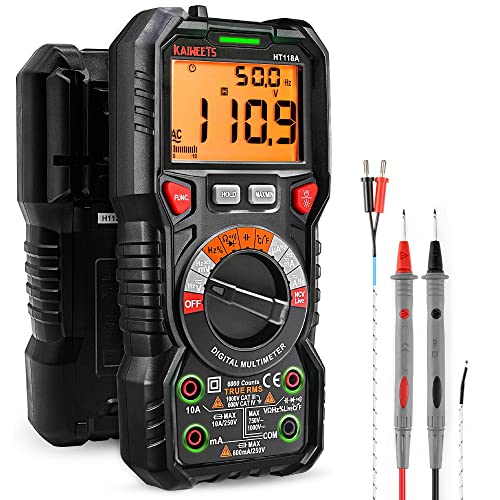 KAIWEETS HT118ARated for 1000V DC
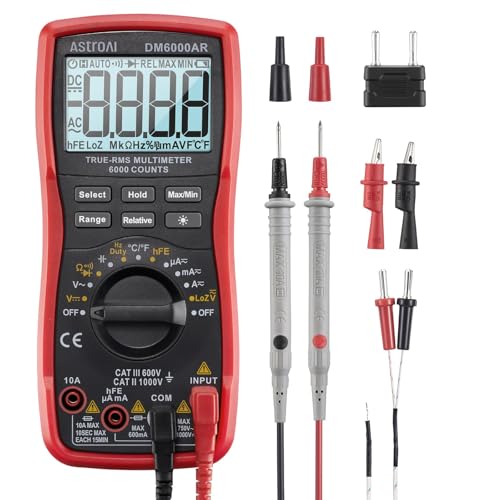 AstroAI DM6000ARPlain capacitance meter
What "size" means for a multimeter
People ask about size in a few different ways. Some mean the capacitance range, some mean how many display counts the meter has, and some mean how big and heavy the meter is. All three matter, but not equally.
The capacitance range is the first thing to check. If the meter cannot read your capacitor's value, nothing else about it helps. After that, counts and safety rating decide how useful and how safe the meter is. Physical size comes last, and it mostly affects comfort in tight spaces.
Our best multimeter for capacitor testing page puts these specs side by side, and it flags listings that leave out the capacitance range.
Match the capacitance range to your capacitor
Capacitors are measured in farads, but real parts are much smaller. Small signal capacitors sit in the nanofarad (nF) and microfarad (µF) range. Large power and motor capacitors run higher, and the biggest parts are rated in millifarads (mF).
A meter with a low floor can read small parts. A meter with a high ceiling can read large ones. The FS899L listings on our page state a 10nF-60mF range, which is 0.01 µF at the low end and 60,000 µF at the top. That covers most small electronics work as well as larger parts.
If a listing gives no capacitance range, the data cannot confirm it. Ask the seller before you buy. One product on our page includes insulated alligator clips but states no range, so it is a good example of a listing to question first.
For AC equipment such as HVAC units, the part is usually a run or start capacitor marked in µF on its label. Read that number first, then make sure your meter's range includes it with room to spare.
Counts, ranging, and reading small differences
Display counts set how finely a meter shows a value. Most meters on our page list 6000 counts, and one lists 4000. More counts help you see small differences, which matters when you compare a reading to the value printed on the capacitor.
Auto-ranging is also worth having. The meter picks the scale for you, so you do not need to know the capacitor's value ahead of time. That saves time when a label is worn or missing.
A bad capacitor often reads well below its marked value. A meter with finer resolution makes that gap easier to spot. Compare your reading to the label and allow for the tolerance printed on it.
Safety rating matters more than you might expect
Capacitors can hold a charge even after the power is off. That is true in appliances, power supplies, and HVAC equipment. A meter with a stated category rating is built to handle the environment you are working in.
Look for a CAT rating on the listing. The FS899L listings on our page show CAT III 1000V. The KAIWEETS HT118A lists CAT III 1000V and measures up to 1000V DC and 750V AC, with double ceramic fuse and thermistor protection. The compact pick on our page lists CAT III 600V.
For AC circuits, True RMS helps because motor and appliance circuits often produce AC waveforms that are not clean sine waves. Fuse protection on the current inputs adds another layer.
A rating does not replace good habits. Always discharge a capacitor before you test it, and never rely on the meter alone for safety.
How to test a capacitor step by step
The steps below cover the basic capacitance check. Follow your equipment's service manual for anything specific.
Wear safety glasses. A failed capacitor can vent or burst, and an eye injury is not worth the risk.
- Turn off power and unplug the equipment. Confirm it is dead with the meter's voltage mode or a non-contact detector.
- Discharge the capacitor safely. Use an insulated tool with a proper discharge resistor, not a bare screwdriver across the terminals.
- Remove the capacitor from the circuit, or at least disconnect one lead, so other parts do not skew the reading.
- Set the meter to the capacitance function and connect the leads to the terminals.
- Wait for the reading to settle. Large capacitors can take a few seconds.
- Compare the reading to the value marked on the capacitor, within the tolerance on the label.
Comparing the specs that count
This table shows what to look for and what our data lists for the meters on the page.
Body size is the least important factor. Weights on our page range from 0.48 lb for the compact pick to 1.21 lb for the HT118A. A lighter meter is easier to hold in a panel, and a bigger one often gives you a larger screen and more features.
| Spec | What to look for | Examples from our data |
|---|---|---|
| Capacitance range | A stated range that includes your capacitor | 10nF-60mF on the FS899L listings |
| Display counts | 6000 or more for finer readings | 6000 on most meters, 4000 on one |
| Safety rating | A stated CAT rating | CAT III 1000V or CAT III 600V |
| Ranging | Auto-ranging if you do not know the value | Auto-ranging on the top meters |
| AC readings | True RMS for motor and appliance circuits | True RMS on the top meters |
| Weight | Lighter for tight spaces | 0.48 lb to 1.21 lb |
Which meter fits your job
For small electronics, a stated range with a low floor and 6000 counts is enough. For HVAC and appliance repair, add a CAT rating, True RMS, and fuse protection, since you will work near live circuits.
If you want a short list of options ranked by these specs, see our multimeter comparison for capacitor testing. It marks the products where the capacitance range is missing so you know what to confirm with the seller.
Frequently asked questions
Can any multimeter test a capacitor?
No. The meter needs a capacitance function. Some basic models only measure voltage, current, and resistance, so check the listing for a capacitance mode and a stated range.
Does the meter need to be True RMS to test a capacitor?
Not for the capacitance reading itself. True RMS helps when you measure AC voltage or current around motors and appliances, which is common in the same repair jobs.
Why does my reading differ from the label?
Capacitors have a tolerance, and a failing part often reads lower than its marked value. Compare the reading to the label and its tolerance. A large gap usually points to a bad capacitor.
Do I need a clamp meter for capacitor testing?
No. A standard digital multimeter with a capacitance mode does the job. A clamp is useful for measuring current but is not required for checking capacitance.