How to Set a Multimeter for Testing a Car Battery
Turn the dial to DC voltage (marked V with a straight line, or VDC) and pick the 20V range if your meter is not auto-ranging. Put the black lead in COM and the red lead in the voltage jack, then touch red to the positive terminal and black to the negative terminal. A rested, healthy 12V battery reads about 12.6 volts or a little higher.
 allsun EM133AWidest RPM range
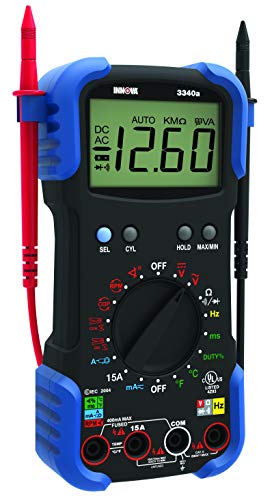 Innova 3340Lightest and simplest
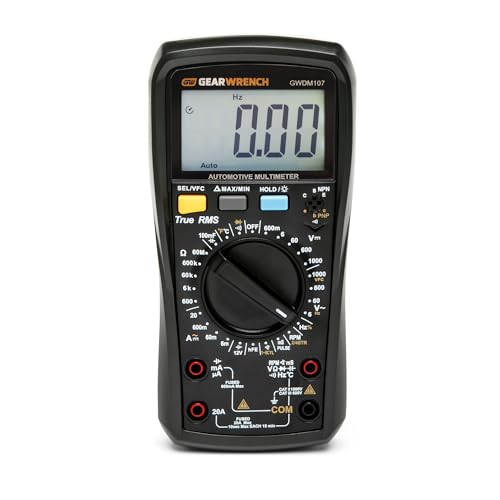 GEARWRENCH GWDM107_1Highest safety rating
Set up the meter in five steps
Most car batteries are 12-volt lead-acid units, so you only need the basic DC voltage function. You do not need engine functions like RPM or dwell for this job. Here is the setup from start to finish.
- Turn the car off, remove the key, and switch off the lights, radio and anything else that draws power.
- Plug the black lead into the COM jack and the red lead into the jack marked V (often shared with ohms). Do not use the 10A or mA jack for voltage.
- Turn the dial to DC voltage, shown as V with a straight line and sometimes a dotted line beneath it. Avoid the wavy V, which is AC.
- Choose the 20V range if your meter has fixed ranges. On an auto-ranging meter, just select DC volts and let it pick.
- Touch the red probe to the positive (+) terminal and the black probe to the negative (-) terminal. Read the display once it settles.
Why the 20V range is the right choice
A car battery sits near 12 to 13 volts, and a running charging system pushes it a bit higher. Fixed-range meters usually jump from 2V to 20V to 200V. The 20V setting is the lowest range that can show those readings, so it gives you the most precise number.
If you pick 2V, the display will show an over-range symbol such as OL or 1. That is not a fault. It just means the range is too low. If you pick 200V, you will still get a reading, but with less detail.
Auto-ranging meters take care of this for you. For example, the Innova 3340 and the allsun EM133A in our data are both listed as auto-ranging, so you only choose DC volts. Either way, the connection steps stay the same.
How to read the voltage
Take your first reading after the car has sat for a few hours. Right after driving or charging, a battery shows a surface charge that reads higher than its real condition. If you must test sooner, turn the headlights on for a minute, switch them off, wait a few minutes, then measure.
Use this table as a general guide for a 12V lead-acid battery at rest. Exact figures vary a little by battery type, so treat them as a rough picture of charge, not a verdict on battery health.
| Resting voltage | What it usually means |
|---|---|
| 12.6V or higher | Fully charged |
| About 12.4V | Roughly three-quarters charged |
| About 12.2V | Roughly half charged |
| About 12.0V | Low, charge it soon |
| Below 11.8V | Discharged, recharge and retest |
Check the battery under load and while charging
A resting reading only tells part of the story. A weak battery can look fine at rest and then sag when the starter pulls hard. Two more quick checks give you a fuller picture.
For a cranking test, have a helper start the engine while you watch the meter. Many technicians look for the voltage to stay above roughly 9.6 volts during cranking. A much lower dip points to a tired battery, bad cables or a poor connection.
For a charging test, start the car and measure again at the terminals. A healthy alternator usually holds the battery somewhere around 13.7 to 14.7 volts. If you see about the same as your resting number, the alternator may not be charging. If the reading climbs well above that range, the regulator may be at fault.
If the numbers look odd, clean the terminals and make sure the probes touch bare metal, not corrosion. A poor contact is a common cause of confusing readings.
Safety notes before you touch the battery
A car battery can deliver a lot of current and gives off hydrogen gas while charging, so a little care goes a long way.
- Wear safety glasses. A battery can vent gas or spit acid.
- Remove rings, watches and bracelets so metal never bridges the terminals.
- Keep sparks, flames and cigarettes away from the engine bay.
- Never leave the red lead in the 10A or mA jack while measuring voltage. Probing a battery that way can blow the meter's fuse or damage the meter.
- Hold the probes by the insulated handles and keep them from touching each other or any metal part while they are on the terminals.
- Keep loose clothing, hair and the probe leads clear of the fan and belts when the engine is running.
Which meter suits this job, and when to use a tester
Any decent digital meter can do a basic voltage check. If you plan to do more car work, such as parasitic drain tests, look at the current rating. Our best multimeter for automotive page compares meters with 10A to 20A current ranges, which is enough for drain checks. The Innova 3340 is listed at 15A and 0.5 lb, with 10 MegOhm input impedance, which protects sensitive car electronics.
Some meters add helpful extras. The GEARWRENCH GWDM107 lists a battery test function and a CAT IV safety rating. The FROGBRO model in our data has 20,000 counts and a backlit screen, which helps in a dim engine bay.
A multimeter shows voltage, but it does not measure cold cranking capability directly. If you want a quicker pass or fail answer on battery health, a dedicated unit may suit you better. You can compare options on our best car battery tester page. If the battery is simply flat, you can also look at our best portable car battery jump starter comparison.
Frequently asked questions
Do I need to disconnect the battery to test it?
No. For a voltage check, leave the battery connected and touch the probes to the terminals. Disconnecting is only needed for some other jobs, like cleaning or replacing the battery.
What if my meter shows a negative number?
The probes are reversed. Red should touch positive and black should touch negative. A minus sign is harmless, so swap the leads and read again.
Can I test the battery with the engine running?
Yes, but that checks the charging system, not the battery alone. A reading of roughly 13.7 to 14.7 volts is typical when the alternator is working.
Why does my battery read 12.8V right after a drive?
That is likely surface charge. Let the car rest for a few hours, or turn on the headlights briefly and wait, then test again for a truer number.
Is a low reading always a bad battery?
Not always. A discharged battery may recover after a full charge. If it drops low again within a day or two, check for a parasitic drain or have the battery load tested.