What Size Solar Panel Do You Need for a 12V Battery?
For keeping a parked car, boat or tractor battery topped up, a 10W to 30W panel is usually enough. To actually recharge a deep-cycle battery that you use for off-grid power, plan on a 100W or larger kit. The right size depends on whether you are maintaining a battery or charging one that gets used every day.
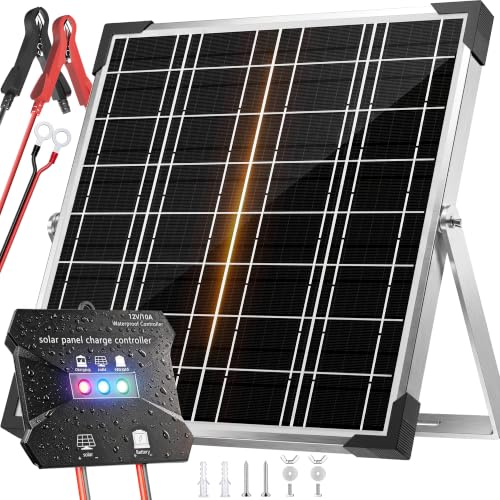 Voltset VS-20WBest overall maintainer
 SOLPERK SOLPERKMost efficient cells
 SUNER POWER BC-20W-ProBest 3-stage maintainer
Start with your goal: maintain or charge
Solar panels for 12V batteries fall into two jobs. A maintainer offsets the slow drain of a battery that sits unused, like the one in a stored car, boat, motorcycle or gate opener. A charging kit replaces energy you take out every day, such as in an RV, a camper or a cabin.
Our best solar battery charger page draws the same line. Small 10W to 30W panels act as maintainers for slow drain, while 100W and larger kits can recharge batteries for off-grid use. Pick your job first, then work out the size.
Quick size guide by use
This table gives a starting point. It is general guidance for typical 12V setups, and the worked example below shows how to fine-tune it for your own battery.
| Your situation | Typical panel size | Why |
|---|---|---|
| Car, truck or motorcycle parked for weeks | 10W to 20W | Only needs to cover slow self-discharge and small standby loads |
| Boat, trailer or tractor stored outdoors | 20W to 30W | Slightly more output helps in cloudy weather and covers alarms or bilge pumps |
| Gate opener or small gadget with a daily load | 30W to 100W | Depends on how much energy the load uses each day |
| RV or camper battery used daily | 100W to 200W | Has to refill what you use overnight, not just hold a charge |
| Off-grid cabin or larger battery bank | 200W and up | Larger banks and loads need more panels and a bigger controller |
The simple formula for sizing a panel
If you want a number instead of a range, three steps get you there. You only need your battery size in amp-hours (Ah) and a rough idea of how much of it you use.
A 12V battery stores about 12 watt-hours for every amp-hour. A 100Ah battery holds roughly 1,200 watt-hours (Wh). Lead-acid types such as AGM, gel and flooded batteries last longer if you avoid draining them below about half, so count roughly 600Wh as usable.
- Estimate the energy you use per day in watt-hours. For a maintainer, this is small. For an RV, add up each device's watts times hours of use.
- Estimate your peak sun hours. Many places get around 3 to 5 hours of strong sun per day, with less in winter. Use a lower figure if you live somewhere cloudy.
- Divide daily watt-hours by sun hours, then divide again by about 0.7 to allow for losses in wiring, heat and the controller.
A worked example
Say your RV battery is 100Ah and you use about 300Wh per day on lights, a fan and phone charging. Assume 4 peak sun hours. That is 300 divided by 4, which is 75W, and dividing by 0.7 gives about 107W. A 100W panel is close, and a bit more gives you a buffer for cloudy days.
Now take the same battery after a long weekend where you used the 600Wh of usable energy. A 100W panel at 4 sun hours and 0.7 efficiency makes about 280Wh per day, so it needs a little over two days of good sun to refill. If you want to recover in one day, you would need roughly double that.
For reference, the Renogy 100W 12V Solar Starter Kit lists an average daily output of 500Wh, with the note that it varies with sunlight. Treat that as a best-case average rather than a guarantee, since your location and season change the result.
Maintaining a car battery with a small panel
A car battery that sits for weeks loses a little charge on its own, and modern cars also draw a small standby current for the clock and computers. A 10W to 20W panel is generally enough to cover that, which is why maintainers in this size are so common.
Among the options we compare, the Voltset 20W MPPT kit and the SUNER POWER 20W Maintainer Pro are both rated at 20W with IP67 water resistance. The SOLPERK 30W kit offers more output, which helps if the panel sits in partial shade or you live somewhere with weak winter sun. The SUNER POWER 12W model is the smaller and lighter choice at 3.25 lb, although its listing does not state a water resistance rating.
If you need something to carry, take a look at our best solar battery charger for backpacking picks. Those favor low weight over output.
Choose the controller and battery type too
Panel wattage is only half the picture. The charge controller sits between the panel and battery and prevents overcharging. MPPT controllers get more energy from the panel, especially in low light. PWM controllers are simpler and cheaper. The Renogy 100W kit uses a 30A PWM controller, while the Voltset, SOLPERK and both SUNER POWER models above use MPPT.
Check that the controller supports your battery chemistry. All the products listed here are marked lithium compatible, and their listings also mention AGM, gel or flooded support, but always confirm for your exact battery before buying. Also look for protection against reverse current at night, so the panel never drains the battery.
Safety and setup tips
A 12V system carries low voltage, but a car or deep-cycle battery can deliver very high current, so a short circuit can melt wires or start a fire. Use fused wiring on larger kits and never let metal tools bridge the terminals.
Lead-acid batteries can release hydrogen while charging, so keep them in a ventilated space and away from sparks. Wear eye protection when working near battery terminals. If you mount a panel on a roof, use fall protection and avoid working in wet or windy conditions.
- Connect the battery to the controller first, then the panel, and disconnect in the reverse order.
- Point the panel toward the sun and keep it free of shade, leaves and dirt.
- Check connections for corrosion a few times a year.
- Follow the manufacturer's instructions for your specific kit.
Frequently asked questions
Can a panel that is too big damage a 12V battery?
Not if it has a proper charge controller. The controller limits current and voltage, so a larger panel simply reaches full charge sooner. Never connect a panel directly to a battery without a controller on anything above a tiny trickle unit.
Does a solar charger work through a car windshield?
It can produce some power, but glass blocks part of the light, so output drops. If you can, place the panel outside in direct sun, and use a slightly larger panel if you must use it indoors behind glass.
Will solar charging work in winter?
Yes, but with less output because days are shorter and the sun sits lower. Choosing a bit more wattage than you think you need, and an MPPT controller, helps maintain charge in low light.
Can I connect more than one panel?
On expandable kits, yes. The Renogy 100W kit lists support for up to 400W with additional panels. Always check the controller's current rating and the maker's wiring guidance first.