#1
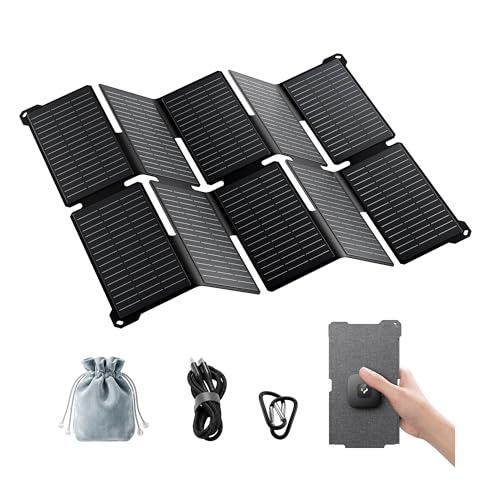
GEYOTO YP45-01-ECGEYOTO 45W Solar Panel Charger
45W with 26% efficient cells and IP68 waterproofing.
- Rated solar power
- 45 W
- Weight
- 1.65 lb
- Waterproof rating
- IP68
On a multi-day hike, a folding solar panel keeps your phone, GPS, headlamp and power bank charged without carrying spare batteries. For backpacking, weight and folded size matter as much as watts: a panel you leave at home because it is too bulky does nothing. Compare rated power, cell efficiency, USB-C output for fast charging, how many ports it has, and its waterproof rating, since weather on the trail changes fast. We put 9 backpacking solar chargers on one spec sheet so you can compare them side by side.
Quick answer
Ranked from 9 portable solar chargers that met our standard, compared on weight, rated power, waterproof rating.
As an Amazon Associate I earn from qualifying purchases. Links to retailers on this site are affiliate links; we may earn a commission at no extra cost to you.
45W with 26% efficient cells and IP68 waterproofing.

BigBlue 28W with three USB ports at 1.48 lb.

BigBlue 25W at 0.84 lb, folded to iPad size.
| Spec | |||||||||
|---|---|---|---|---|---|---|---|---|---|
| Best Scoreout of 100 | 64 | 62 | 59 | 59 | 55 | 52 | 48 | 39 | 35 |
| Rated solar powerW | 45 W | 28 W | 25 W | 35 W | 35 W | 15 W | 30 W | 30 W | 60 W (best in row) |
| Cell efficiency% | 26.0 % (best in row) | 25.4 % | 25.4 % | 25.4 % | 26.0 % (best in row) | 23.0 % | 23.5 % | 23.0 % | 24.0 % |
| Weightlb | 1.65 lb | 1.48 lb | 0.84 lb (best in row) | 1.54 lb | 1.54 lb | 1.45 lb | 1.70 lb | 1.54 lb | 3.70 lb |
| Folded lengthin | 8.4 in | 11.0 in | 6.4 in | 8.3 in | 4.8 in (best in row) | 8.3 in | 12.0 in | 8.5 in | 16.9 in |
| Folded widthin | 12.5 in | 6.0 in | 4.7 in (best in row) | 4.8 in | 8.3 in | 4.7 in | 8.3 in | 8.9 in | 9.8 in |
| Folded thicknessin | 1.3 in | 1.4 in | 1.4 in | 1.9 in | 1.6 in | 1.6 in | 1.0 in | 0.7 in (best in row) | 2.0 in |
| Max USB-C outputW | 25 W | 15 W | 15 W | 25 W | — | 20 W | — | — | 45 W (best in row) |
| Number of USB ports | 3 | 3 | 2 | 3 | 2 | 4 (best in row) | 2 | 2 | 3 |
| DC output port | — | — | — | — | — | — | — | Yes | Yes |
| Waterproof rating | IP68 (best in row) | IP44 | IP68 (best in row) | IP68 (best in row) | IP68 (best in row) | — | IP67 | IP65 | IP67 |
| Panel surface | — | Other | ETFE (best in row) | — | — | — | ETFE (best in row) | ETFE (best in row) | ETFE (best in row) |
| MPPT charge control | — | — | — | — | — | — | — | — | Yes |
| Built-in power display | — | — | — | — | — | Yes | Yes | — | — |
We reviewed 10 portable solar chargers and kept only the 9 that pass every check below. Those are ranked by a Best Score built from spec fit for this job, sales rank.
These reviews are based on each charger's published specifications and listing information, in the order of our ranking.
GEYOTO 45W, the most capable panel for the trail
The GEYOTO YP45-01-EC leads our ranking. It is a 45W folding solar charger with monocrystalline cells that GEYOTO says convert up to 26% of sunlight into usable energy, tied for the highest efficiency on this page. More watts and efficiency mean faster charging in the few strong sun hours you get between camps.
It has three ports, two USB-C and one USB-A, so you can charge a phone, a GPS and a power bank together. A 25W PD USB-C port gives fast charging to compatible phones, and its IP68 waterproof rating is the highest level listed here, which matters in sudden rain.
The trade-off is size. It weighs 1.65 lb and folds to 8.44 by 12.52 by 1.26 in, the widest folded panel in our top five, so it suits a pack with a large outer pocket or straps. For backpackers who need to keep several devices running, it is the best choice here.
VerdictThe best backpacking solar charger on this page.
BigBlue 28W, a proven trail favorite
Second in our ranking, the BigBlue B401D is a long-running 28W folding charger. BigBlue says its shadow-free surface design, with no metal lines on the front, gives about 20% more power from the same light, and it lists 25.4% cell efficiency.
It has two USB-C ports and one USB-A port, each up to 5V/3A, with a combined output of 5V/4.8A, so you can charge two or three small devices at once. Its maximum USB-C output is 15W, slower than the 25W PD ports on newer models.
It folds to 11 by 6 by 1.4 in and weighs 1.48 lb. Its IP44 rating covers splashes and light rain, but it should not get soaked. For hikers who want a light, proven panel for phones and headlamps, it remains an excellent pick. Keep the panel facing the sun and out of puddles, and charge a power bank during the day so your phone can top up at night. Strap it to the outside of your pack on open sections of trail.
VerdictA dependable classic for the trail.
BigBlue 25W, the lightest panel here
The BigBlue 25W ranks third and is the lightest charger on this page at 0.84 lb. It folds to about the size of an iPad, 4.65 by 6.42 by 1.38 in, which makes it the easiest panel here to carry on a long trail.
It uses N-type solar cells with no metal lines on the front to capture more sunlight, at 25.4% efficiency, and a durable ETFE coating with UV-resistant EVA. Its IP68 rating matches the leader, so rain is not a worry.
It has two ports, a USB-A at 5V/2.4A and a USB-C at 5V/3A, enough to charge a phone and a headlamp together, though not quickly. For ultralight backpackers who mainly top up a phone and power bank, it is the best choice. Lay it flat at lunch breaks or strap it high on your pack so it catches the sun. Charging a small power bank by day and the phone at night works best with a panel this size, and it is small enough to bring on every trip.
VerdictThe best ultralight panel here.
BigBlue 35W with a shade-tolerant design
Fourth in our ranking, the BigBlue 35W adds faster charging. Its USB-C port delivers 25W PD with PPS for faster, cooler charging of phones, and its USB-A port supports QC 18W, with three ports in total.
Its dual-string parallel circuit design means one section keeps charging even if the other is shaded by a branch or your pack, which is a real advantage on forest trails. It lists 25.4% cell efficiency and an IP68 waterproof rating.
It folds to 8.29 by 4.84 by 1.89 in and weighs 1.54 lb. For hikers who walk under trees and want fast phone charging, it is a strong pick. Point the panel at the sun during breaks and strap it to your pack between them. Charging a power bank first, then the phone from it, keeps devices charged even when clouds pass over. The shade-tolerant circuits help most on forest trails where the light is broken and patchy.
VerdictThe best panel here for patchy shade.
GEYOTO 35W, compact with high-efficiency cells
The GEYOTO YP35-01-EC completes our top five. It is a 35W charger with the same 26% efficient monocrystalline cells as the 45W leader, tied for the highest on this page, in a smaller package.
It has one USB-C port and one USB-A port with up to 35W combined output, so two devices can charge at once. At 1.54 lb and folded to 4.76 by 8.29 by 1.57 in, it fits easily in a backpack, travel bag or emergency kit.
It is IP68 rated for wet weather. With two ports it charges fewer devices than the three-port models. For backpackers who want efficient cells in a compact folded size, it is a good option. Use the USB-C port for the phone and the USB-A port for a headlamp or power bank. Strap it high on your pack so it is not shaded by your body, and lay it out flat at breaks. A small power bank lets you store energy for cloudy days and night-time charging.
VerdictA compact, efficient choice.
Best among the reviewed tools
Panels here weigh from 0.84 to 3.7 lb. Ultralight hikers should favor smaller panels; groups may want more watts.
More watts and higher cell efficiency charge faster in limited sun. Efficiency here runs from 23% to 26%.
USB-C power delivery charges phones faster. Three ports let you charge several devices at once.
IP68 panels handle rain best. IP44 resists splashes only.
Yes, in good sun. Many hikers charge a power bank during the day and the phone from it at night.
20W to 30W suits a phone and headlamp. More devices or cloudy regions need 35W or more.
Output drops sharply under clouds. Efficient cells and shade-tolerant designs help, but plan for less power.
Strap it to the outside of your pack facing the sun, or lay it out at breaks for the best charge.
Your own selection is kept in the link, so friends see the same side-by-side.