#1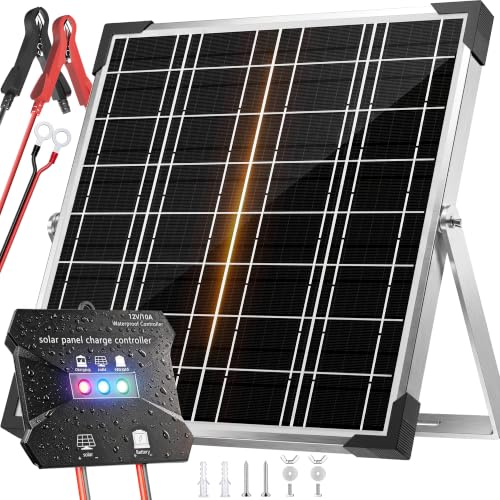
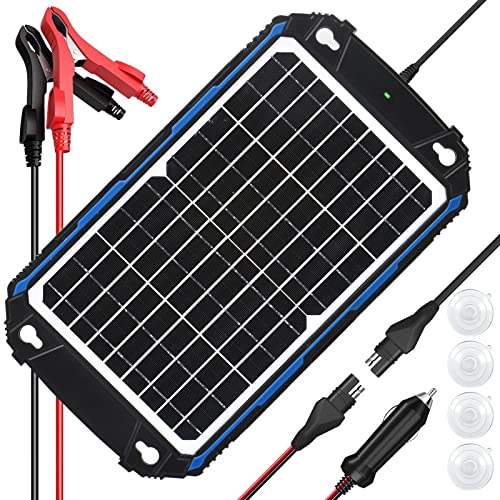
Voltset VS-20WVoltset 20W 12V MPPT Solar Battery Charger
20W MPPT kit with IP67 waterproofing.
- Rated power
- 20 W
- Controller type
- MPPT
- Warranty
- —
A solar battery charger keeps a 12V battery topped up without a power outlet, which is ideal for a stored car, boat, RV, tractor or gate opener that sits for weeks. Small 10W to 30W panels act as maintainers that make up for slow drain, while 100W and larger kits can actually recharge batteries for off-grid use. The charge controller matters: MPPT controllers get more energy from the panel than basic PWM controllers. We put 16 solar battery chargers on one spec sheet so you can compare them side by side.
Quick answer
Ranked from 16 solar battery chargers that met our standard, compared on rated power, controller type (PWM vs MPPT), and system voltage (12V/24V) for 12V batteries and power banks.
As an Amazon Associate I earn from qualifying purchases. Links to retailers on this site are affiliate links; we may earn a commission at no extra cost to you.
20W MPPT kit with IP67 waterproofing.

30W panel with 30% cell efficiency and a 360° bracket.

20W MPPT with bulk, absorption and float charging.
| Spec | ||||||||||
|---|---|---|---|---|---|---|---|---|---|---|
| Best Scoreout of 100 | 65 | 63 | 57 | 55 | 54 | 53 | 48 | 36 | 36 | 32 |
| Rated powerW | 20 W | 30 W | 20 W | 100 W | 12 W | 30 W | 200 W (best in row) | 9 W | 20 W | 10 W |
| System voltage | 12V | 12V | 12V | 12V | 12V | 12V | 12V | 12V | 12V | 12V |
| Controller type | MPPT (best in row) | MPPT (best in row) | MPPT (best in row) | PWM | MPPT (best in row) | MPPT (best in row) | — | — | PWM | MPPT (best in row) |
| Controller currentA | — | — | — | 30 A (best in row) | — | — | 30 A (best in row) | — | 10 A | — |
| Cell efficiency% | — | 30.0 % (best in row) | — | 22.5 % | — | — | 25.0 % | — | — | — |
| Typical daily outputWh | — | — | — | 500 Wh | — | — | 800 Wh (best in row) | — | — | — |
| Weightlb | 4.0 lb | 4.5 lb | 5.2 lb | 14.1 lb | 3.3 lb | 4.0 lb | 11.5 lb | 2.0 lb | — | 1.4 lb (best in row) |
| Panel footprintsq in | — | — | 278 sq in | — | 155 sq in | 289 sq in | 821 sq in | 126 sq in (best in row) | 214 sq in | — |
| Waterproof rating | IP67 (best in row) | — | IP67 (best in row) | — | None stated | None stated | None stated | None stated | IP65 | IP67 (best in row) |
| Lithium battery compatible | Yes | Yes | Yes | Yes | Yes | Yes | Yes | Yes | Yes | Yes |
| Display or app monitoring | Yes (best in row) | Yes (best in row) | — | Yes (best in row) | — | Yes (best in row) | Yes (best in row) | Yes (best in row) | Yes (best in row) | No |
| Expandable with more panels | — | — | — | Yes | — | — | — | — | — | — |
| Warrantyyears | — | — | — | 10 years (best in row) | — | — | — | 1 year | — | 1 year |
We reviewed 41 solar battery chargers and kept only the 16 that pass every check below. Those are ranked by a Best Score built from spec fit for this job, warranty, sales rank.
These reviews are based on each charger's published specifications and listing information, in the order of our ranking.
Voltset 20W MPPT kit, a weatherproof maintainer
The Voltset VS-20W leads our ranking. It is a 20W solar panel with an MPPT charge controller for 12V batteries. Voltset says the MPPT tracking delivers 20 to 30% faster charging than basic controllers, and the A+ monocrystalline panel helps convert more sunlight into power.
It works with LiFePO4, AGM, gel, flooded and lithium ion batteries, which covers cars, boats, RVs, trailers and farm equipment. Multi-layer protection guards against overcharging, over-discharging, short circuits and reverse polarity, and the controller stops the battery draining back into the panel at night.
Its IP67 waterproof, marine-grade build is rated from -40 to 185 °F, so it can stay outdoors year round. Monitoring is included and it weighs 4 lb. At 20W it is a maintainer, not a fast recharger for a dead battery. For keeping parked vehicles ready to start, it is the best choice here. Face the panel south in the Northern Hemisphere for the best charge.
VerdictThe best solar battery charger on this page.
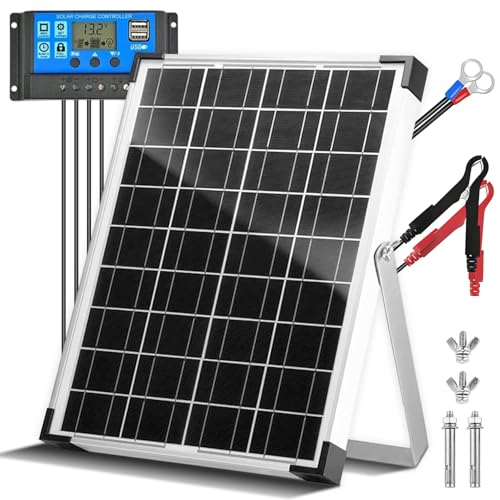
SOLPERK 30W kit with high-efficiency cells
Second in our ranking, the SOLPERK kit pairs a 30W panel with an MPPT controller. Its A+ monocrystalline cells list 30% cell efficiency, tied for the highest on this page, and the extra 10W over the leader helps in cloudy weather or shorter winter days.
A 360° adjustable bracket lets you angle the panel for the best sun, and it mounts easily on a fence, roof or trailer. The panel has low-iron tempered glass and a corrosion-resistant aluminum frame, and SOLPERK says it is waterproof and rustproof.
The controller protects against overcharging, over-discharging, short circuits and reverse polarity, and it supports lithium batteries. Monitoring is included and it weighs 4.5 lb. For owners who want a bit more power than a 20W maintainer, it is an excellent pick. Angle the panel toward the midday sun and adjust it with the seasons, since a few degrees can make a real difference in winter. Keep the glass clean so dust and leaves do not cut its output.
VerdictThe most efficient panel in our top five.
SUNER POWER 20W Pro with 3-stage charging
The SUNER POWER BC-20W-Pro ranks third. It is a 20W panel with SUNER POWER's own UltraSmart MPPT controller, designed in-house, and an improved 3-stage charging process of bulk, absorption and float.
That smarter charging helps batteries last longer, and it stops charging when the battery is full and resumes automatically when it drops, so it can be left connected all season. Eight protections cover overcharge, over-discharge, over-voltage, over-current, overload, short circuit and reverse polarity.
It is IP67 rated, supports lithium batteries and weighs 5.15 lb, with a panel area of 277.7 sq in. It is a little heavier than the Voltset. For boat and RV owners who leave batteries on a maintainer for months, it is a sound choice. Mount it where it gets several hours of direct sun each day, away from tree shade, and tilt it toward the midday sun. Check the connections each season so corrosion does not interrupt charging, and keep the glass clean of dust and bird droppings.
VerdictA smart, set-and-forget maintainer.
Renogy 100W starter kit for off-grid use
Fourth in our ranking, the Renogy KIT-STARTER-100D is a different class of product. It is a 100W panel with a 30A PWM controller, which Renogy says can generate an average of 500Wh per day depending on sunlight, enough to run lights and small devices from a battery bank in a camper or cabin.
Its panel lists 22.5% cell efficiency and is certified to UL 61730 and IEC standards, rated for 2400Pa wind and 5400Pa snow loads with an IP65 junction box. The Wanderer PWM controller can add Bluetooth monitoring with an optional module.
Renogy lists 10 years of coverage for panel material and workmanship, the longest on this page, and the kit is expandable. At 14.1 lb it is not portable, and it uses PWM rather than MPPT. For RV and off-grid starters, it is the best foundation here. Pair it with a deep-cycle battery sized for your daily use.
VerdictThe best off-grid starter kit here.
SUNER POWER 12W Pro, a small MPPT maintainer
The SUNER POWER BC-50W-P completes our top five. Despite the model name, it is a 12W panel, the smallest in our top five, with the same Ultra-Smart MPPT controller and 3-stage charging as the 20W Pro.
It stops charging when the battery is full and resumes when it drops, and lists eight safety protections including over-charge, over-discharge, short circuit and reverse polarity. It supports lithium batteries.
At 3.25 lb and 155.1 sq in, it is easy to mount on a boat rail, motorcycle cover or gate. Our data does not list a waterproof rating. For small batteries or very low drain, it is a compact, smart maintainer. Use it on batteries with a light drain, such as a motorcycle, lawn tractor or small boat, and give it as much direct sun as possible. Keep the panel clean and check the clips each season. If the battery still runs down, step up to the 20W or 30W models above.
VerdictA compact smart maintainer.
Best among the reviewed tools
10W to 30W panels maintain parked batteries. 100W and larger kits can recharge batteries for off-grid use.
MPPT controllers get more energy from the panel, especially in low light. PWM is simpler and cheaper.
Check the controller supports your battery: AGM, gel, flooded or lithium. Many here support all of them.
Look for a waterproof rating and an adjustable bracket so the panel faces the sun year round.
A small 10W to 30W panel is too slow for a dead battery. Use a plug-in charger first, then solar to maintain it.
A 10W to 20W panel usually offsets normal drain on a parked car. Larger drains need more.
Yes, except for very tiny trickle panels. A controller prevents overcharging and stops reverse drain at night.
It helps get more charge in cloudy or short winter days, which matters for small panels.
Your own selection is kept in the link, so friends see the same side-by-side.