What Bits Does a Die Grinder Use and What Are They For?
A die grinder uses small rotary bits held in a collet. The most common are tungsten carbide burrs (also called rotary files), which cut and shape metal. Other bit types include mounted abrasive points, sanding drums, flap wheels and wire brushes for grinding, smoothing and cleaning. Most bits have a 1/4 in shank, so check your collet size first.
 BLENCEE Burr14-10Best overall
 Sworker 5TC635Best long-reach set
 Sworker CBS-5Best mixed head sizes
The short list of die grinder bits
Die grinder bits are often called burrs, rotary files, mounted points or simply grinder bits. The name depends on the material. A burr is a metal bit with cutting teeth. A mounted point is an abrasive stone or wheel fixed to a metal stem.
Every one of them mounts the same way: a straight shank slides into the collet and gets tightened. That is why a single die grinder can handle cutting, grinding, sanding and cleaning just by swapping the bit.
- Tungsten carbide burrs: cut and shape metal, remove weld spatter, deburr edges.
- Mounted abrasive points: grind and sharpen with a stone-like head.
- Sanding drums and rolls: smooth surfaces and blend edges.
- Flap wheels and flap brushes: blend and finish with a softer touch.
- Wire brushes: remove rust, paint and scale.
- Cut-off wheels: make small cuts in thin material.
- Polishing bits: bring up a finish after sanding.
Carbide burrs: the main bit for metal
If you only buy one kind of bit, this is usually it. Carbide burrs are made from tungsten carbide, a very hard material that cuts steel, cast iron and aluminum. They are used for deburring, weld cleanup, porting, chamfering and enlarging holes.
For metal, a double cut pattern is the usual choice. The crossed teeth make small chips and leave a smoother finish. Single cut burrs remove material faster, but they throw longer chips and leave a rougher surface.
If you want to see how specific sets stack up, our best die grinder bits for metal page compares carbide burr sets side by side on shank size, piece count, cut type and more.
Head shapes and what each one does
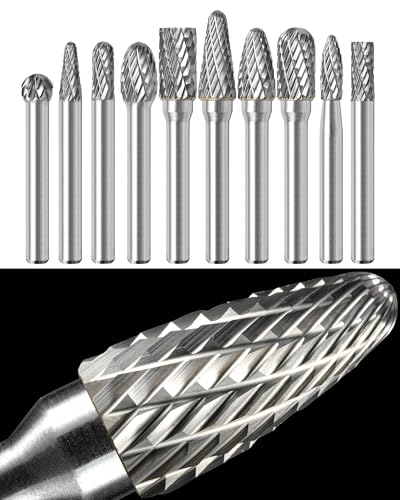
The shape of the burr head decides where it can reach and what it can do. Sets usually mix several shapes so one kit covers most jobs. For example, the BLENCEE 10-piece set on our comparison page includes 10 head shapes in cylindrical, ball and tree styles.
Here is a quick guide to the common shapes.
| Shape | Good for |
|---|---|
| Cylinder | Flattening surfaces, squaring edges, cleaning up welds |
| Ball | Hollowing out curves and cutting concave surfaces |
| Tree | Reaching into corners and shaping tight contours |
| Flame | Detail work in pointed or narrow areas |
| Cone | Chamfering holes and angled edges |
Other bit types and when to choose them
Carbide burrs remove material, but they are not always the right tool. Mounted abrasive points grind more like a small stone wheel. They suit sharpening and general grinding, and they come in many head shapes too.
Sanding drums and flap wheels are better when you want to smooth a surface rather than carve it. Wire brushes strip rust and old paint without cutting into the metal underneath. Cut-off wheels handle small cuts, but they are thin and brittle, so use them with extra care.
Match the bit to the goal. Shaping and stock removal call for a burr. Smoothing calls for a sanding drum or flap wheel. Cleaning calls for a brush.
Match the shank to your collet
Shank size is the first thing to check. Most die grinders take 1/4 in (6.35 mm) shanks, and all the carbide sets on our metal bits page use that size. Some listings note that their bits do not fit 6 mm collets, so a metric collet is a real compatibility issue.
Smaller rotary tools like a Dremel often take 1/8 in shanks instead. One set on our page, a 20-burr kit, is built for those tools. A 1/8 in shank will not grip properly in a 1/4 in collet, and the reverse does not fit at all.
Length matters too. Standard burrs suit general work. Long-reach burrs help with porting and getting into deep openings. The Sworker 5-piece long set on our page is 158 mm overall with head diameters up to 10 mm.
Using bits safely and getting good results
A die grinder spins fast, so safe habits matter as much as the bit you choose. Wear safety glasses or a face shield, because chips and fragments can fly off. Wear hearing protection, since grinding metal is loud, and gloves that will not catch on the tool. A dust mask helps when you are grinding metal or rust.
Follow these steps each time:
- Check that the bit's rated speed is at least as high as your grinder's free speed. One 14-piece kit on our page is rated to 45000 rpm, and you should look for a similar rating on any bit you buy.
- Insert the shank well into the collet and tighten it with the right wrench.
- Clamp the workpiece so it cannot move.
- Start the tool away from the work, then touch the bit to the surface with light pressure.
- Keep long burrs in contact with the work when starting and stopping, to avoid bending the shank.
- Let the tool stop completely before you set it down.
Choosing a grinder to go with your bits
Bits only work as well as the tool driving them. Air die grinders run off a compressor and are light and compact. Electric models plug in and need no compressor. Our best air die grinder page covers pneumatic options, and our best die grinder page compares the wider field.
Whichever you pick, check the collet size before you buy bits. It is the one spec that decides whether a set will fit at all.
Frequently asked questions
What is a die grinder bit called?
Most people call it a burr, a rotary burr or a rotary file when it is made of carbide. Abrasive versions are called mounted points. Some sellers simply label them die grinder bits.
Can I use a die grinder bit in a drill?
It is not a good idea. A drill usually turns much slower than a die grinder, so carbide burrs cut poorly. Hand drills also lack the support these bits expect, which can make them harder to control.
Can carbide burrs be used on wood or plastic?
Some listings say their burrs work on plastic and wood as well as metal. The cut can be aggressive, so use light pressure and practice on scrap first.
Why is my burr bending or chattering?
Common causes include too much pressure, a shank not fully seated in the collet, or starting and stopping a long burr away from the work. Ease off, reseat the bit and keep the burr in contact when starting and stopping.