Why Does My Band Saw Not Work or Make Noise? A Troubleshooting Guide
Most band saw problems come from a short list of causes: no power reaching the motor, a dull or badly installed blade, wrong tension or tracking, and blade guides or bearings set too tight or worn. Unplug the saw, then check the blade first, because it causes the most trouble and is the easiest part to fix. If the blade is sound and the saw still misbehaves, move on to guides, bearings, wheels and the drive belt.
 Jet 714400KBest overall
 QD-KYOHO QBS-14"Widest throat capacity
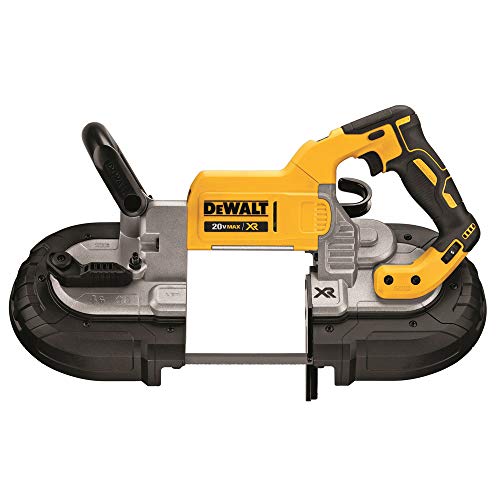 DEWALT DCS374BBest portable cordless
Start with safety before you open anything
Unplug the saw before you touch the blade, guides, wheels or belt. For a cordless saw, remove the battery. A band saw blade is a long loop of sharp steel under tension, and a switch bumped by accident can start the motor while your hand is near the blade.
Wear safety glasses whenever you test the saw, and use hearing protection for longer runs. A blade can break without warning, so keep your face out of the line of the upper wheel when you power it up after repairs. Close and latch the wheel covers before every test run.
If the saw will not start or stops mid-cut
A saw that is completely dead is usually a power problem, not a mechanical one. Work from the wall inward, and stop as soon as you find the fault.
Corded saws also have overload protection or a thermal cutout in many designs. If the motor stops during a heavy cut and restarts after a rest, you are likely asking too much of the blade or the motor. Slow your feed rate, switch to a sharper blade, or pick a narrower cut.
- Check that the outlet works by plugging in a lamp or another tool.
- Look at the cord and plug for damage, and reset any tripped breaker or GFCI outlet.
- Make sure the switch is fully engaged. Some saws have a paddle or safety key that must be in place.
- Check that the wheel cover or door is closed. Many saws have an interlock that blocks the motor if it is open.
- Let the motor cool for a while if it shut off under load, then try a lighter cut.
- On a cordless saw, confirm the battery is charged and seated firmly, and try a different battery if you have one.
If the motor hums but the blade does not move
A humming motor with a still blade points to the drive. On floor models with a V-belt, such as the stand-mounted Jet saws in our lineup, the belt may be loose, worn or off its pulley. Open the cover and check it with the power off. A glazed or cracked belt should be replaced.
Also check that the blade is not jammed in the cut or pinched in a tight guide. Spin the upper wheel by hand. It should turn freely. If it grinds or locks, look for a seized bearing or a blade caught on the table insert.
Capacitor-run motors, like the one described for the Jet JWBS-14SFX, can also fail to start under load if the capacitor is weak. That is a job for a qualified repair person, since capacitors can hold a charge even when the saw is unplugged.
If the saw makes noise
Where the noise comes from tells you a lot. Squealing near the guides is often a bearing guide set too close to the blade. A rhythmic click or tick usually means a damaged spot or bad weld on the blade, or a kink where it was folded. A rumble or whine from the wheels or motor points to worn bearings.
Rattling or buzzing can mean a loose cover, a loose table trunnion, or a worn belt. Vibration that grows with speed can come from a loose wheel or an unbalanced wheel. Cast wheels that are balanced from the factory run smoother, but they still need clean tires. Pitch and sawdust stuck to them can cause thumping.
| Sound | Likely cause | What to try |
|---|---|---|
| High squeal at the guides | Guides or thrust bearing too tight | Reset a gap of roughly a sheet of paper from the blade |
| Regular click or tick | Cracked or kinked blade, bad weld | Inspect the loop and replace the blade |
| Rumble or grinding from wheels | Worn wheel bearings | Spin by hand and replace rough bearings |
| Slapping or flutter | Loose belt, loose cover, low blade tension | Tighten, secure and retension |
| Loud screech while cutting | Dull blade or wrong speed for the material | Fit a sharp blade and adjust speed |
If the cuts are poor or the blade wanders
Burning, rough surfaces and curved cuts that should be straight almost always trace back to the blade. Check that the teeth point down toward the table at the front of the cut. A blade put on inside out looks fine but cuts badly. Then check for dullness, missing teeth and pitch buildup.
Match the blade to the job. Wide blades suit straight cuts and resawing, and narrow blades suit tight curves. The Jet JWBS-14SFX, for example, accepts blades from 1/8 in to 3/4 in wide, so the same saw can do scrollwork and thick resawing with different blades. If you resaw often, see our picks for the best band saw blade for resawing, and for general cutting browse the best band saw blades.
Metal needs its own blades and speeds. A woodworking saw is not meant for it. The Jet JWBS-14CS listing states it is for wood only and not for metal. If you cut steel or pipe, look at the best band saw blades for metal and a saw built for the job.
Tension, tracking and guide setup
Once the blade is good, set it up in order. Tension first, then tracking, then guides. Skipping a step is how many saws end up noisy or off line.
Do these steps with the saw unplugged, and spin the wheel by hand before powering on.
Remember that a blade left under full tension for weeks can stretch and wear. Release the tension after long jobs if your saw manual recommends it.
- Set tension using the saw's scale or the method in the manual, so the blade does not flutter but is not over-stressed.
- Spin the upper wheel by hand and watch where the blade rides. It should sit centered on the tire, and the tracking knob moves it.
- Set the upper guides just above the thickest part of your workpiece, about as high as the cut allows.
- Adjust the side guides so they are close to the blade but do not squeeze it. The gullets should stay in front of the guide blocks.
- Set the thrust bearing so it only touches when you push the wood into the cut.
- Wax the table and keep it clean. Our top-ranked Jet listing suggests an occasional coat of paste wax to keep stock moving and prevent rust.
When it is time to repair or replace
If a good blade, correct setup and fresh bearings still leave the saw rough or underpowered, the saw may not suit your work. A small saw asked to resaw thick stock will struggle. Compare cut height and throat width to your projects: our lineup runs from 5 in cut height on the compact RIKON 10-3062S to 13 in on the larger 14 in saws.
Our best band saw for home workshop page lays out capacity, table size, weight and warranty side by side. If your work is mostly metal, the best band saw for metal page is the better place to start.
Frequently asked questions
Why does my band saw blade keep coming off the wheels?
Usually the tracking is off, the tension is too low, or the wheel tires are dirty or worn. Reset tension, then adjust tracking by spinning the wheel by hand until the blade stays centered.
Can I run a band saw with a dull blade?
You can, but it is not a good idea. A dull blade forces the cut, heats the blade, burns wood and strains the motor. Replace it once cuts get slow or rough.
How often should I check my band saw?
Give it a quick look before each session. Check the blade for cracks, the guides for gaps, and the table for debris. Do a closer inspection of bearings and belts now and then.
Is a little vibration normal?
A faint hum is normal. Strong shaking is not. Look for a bad blade, loose parts, a worn belt or a wheel problem, and stop using the saw until you find it.