Why Does My Aluminum Floor Jack Not Work? Causes and Fixes
Most aluminum floor jacks that stop working have a simple hydraulic problem: air trapped in the system, low or wrong oil, a release valve that is not fully closed, or worn seals. Start by closing the release valve, checking the oil level, and bleeding the air out. If the jack still leaks or will not hold a load after that, the seals are likely worn and the jack should be replaced, not patched.
 SATA 3T AluminumBest overall
 YELLOW JACKET AS83003XL.Most compact footprint
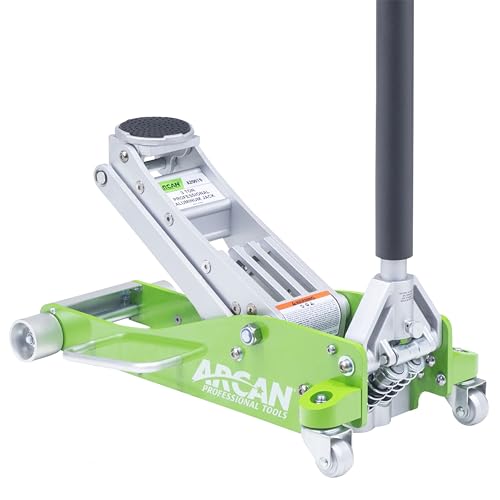 ARCAN A20019Lightest listed 3-ton
Safety first, before you touch the jack
A floor jack is a lifting tool, not a holding tool. Never get under a vehicle that is supported only by a jack. Use jack stands rated for the load, and work on flat, solid ground.
Before you open any part of the hydraulic system, lower the jack fully and take any load off it. Wear safety glasses, because hydraulic oil can spray when a plug or valve is opened. Wipe up spills right away, since oil on a garage floor is a slip hazard and the pad and wheels get slick.
Match the symptom to the likely cause
Aluminum and steel jacks share the same basic hydraulic design: a pump piston pushes oil into a lift cylinder, and a release valve lets it flow back. That means most problems fall into a few groups. The table below is a quick way to narrow things down.
| Symptom | Likely cause | First thing to try |
|---|---|---|
| Handle pumps but saddle does not rise | Air in the system or low oil | Close the release valve, then bleed and top up oil |
| Saddle rises, then slowly sinks | Worn seal or valve not seating | Check for leaks, clean the valve area, replace if it persists |
| Handle feels spongy | Trapped air | Bleed the system |
| Handle is stiff or will not move | Overload valve active or load too heavy | Lower the load and check the rating |
| Oil on the body or floor | Failed seal or overfilled reservoir | Find the source, check the fill level |
| Jack is hot to the touch | Heavy repeated pumping or friction | Rest it and check oil and load |
Why the jack pumps but does not lift
This is the most common complaint. The usual cause is air in the hydraulic circuit. Air compresses, oil does not, so air makes the pump feel soft and the saddle barely moves. It often gets in when a jack is stored on its side, tipped over, or carried with the handle in the wrong position.
The second cause is low oil. If the reservoir is short, the pump pulls in air instead of fluid. The third is a release valve that is not fully closed. Turn the handle clockwise until it is snug, not forced, then pump again.
Finally, check whether the load is too heavy. Many aluminum jacks include an overload valve that stops lifting once the limit is reached. Among the jacks on our best aluminum floor jack page, five of seven are rated 3 ton, one is 2 ton, and one is 1.5 ton. If you are raising a heavy truck with a lower-rated jack, the valve may be doing its job.
Why an aluminum floor jack leaks
Leaks almost always come from a worn or damaged seal, or from overfilling. Seals harden with age and can be scored by dirt in the oil. Rough handling, such as dropping the jack or letting it slam down, can also damage them.
Look for where the oil is coming from before you decide what to do. A wet reservoir cap or fill plug points to overfilling or a loose plug. Oil around the ram, which is the shiny rod that extends, points to a worn ram seal. Oil leaking near the pump or release valve points to those seals.
A loose plug is an easy fix. A leaking ram or pump seal usually means a rebuild or replacement. Because the jack holds a load, a jack that leaks and sinks is not safe to rely on.
Why the jack gets hot
Some warmth is normal. Pushing oil through small passages under pressure creates heat, and repeated pumping adds more. A jack that is too warm to touch for long is a sign to stop and look for the cause.
Common reasons include a load near or above the rating, low or old oil that does not flow well, or a stiff pump from dirt and dried grease. Overload valves are designed to limit the load. The SATA jack on our page, for example, lists an integrated overload protection valve and a slow-release lowering system.
If the jack feels hot, lower the load onto stands, let the jack cool, and check the oil level and condition. Dark, gritty, or milky oil should be replaced.
How to bleed and refill the jack
Always check your manual first, since oil type and fill location vary. In general, use hydraulic jack oil made for this purpose. Do not use brake fluid or motor oil, because they can damage seals.
Here is a typical process for a floor jack that pumps without lifting:
- Lower the jack all the way and open the release valve by turning the handle counterclockwise.
- Pump the handle 10 to 15 times with the valve open to move trapped air toward the reservoir.
- Set the jack upright on level ground and locate the fill plug on the reservoir.
- Remove the plug and check the oil level. It should sit near the bottom of the fill hole, or as your manual states.
- Top up with jack oil if low, then refit the plug.
- Close the release valve, pump the handle several times, and watch the saddle rise.
- Repeat the bleed steps if the handle still feels spongy.
Repair or replace?
Bleeding, topping up, and cleaning are reasonable DIY jobs. Rebuilding seals is harder, and for an inexpensive jack the parts and time may not be worth it. If the jack sinks under load, leaks from the ram, or the frame is bent or cracked, replace it.
Replacing is also a good moment to rethink the fit. A jack should have a capacity that exceeds what you plan to raise, a minimum height that clears your car, and a weight you can handle. On our best aluminum floor jack page the minimum saddle height runs from 3 in to 3.75 in, and the listed weights run from 32.8 lb to 58 lb.
If you are not set on aluminum, our [[best-floor-jack]] page compares more types. For sports cars and other low vehicles, see the best low profile floor jack page.
Storage habits that prevent problems
Many hydraulic problems start with how the jack is stored. Store it upright with the ram fully lowered and the release valve closed, which protects the polished ram from rust and dirt. Keep it dry, and wipe the ram before lowering it.
Do not leave a jack loaded for long periods, and never use it past its rating. Check it for leaks and bent parts every so often, especially after a drop.
Frequently asked questions
Can I use motor oil or brake fluid in my jack?
No. Use hydraulic jack oil. Other fluids can swell or damage the seals and lead to leaks or a jack that will not hold.
Why does my jack lift fine without a load but not with a car on it?
This often points to worn seals or low oil. It can also mean the load is above the jack's rating and the overload valve is limiting the lift.
Is it safe to keep using a jack that slowly sinks?
No. A jack that loses height under load can drop the vehicle. Stop using it, support the vehicle on jack stands, and repair or replace the jack.
How often should I check the oil?
Check it whenever the jack feels weak or spongy, and look for leaks before each use. Replace oil that looks dark, gritty, or milky.