What Temperature Can Welding Gloves Withstand?
Most welding gloves list a maximum heat resistance between about 662°F and 1000°F. Among the gloves we compare, 932°F is the most common rating, and the highest listed is 1000°F. These are maker claims for the glove, not a promise that your hand stays comfortable at that temperature for as long as you like.
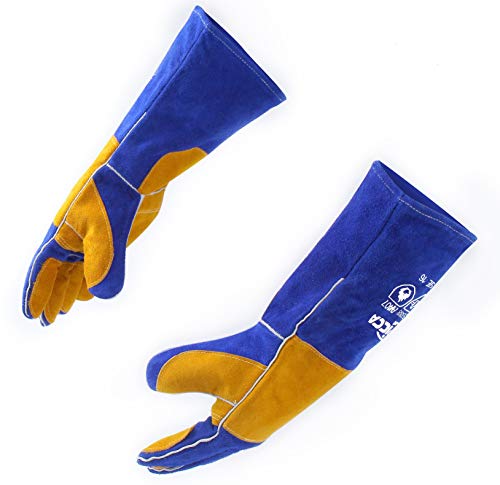 RAPICCA 7169a460-6cc9-4f72-b127-964f3fc0117aBest overall
 TICONN Ticonn-1702Highest listed heat rating
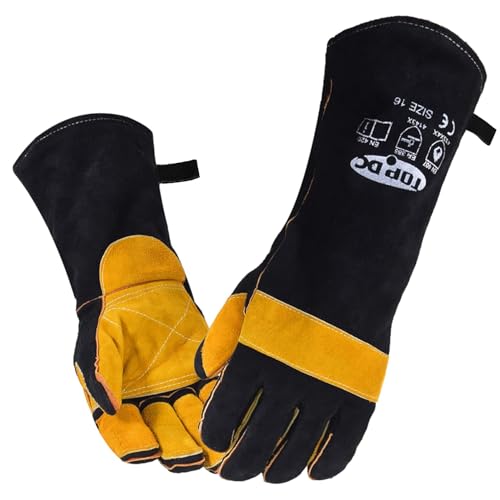 TOPDC TD-GL16Most pairs included
The short version: ratings run from 662°F to 1000°F
Heat ratings on welding gloves are given by the manufacturer, usually as a single maximum temperature. On our comparison, the listed values run from 662°F at the low end to 1000°F at the high end. Most of the long-cuff gloves sit at 932°F, which is the same as 500°C.
The test method behind each number is not given in the listings. That means a rating is best used to sort gloves into rough groups, not to calculate exactly how long you can hold a hot part. If you want to see the ratings next to leather type, cuff length and weight, our best welding gloves page puts them on one sheet.
Heat ratings on the gloves we compare
Here are the ratings from the published specifications. Where a model does not list a rating, we leave it out rather than guess.
The ratings are close together for most of the long gauntlets. What differs more is leather thickness, weight and cuff length, which affect how the glove feels and how much of your arm it covers.
| Glove | Listed heat rating | Leather | Thickness | Weight |
|---|---|---|---|---|
| TICONN 16 in | 1000°F | Cowhide | 2.4 mm | 1.19 lb |
| RAPICCA 16 in | 932°F | Fireproof leather | Not listed | 1.06 lb |
| TOPDC 16 in | 932°F | Natural cowhide | 1.2 mm | 0.5 lb per pair, 2 pairs included |
| WZQH 16 in | 932°F | Cowhide split leather | 1.2 mm | 1 lb |
| Shorter 14 in glove | 662°F | Not covered here | Not covered here | Not covered here |
Why a rating is not the whole story
A temperature number tells you the glove is built to survive that heat, but it does not tell you how long your hand is protected. Heat moves through a glove over time. A quick touch of a warm workpiece and a long hold on a hot one are very different jobs, even if both stay under the rating.
Several things change how a glove performs in real use:
- Contact time: brief contact is far easier on a glove than holding something hot.
- Thickness: thicker leather slows heat down more than thin leather.
- Insulation: extra layers and a full lining add a buffer between the hot surface and your skin.
- Moisture: damp or sweaty gloves can let heat through faster, and steam can burn.
- Wear: thin spots, cracked leather and worn seams lower the real protection.
What is inside a glove that handles high heat
The gloves in our comparison mostly use a layered build. A leather outer shell takes the spatter and abrasion. Several listings describe an aluminum foil layer in the middle that adds insulation, and a cotton lining on the inside for comfort and some extra heat buffer.
Leather type matters too. Cowhide is the common choice for stick and MIG work because it stands up to spatter and heat. Goatskin is softer and gives better fingertip feel, which is why TIG gloves like the Caiman use it on the palm. TIG work usually creates less radiant heat and spatter, so a thinner glove makes sense there.
Seams are a weak point in any welding glove. Kevlar stitching is listed on five of the six models in our comparison, and it helps seams resist heat better than ordinary thread.
Match the rating to the work you do
More rating is not always better. A thick 2.4 mm cowhide glove rated to 1000°F gives a lot of cover, but it is also the heaviest glove we compare at 1.19 lb, and it will feel stiffer for detailed work. A lighter glove tires your hands less over a long day.
As a rough guide:
- Stick and flux-core: choose thick leather, a long cuff and a high rating. The 16 in gloves with 7.5 in sleeves suit this work.
- MIG: a long-cuff cowhide glove in the 932°F range balances cover and grip.
- TIG: pick thin, close-fitting goatskin so you can feel the filler rod. The Caiman is 0.4 lb with a 4 in cuff.
- Light hot work and grilling: a shorter glove with a lower rating, such as the 14 in model at 662°F, can be enough.
Safety notes
A glove rating covers the glove, not your whole body or the whole job. Keep these points in mind every time you weld or handle hot metal:
- Do not hold hot metal for long periods, even when the glove is rated well above the metal temperature. Use tongs or clamps.
- Never wear damp, oily or greasy gloves near an arc or open flame. Oil can burn, and moisture can turn to steam.
- Always wear a proper welding helmet with the right shade lens. Gloves do nothing for your eyes.
- Wear hearing protection when grinding, and safety glasses under your helmet.
- Check for holes, burned spots and loose stitching before each session, and replace gloves that are worn through.
- Keep your sleeves and collar covered. Spatter often lands on the wrist and forearm, so a long cuff matters.
How to make gloves last longer
Leather that gets very hot can shrink, harden and crack. Let gloves cool before you put them away, and keep them dry. Do not leave them on a hot workpiece or a stove.
If a glove has gone stiff, charred at the fingertips or lost its lining, it is no longer giving the protection the rating suggests. Treat the heat rating as the number for a new glove in good shape. When you are ready to shop, compare cuff length, leather and stitching on our best welding gloves page so you pick a glove for your process, not just the biggest number.
Frequently asked questions
Are welding gloves fireproof?
Not completely. The listings call the leather fire and heat resistant, but leather can still char and wear down with repeated exposure. Think of them as heat resistant, not a shield you can leave in a fire.
Can I use welding gloves for a fireplace or grill?
Many listings say yes, and some name fireplace, wood stove, campfire and grill tasks. A long cuff helps keep coals and flames off your forearm. Keep contact short and use tools for hot items.
Is a 1000°F glove safer than a 932°F glove?
Not automatically. The gap between the two numbers is small, and the test method is not given. Thickness, lining, stitching and fit often matter more for how long a glove protects you.
Do TIG gloves handle less heat?
Often they are made thinner for feel, so they trade some cover for control. The Caiman TIG model in our comparison does not list a heat rating, so check the maker details before using it for hot work.