What Size Wrecking Bar Do You Need for Demolition Work?
For most demolition work, a 24 in forged wrecking bar is the best starting size. It gives solid leverage on stuck boards and still fits between studs and joists. Go down to 15 to 18 in for tight spaces and lighter tear-out, and up to 30 in or more when you need extra leverage on framing and subfloors.
 Titan 11509Lightest in the lineup
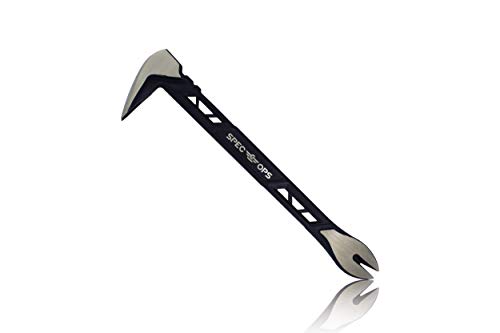 Spec Ops SPEC-D10CLAWCat's paw nail puller
 Estwing EWB-24Balanced forged demo bar
The short version: match the bar to the job
Wrecking bar size comes down to a trade-off. A longer bar gives you more leverage, so stubborn boards and framing move with less effort. A shorter bar is easier to swing around in tight spots and tires you less.
Weight matters as much as length. A heavier forged bar adds force when you pry, but it also wears you out faster over a long day. Our best demolition bar comparison lists length in inches and weight in pounds for every bar, so you can see that trade-off directly instead of guessing from a product photo.
A size guide by task
The table below gives general rules of thumb for matching length to the work. Treat the ranges as starting points, not hard limits. Your access, the fasteners and how much material you are removing all change the answer.
| Bar length | Best for | Trade-off |
|---|---|---|
| Under 12 in | Trim, baseboards, tight gaps, small nails | Little leverage, not for framing |
| 15 to 18 in | Subfloor, siding, window trim, light tear-out | Easy to control, limited reach |
| 24 in | General demolition, stuck boards, nailed framing | Good balance of leverage and size |
| 30 in and up | Heavy framing, decking, stubborn assemblies | Awkward in tight spaces, heavier to carry |
What the published specs show at each size
Looking at the bars on our comparison page makes the size ranges concrete. At the small end, the Titan 11509 is 9.25 in long and 0.1 lb, and the Spec Ops 10 in cat's paw weighs 0.7 lb. These suit nails and trim, not prying apart framing.
In the middle, the Steelhead 15 in flat bar is listed at 1.55 lb and the Spec Ops 15 in flat bar at 1.68 lb. The Estwing Pro-Claw is 16 in and 2 lb. The Estwing PB-18 is 18 in and 1.5 lb, and the Olympia 18 in wrecking bar is 2 lb. These are easy to handle and work well for subfloor, trim and light tear-out.
At the long end of the ranked bars, two Estwing gooseneck models are 24 in. The EWB-24 is 3.6 lb and the EWB-24PS is 4.8 lb. Both are forged in one piece, which is what you want for tear-out. The Olympia listing says its bar also comes in 24, 30, 36 and 48 in versions, so you can go longer if the job calls for it. We only have specs for the 18 in version, so check the listing for weight at the longer sizes.
Choosing by project
Think about what you will be prying and how much room you have. These are common cases:
- Removing trim, baseboards or shingles: 10 to 16 in is plenty, and a thin blade end helps.
- Pulling nails from boards: an 18 in bar with a slotted claw or nail slot is easy to control.
- Tearing out subfloor or sheathing: 18 to 24 in gives enough leverage without too much bulk.
- Taking apart nailed framing: 24 in or longer, forged in one piece, with a gooseneck for extra lift.
- Working between studs or in crawl spaces: favor the shorter end of your range, since a long bar can bind.
Beyond length: features that matter more than you think
A forged one-piece bar has no weld or joint that can snap under load. For demolition, check that the listing says forged and one piece. Flat bars and sets often do not list this, which is fine for trim but a weaker choice for heavy prying.
A gooseneck shape lifts the work higher as you pull, and a chisel end gets under stuck material. A slotted hook or claw handles nails. These features add jobs but do not add strength.
Also look for a strike cap if you plan to hit the bar with a hammer. None of the ranked bars on our demolition bar list mention one, so avoid hammering hard on the end unless the maker says it is designed for it.
Safety before you pry
Demolition throws debris and splinters, so wear safety glasses or goggles and sturdy gloves. A bar can slip or a board can snap loose suddenly, so keep your face and body out of the line of the bar's travel.
Before you pull out anything, check for hidden wiring, plumbing and gas lines behind walls and under floors. Shut off power to the area first. If you are working above ground level, use a stable ladder or platform and brace your footing before you apply force.
If you hammer on a bar, wear hearing protection and keep other people clear, because steel on steel can send chips flying.
Which size should you buy?
If you want one bar for a mix of jobs, 24 in is the safest all-around pick. It is long enough for real leverage and short enough to use in most rooms. If your work is mostly trim, flooring and nails, an 18 in bar is easier on your arms.
If you do heavy framing or deck removal, add a longer bar later instead of forcing a short one to do the job. Many people end up with two sizes, one compact and one long. You can compare lengths, weights and features side by side on our best demolition bar page before you decide.
Frequently asked questions
Is a longer wrecking bar always better?
No. Extra length gives more leverage, but it is harder to position, can bind in tight spaces and adds weight to carry. Pick the shortest bar that moves the work comfortably.
Do I need a gooseneck wrecking bar?
Not for every job. The curved neck helps lift boards and framing as you pull. For trim and nail pulling, a flat bar or cat's paw is easier to control.
Can I use a wrecking bar for fine trim work?
You can, but a smaller flat bar does less damage. A heavy bar can crush trim and dent walls, so save the large bar for material you plan to discard.
How do I keep a bar from slipping?
Seat the chisel end or claw firmly, pry with steady pressure and keep your hands clear of pinch points. Wear gloves and sturdy shoes, and stand so a slip will not throw you into the work.