What Size Sewage Ejector Pump Do You Need? A Practical Sizing Guide
Most homes need an ejector pump with a 2 in discharge, 2 in solids handling and enough lift to cover the vertical rise to the sewer line, with some margin. Horsepower matters less than the pump's lift and flow at your actual height. For a typical basement bathroom, a 3/4 HP to 1.5 HP unit on a dedicated circuit is the usual range, but check your local code first.
 FOTING FT-Q1300215-BLUEBest overall
 LANCHEZ Q800167-1Best 1 HP ejector
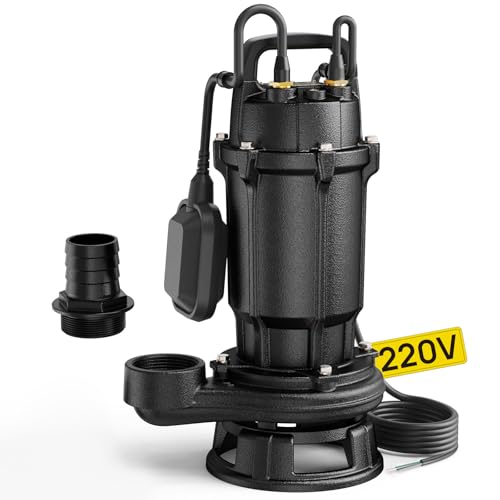 AQUASTRONG SEP100CABest 220V grinder
The four numbers that set the size
Sizing a sewage ejector pump comes down to four things: how high it must lift, how much flow it needs at that height, what solids it must pass, and what power you have available. Horsepower is a result of those choices, not a starting point.
Two pumps with the same horsepower can behave very differently. One may be built for high flow at low lift, while another is built to push waste higher. That is why the spec sheet matters more than the label on the box.
If you are still choosing a model, our best sewage ejector pump comparison puts lift, flow, solids handling and power side by side.
- Lift (head): the vertical distance the pump must raise waste.
- Flow: gallons per hour at that lift, not the maximum at zero lift.
- Solids and pipe size: usually 2 in solids and a 2 in discharge.
- Power: 110V, 115V or 220V, and the circuit you have.
Step 1: Measure the lift you need
Measure straight up from the bottom of the basin, where the pump sits, to the point where the discharge pipe joins the sewer line or building drain. Horizontal pipe and fittings add friction, so your real working head is a bit higher than the vertical measurement alone.
Pick a pump whose lift comfortably exceeds that number. A pump running at its very limit moves much less waste and wears faster. A margin of several feet is a sensible habit.
The pumps on our comparison page range from 18 to 42 ft of lift. For example, the FOTING 1.5HP lists 29 ft, the LANCHEZ 1HP lists 27 ft, and the Schupethauer grinder lists 42 ft. A typical basement is often well within the range of any of these, but a long horizontal run or a tall rise to a high sewer line may call for more.
Step 2: Check flow at your lift
Flow ratings are usually quoted at zero lift, and they fall as the pump works against more height. The LANCHEZ listing shows this clearly: it lists 6,600 GPH at 0 ft and 5,644 GPH at 5 ft.
For a bathroom, a bathroom group and a laundry, most residential ejectors have far more capacity than the fixtures produce. What you want is flow high enough to keep waste moving in the discharge pipe so solids do not settle and clog. A commonly cited target is about 2 feet per second of velocity in the pipe.
If a pump's published flow at your lift is not listed, ask the maker or look for the pump curve. Do not assume the headline number applies at your height.
Step 3: Match solids handling and pipe size
Sewage ejectors should pass solids of at least 2 in in diameter, and many codes require it. That is why most residential ejectors, including the FOTING, Schupethauer and Acquaer models in our data, pair 2 in solids handling with a 2 in discharge.
Do not shrink the discharge pipe below the pump outlet. A smaller pipe invites clogs and strains the motor. Some larger pumps use a 3 in or 4 in discharge to move more volume, but a 2 in pipe is the common size for a home.
A grinder pump is the exception. It chops waste with blades, so it can push it higher or farther, and it suits systems where wipes get flushed. Our data lists the Aquastrong and Schupethauer grinders at 40 ft and 42 ft of lift, with a 2 in discharge on both. Follow the maker's pipe guidance and local code for any grinder install.
Step 4: Choose horsepower and voltage
Horsepower follows from lift and flow. Lower lifts and a single bathroom can work with a 3/4 HP or 1 HP pump. Higher lifts, longer runs or more fixtures point toward 1.5 HP or a grinder.
Voltage is the other limit. Many ejectors run on 110V or 115V, but some grinders need 220V, which means a different circuit. Check what your panel can supply before you shop.
Here is how a few pumps from our comparison line up, using published specs:
| Pump | HP | Max flow (GPH) | Max lift (ft) | Discharge | Voltage |
|---|---|---|---|---|---|
| FOTING FT-Q1300215-BLUE | 1.5 | 9000 | 29 | 2 in | Not listed |
| LANCHEZ Q800167-1 | 1 | 6600 | 27 | 2 in | Not listed |
| Acquaer SSEC075T | 0.75 | 6400 | 29 | 2 in | 115V |
| Aquastrong SEP100CA (grinder) | 1 | 4200 | 40 | 2 in | 220V |
| Schupethauer SC-GP-02 (grinder) | 1.5 | 6600 | 42 | 2 in | 110V |
Basin, check valve and safe installation
The pump sits in a sealed, vented basin. Size the basin so the pump does not start and stop too often, and follow your local code for the basin size and the vent. Many areas also require a check valve and a shut-off valve on the discharge line, and many require a licensed plumber.
Float switches also need room to move. A tethered float that can snag on the basin wall or the pipe can leave the pump stuck on or off. Set the float length so the pump runs through a full cycle and the water level drops below the switch.
Safety notes matter here, because you are mixing electricity, water and sewer gas:
- Unplug the pump or switch off its breaker before reaching into the basin.
- Never lift a pump by its power cord. Use the handle.
- Sewer gas is hazardous. Keep the basin sealed and vented to the outside, and do not enter it.
- Use a grounded outlet on the circuit the maker specifies, and have an electrician handle any new circuit.
- Wear gloves and eye protection when servicing, and wash up afterward.
A quick way to decide
Start with the measured rise, then add a few feet for friction and margin. Pick a pump that lifts well above that number and still lists healthy flow at that height. Confirm 2 in solids handling, a 2 in discharge, and a voltage your panel can deliver.
If you are comparing models, the sewage ejector pump comparison lists solids handling, lift, housing and warranty together so you can narrow the choice quickly.
Frequently asked questions
Can I use a sump pump instead of a sewage ejector?
No. Sump pumps and most effluent pumps pass only small solids and are not meant for toilet waste. Use a pump rated for sewage with at least 2 in solids handling.
Is a bigger pump always better?
No. An oversized pump can short cycle in a small basin, which wears it out. Match the lift and flow to your job rather than buying the highest horsepower.
When do I need a grinder pump instead?
Consider a grinder when you have a high lift, a long run, or a household that flushes wipes. Grinders chop waste so it can move farther through the pipe.
Does the discharge pipe size need to match the pump outlet?
Yes, as a rule. Keep the pipe at least as large as the outlet, which is 2 in on the pumps in our data, and follow local code.
Do I need a plumber?
Many areas require a licensed plumber for sewage ejector installs, along with a sealed and vented basin. Check with your local building department before you start.