What Is a Low Profile Floor Jack and What Is It For?
A low profile floor jack is a hydraulic jack with a very short saddle height, so it can slide under cars that sit close to the ground and still lift them high enough to work. It is used for tire changes, brake work, oil changes and other jobs on sports cars, lowered cars and any vehicle where a regular jack will not fit. The key numbers are minimum saddle height, maximum lift height and rated capacity.
 SATA 3T AluminumBest overall
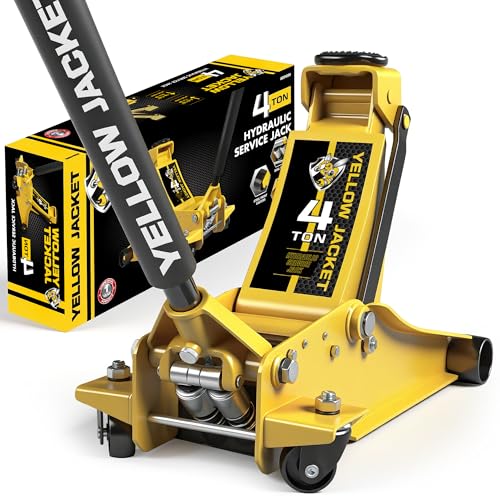 YELLOW JACKET AS840094-ton capacity
 VEVOR Aluminum and Steel Racing JackThree safety standards listed
What a low profile floor jack is
A floor jack is a wheeled hydraulic lifting tool. You roll it under a vehicle, set the saddle (the round pad that touches the car) on a lift point, and pump a long handle to raise the car. A low profile floor jack is the same tool with a frame and lift arm built to start much lower to the ground.
The phrase "low profile" describes the jack's starting height, not the car's. When someone asks what a low profile jack means, they are asking about the gap the jack needs to slide under the vehicle. The smaller that gap, the lower the profile.
A low profile hydraulic jack works like any other hydraulic jack. Pumping the handle pushes fluid into a cylinder, and the pressure pushes a ram up. A release valve lets the fluid return slowly so the car comes down in a controlled way. The difference is in the frame shape and the lift arm, which are designed to sit flat.
How low is low profile?
There is no single official cutoff. The number to look for is the minimum saddle height, which is the lowest the saddle sits before you start pumping. On our best low profile floor jack page, the lowest listed minimum is 2.75 in, and the ranked examples we show start between 2.75 in and 4.3125 in.
A low starting point is only half the job. A jack that slides under but cannot lift high enough is not much use. The same ranked examples reach a maximum lift of roughly 18.3 in to 24 in, which gives room to remove a wheel or place a jack stand.
If your car has a front lip, side skirts or a lowered suspension, measure the clearance at your lift point first. Then choose a jack with a minimum saddle height below that number.
What a low profile floor jack is used for
Most people buy one for a simple reason: the factory jack or a standard shop jack will not fit under their car. Once it does fit, the jobs are the same as with any floor jack.
Common uses include:
- Changing or rotating tires and wheels
- Brake pad and rotor work
- Oil changes, when the car needs to be raised at the front or rear
- Suspension and exhaust work that needs the wheels off the ground
- Track-day and garage prep on sports cars and lowered cars
- Roadside or paddock use, especially with lighter aluminum models
Low profile vs. standard floor jack
A standard floor jack usually trades a taller starting height for a longer reach. A low profile jack trades some of that simplicity for the ability to get under low cars. Many low profile models add a long lift arm or a dual-piston pump to make up the height, so you are not pumping the handle forever.
If you drive a regular sedan or SUV with plenty of clearance, a standard jack may be enough. Our best floor jack page covers the wider field. If your car sits low, start with the low profile list and check clearance first.
Weight is another difference worth knowing about. Aluminum frames are lighter and easier to carry, while steel frames are common and sturdy. If portability matters, see our best aluminum floor jack comparison.
Specs to compare
These examples come from the published specs on our low profile page. They show how much the numbers can vary from one jack to the next.
Notice that the 2-ton Sunex has the lowest start and the tallest lift, while the 4-ton Yellow Jacket starts higher. Higher capacity often comes with a taller minimum, so match the rating to your vehicle without going further than you need.
| Jack | Capacity | Min saddle height | Max lift height | Frame |
|---|---|---|---|---|
| Sunex 6602LP | 2 tons | 2.75 in | 24 in | Steel |
| AV Steel AV-300102F | 3 tons | 3.125 in | 19.875 in | Steel |
| VEVOR Racing Jack | 3 tons | 3.54 in | 19.69 in | Steel and aluminum |
| SATA 3T Aluminum | 3 tons | 3.75 in | 19.125 in | Aluminum |
| Jack Boss AS830011L | 3 tons | 3.9375 in | 18.3125 in | Steel and aluminum |
| Yellow Jacket AS84009 | 4 tons | 4.3125 in | 19.875 in | Steel |
How to choose and use one safely
Work through these steps before you buy:
- Measure the clearance under your lift point and pick a jack with a lower minimum saddle height.
- Check that the maximum lift height gives you enough room for the job you plan to do.
- Look up your vehicle's curb weight and choose a rated capacity above the portion of the car you will lift.
- Look for a dual-piston pump, an overload valve and a rubber saddle pad, which protects pinch welds.
- Check the listed safety standard, such as ASME PASE.
Safety notes
A jack is for lifting, not for holding. Never get under a car that is supported only by a jack. Set jack stands under the frame or the manufacturer's support points, then lower the car onto them before you work.
Use the jack on a hard, level surface, chock the wheels that stay on the ground, and put the transmission in park or in gear with the parking brake set. Use the lift points shown in your owner's manual. Wear safety glasses when working under a car, since dirt and fluid can fall.
Stay within the rated capacity. Overload valves are a backup, not a limit to test.
Frequently asked questions
Can I use a low profile jack on a regular car?
Yes. It works on any vehicle within its rated capacity. Just check that its maximum lift height is enough for the job.
Is a low profile jack safe to leave under a car?
No. It lifts the car, but jack stands should hold it while you work. Never rely on the jack alone.
Does a higher tonnage mean a lower profile?
No. In our listed examples, the 4-ton model starts higher than several 3-ton models, so check the minimum saddle height on its own.
What does the rubber saddle pad do?
It sits between the jack and the car's lift point and helps protect pinch welds and other contact areas from scratches and dents.