What Is a 4-in-1 Jump Starter with Air Compressor?
A 4-in-1 jump starter with air compressor is a portable battery pack that can jump-start a car, inflate tires, charge your devices over USB and light up a work area. Everything runs from one internal rechargeable battery, so you can use it without a wall outlet or another vehicle. It suits roadside emergencies and light tire top-ups, not heavy shop work.
 birvsw DM1264
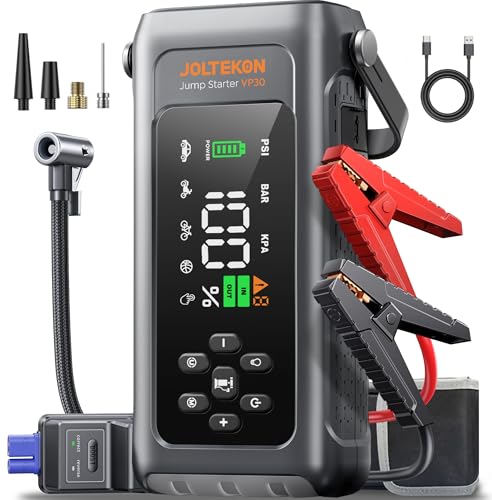 Joltekon VP30
 ODUKAKO DM1264
The four functions in one case
The "4-in-1" label is a marketing shorthand rather than a formal standard, so the exact four features can vary by brand. In most cases, they are the ones below.
Each function draws from the same internal battery. Heavy use of one feature leaves less energy for the others, which is worth remembering when you plan for an emergency.
- Jump starter: heavy clamps deliver a short burst of power to a car battery that is too weak to start the engine.
- Air compressor: a small pump and a hose inflate tires, sports balls and similar items.
- Power bank: USB ports charge phones and other small devices.
- LED flashlight: a built-in light helps with night breakdowns, and some models add a flashing or SOS mode.
How it works
Inside the case is a lithium battery pack, a small electric air pump and control electronics. For jump starting, the pack sends a high current through the clamps for a few seconds. That current helps your starter motor turn the engine over when the car's own battery cannot.
For inflation, the same pack powers a small pump. These pumps are built for short runs, so they move air slowly compared with a garage compressor. They also have no storage tank. Air goes straight from the pump to the tire.
Most units include a pressure gauge or digital display, and many let you set a target pressure so the pump stops on its own. That feature is handy, but you should still confirm the final pressure with a separate tire gauge.
Is it the same as a compressor that connects to a car battery?
Not quite. People often search for a portable air compressor that connects to a car battery, and that describes a different product. A classic 12-volt compressor has alligator clips that attach to your car's battery terminals, or a plug for the 12-volt outlet, and it uses the vehicle's power. A 4-in-1 unit carries its own battery.
The difference matters in the exact situation where you need help. If your car battery is dead, a compressor that depends on it will not run. A self-powered unit still works. On the other hand, a battery-clamp compressor does not run down its own pack, so it can run as long as the engine is on.
Quick comparison of the three common setups
The table below shows how the main options differ in practice. It uses general characteristics rather than product-specific figures.
| Setup | Power source | Works with a dead car battery | Best for |
|---|---|---|---|
| 4-in-1 jump starter with compressor | Internal rechargeable battery | Yes | Emergency kit, mixed jobs |
| 12V compressor with battery clamps or outlet plug | Vehicle battery or outlet | No | Regular tire top-ups on the road |
| Plug-in garage compressor | Wall outlet | Not applicable | Tools, larger tires, regular use |
How to use one safely
Read your product manual first, since clamp procedures and port locations differ. Wear safety glasses when working near a car battery, because batteries can vent gas or spark. A compressor can also be loud in an enclosed space, so consider hearing protection for longer inflation jobs.
A general sequence for jump starting looks like this.
- Turn off the car, the lights and accessories, and make sure the jump starter is switched off.
- Connect the red clamp to the positive (+) battery terminal.
- Connect the black clamp to the negative (-) terminal or to a clean, unpainted metal ground point away from the battery, as your manual directs.
- Switch the jump starter on, then start the car. Do not crank for longer than the manual allows.
- Once the engine runs, switch the unit off and remove the clamps in reverse order, black first.
- Keep the clamps from touching each other, and never use a damaged or swollen unit.
What to check when comparing models
Specifications vary a lot between models, so compare the published numbers rather than the front-of-box claims. Our best portable air compressor and jump starter comparison lines up these specs side by side.
Pay attention to the points below, because they decide whether a unit fits your vehicle and your habits.
Engine size is the first factor. Large gas or diesel engines need more starting power than small four-cylinder cars, so match the rated capability to your engine type. Next, look at the maximum tire pressure and the stated inflation speed, since a unit that tops up a car tire may struggle with a large truck tire.
Also look at the battery protection features, such as reverse polarity protection, which guards against hooking up the clamps the wrong way. Finally, check how well the hose and clamps are stored, and whether the unit works in cold weather as the maker states.
Storage and upkeep
Lithium packs lose charge slowly while sitting, so a unit left in a trunk can be empty when you need it. Recharge it on a regular schedule, and follow the maker's guidance on storage temperature. Extreme heat and cold are hard on lithium batteries.
Keep the clamps and hose coiled and dry. Check the unit before long trips, and replace it if the case shows cracks, swelling or damage.
When you need something bigger
A 4-in-1 unit is a convenience tool. If you inflate tires often, run air tools or work on vehicles, a tank-style compressor is a better fit. See our guide to the best air compressor for home garage use for models that handle more demanding jobs.
If you already own a compressor, the right connector can matter as much as the machine itself. Our best air compressor fittings page explains the options so your hoses and tools connect cleanly and without leaks.
Frequently asked questions
Can a 4-in-1 unit start a completely dead battery?
Often yes, since it supplies its own power. Some models need a minimum voltage to detect the battery, so check whether yours has a manual boost or override mode.
Can I use the compressor to fill a large truck tire?
It may be possible, but small pumps are slow and can overheat. Check the maximum pressure and duty cycle in the specifications, and let the pump rest if the manual says so.
Is it safe to leave one in a hot car?
Extreme heat can shorten lithium battery life and may be unsafe. Check the operating and storage temperature range in your manual, and avoid leaving it in direct summer sun.
Do I need to charge it before first use?
Usually yes. Units often ship partly charged, so charge it fully using the included cable and store it in a spot you can reach quickly.