#1
birvsw DM1264birvsw DM1264 Semi Truck Jump Starter
- Peak current
- 30000 A
- Battery energy
- —
- Weight
- —
A jump starter that also inflates tires has to do two jobs well. Start with peak current and the engine sizes the maker rates it for. Then check maximum tire pressure and airflow, because airflow sets how fast a flat tire fills. Weight and case size decide whether it stays in your trunk. Protections, light output and warranty round out the choice. We put 34 products on one spec sheet so you can compare these numbers directly and see which gaps the makers leave unpublished.
Quick answer
Ranked from 34 jump starters that met our standard, compared on peak current (A), max tire pressure (PSI), and air flow (L/min).
As an Amazon Associate I earn from qualifying purchases. Links to retailers on this site are affiliate links; we may earn a commission at no extra cost to you.

At 1.43 lb it is the lightest among the models that list weight.
| Spec | ||||||||||
|---|---|---|---|---|---|---|---|---|---|---|
| Best Scoreout of 100 | 66 | 58 | 55 | 54 | 52 | 52 | 51 | 50 | 49 | 49 |
| Peak currentA | 30000 A (best in row) | 4500 A | 8000 A | 8000 A | 30000 A (best in row) | 4000 A | 6000 A | 30000 A (best in row) | 5000 A | 8000 A |
| Battery energyWh | — | — | — | — | 236.8 Wh | — | — | — | — | — |
| Max gas engine sizeL | 50.0 L | 9.0 L | 12.0 L | — | 99.0 L (best in row) | 12.0 L | — | 99.0 L (best in row) | 10.0 L | — |
| Max tire pressurePSI | — | 150 PSI | 160 PSI (best in row) | — | — | 160 PSI (best in row) | 160 PSI (best in row) | — | — | 160 PSI (best in row) |
| Air flowL/min | — | — | — | — | — | — | 360 L/min (best in row) | — | — | 45 L/min |
| Weightlb | — | 2.65 lb | 1.43 lb | 1.41 lb | 14.30 lb | — | — | 14.00 lb | 1.21 lb (best in row) | 2.56 lb |
| Output powerW | — | — | — | 18 W | — | — | — | — | — | 160 W (best in row) |
| Operating temperature°F | — | -4–140 | -4–140 | -4–140 | -40–140 | -4–140 | -4–140 | -40–140 | -4–140 | — |
| Light brightnesslm | 2000 lm (best in row) | 500 lm | 600 lm | 800 lm | 2000 lm (best in row) | 500 lm | 800 lm | 2000 lm (best in row) | — | 600 lm |
| Built-in protectionscount | 8 count | 10 count | — | 10 count | 8 count | 10 count | 10 count | 12 count (best in row) | 10 count | 12 count (best in row) |
| Digital display | Yes | Yes | Yes | — | Yes | Yes | Yes | Yes | Yes | Yes |
| Warrantyyr | 5 years (best in row) | — | — | — | — | — | 2 years | — | 2 years | — |
| USB-C charging | usb_c_and_a (best in row) | — | — | usb_c_and_a (best in row) | usb_c_and_a (best in row) | usb_c_and_a (best in row) | — | usb_c_and_a (best in row) | usb_a_only | usb_c_and_a (best in row) |
We reviewed 65 jump starters and kept only the 34 that pass every check below. Those are ranked by a Best Score built from spec fit for this job, warranty, sales rank.
These reviews are based on specifications and listing information, not hands-on use. We read each product's data and explain what the numbers mean for jump-starting and inflating car tires.
The lightest unit here, with 8000A and 12 L engine support
The NACKEO N30 weighs 1.43 lb, the lowest weight among the models that list it. If trunk space or a glove box is tight, that matters. It still lists 8000A of peak current and a 12 L maximum gas engine size, which ties for the highest rating on the page.
For tire work it lists a 160 PSI maximum, auto shut-off, several inflation modes and adjustable units in PSI, BAR and kPa. The maker does not publish airflow, so you cannot judge fill speed from the data. That is the main gap if you plan to top up large truck tires often.
Other listed specs are a 600 lm light, a digital display and an operating range of -4°F to 140°F. Built-in protections are named in the listing, but the count is not published, and neither are battery energy or warranty length. The listing advises recharging every 2 to 3 months in storage and keeping charge above 50% before a jump.
VerdictA strong pick for light carry and big engine support, with gaps in tire-fill data.
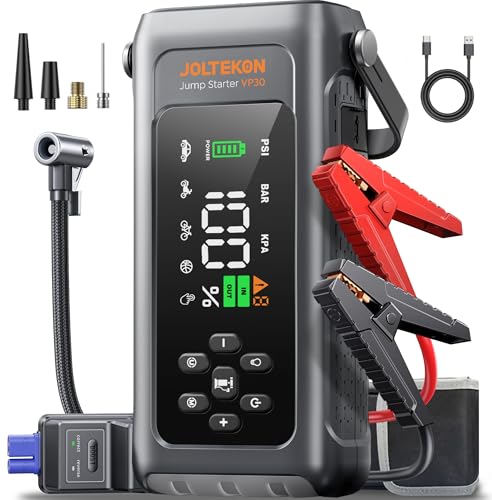
Very high airflow figure, with 6000A of starting power
The Joltekon VP40 stands out for airflow. It lists 360 L/min, the highest on the page. Read that number with care. The listing ties it to an air blower function for mattresses and kayaks, and separately describes a 160 PSI inflator for tires. The maker does not publish a tire-specific flow rate.
Starting power is 6000A, which is below the 8000A models but well within what a car or SUV needs. The listing says it handles all gas engines and 12L diesels, with normal and forced start modes. It works from -4°F to 140°F, so cold-weather starts are covered by the stated range.
Extras are generous. The light is rated at 800 lm with 4 modes, including a red strobe for warning. It has a digital display, 10 built-in protections and a 2-year warranty. Weight is not published, which makes trunk planning a guess. Check the carrying case size before you count on it fitting in a small space.
VerdictA capable all-rounder for cars and camping gear, held back only by the missing weight.
8000A, 12 protections and a 160 W output port
The ANFLAG BD60 pairs 8000A of peak current with 12 built-in protections. The listing rates it for all gasoline engines and diesels up to 14.0L. That is a higher diesel figure than most listings here, though the data does not publish a separate gas engine size. A force-start mode helps with badly drained batteries.
Tire inflation lists 160 PSI and 45 L/min. The listing says it raises a tire from 0 to 30 PSI in about 2 minutes. A 3.3 in screen shows pressure, and auto shut-off helps prevent over-inflation. It comes with a detachable hose and 4 nozzles for cars, bikes, balls and motorcycles.
Power delivery is a strength. It lists 160 W output, tied for the highest on the page, plus USB-C and USB-A ports. The listing mentions a 26,800 mAh capacity and 65 W USB-C charging. It weighs 2.56 lb and has a 600 lm light. Warranty length and operating temperature range are not published. Insulated gloves are included.
VerdictA well-rounded 8000A unit with a useful 160 W port, but with some unpublished specs.
Top-ranked unit with strong starting and inflation numbers
The NACKEO N40 lists 8000A of peak current, which ties for the highest on the page. A car rarely needs that much, so the extra headroom matters most for trucks, cold mornings and deeply drained batteries. The listing says it starts all gas engines and diesels up to 12.0L, and it adds a force-start function for batteries that read very low.
For tires, it lists a 160 PSI maximum and 45 L/min of airflow. The listing says it can raise a car tire from 0 to 36 PSI in about a minute. It also offers tire pressure detection, auto shut-off, preset modes and a detachable hose with 4 nozzles, so you can set a target and walk away.
At 2.15 lb it is light enough for a glove box or trunk pocket. It works from -4°F to 140°F, has a 600 lm light and a digital display, and carries 12 built-in protections. The warranty is 2 years. The maker does not publish battery energy in watt-hours.
VerdictIt earns the top rank by combining high starting power, 160 PSI inflation and a long protection list.
Big battery and 160 W output, but the heaviest here
The WOLFBOX MegaVolt 24Air is one of few models that list battery energy: 88.8 Wh. It also lists 160 W of output power, tied for the highest on the page. That makes it more useful as a power bank for laptops or 12V gear, on top of jump-starting and inflating.
Starting power is 4000A, rated for gas engines up to 10L and diesels up to 6L. That is plenty for sedans, SUVs and most pickups, but lower than the 8000A units. The tire pump lists 160 PSI and 45 L/min. The listing gives 40 seconds for a 195/65 R15 sedan tire from 29 to 36 PSI.
It weighs 3.42 lb, the heaviest listed, and measures 9.39 × 5.28 × 2.16 in. A storage bag is included for the trunk. It has a 400 lm light, 10 protections, USB-C and USB-A outputs and a 2-year warranty. The data does not list a digital display or a formal temperature range, though the listing says it operates down to -4°F.
VerdictBest for people who value battery capacity and output power over low weight.
Best among the reviewed tools
Peak current shows how hard the unit can push on a dead battery. Most cars need far less than 8000A, but extra headroom helps in cold weather. Always compare the maker's rated gas and diesel engine sizes, since they show what the unit is meant to start.
Max pressure of 150 or 160 PSI is more than any car tire needs. Airflow in L/min is what sets fill speed. Among the models that list it, a higher figure means less time spent inflating a low tire at the roadside.
A lighter unit is easier to store, but a larger battery gives more output for phones and 12V gear. Compare weight in pounds and, where listed, battery energy in Wh. Many makers do not publish both, so check the gaps.
Dead batteries are common in cold snaps, so check the operating range. Most units here list -4°F to 140°F. Protection counts, like reverse polarity and short circuit safeguards, matter if you are new to jump-starting.
Yes. These units combine a battery pack with a built-in pump. The listings show 150 to 160 PSI maximum pressure, which exceeds what car tires need. Check airflow too, since it affects how long inflating takes and how hot the pump gets.
Match the unit's rated engine size to your vehicle. A 4000A unit is rated for gas engines up to 10L, which covers most cars and SUVs. Higher ratings add headroom for trucks and cold weather.
Not always. The heaviest listed model weighs 3.42 lb and lists an 88.8 Wh battery and 160 W output, while the lightest weighs 1.43 lb and lists 8000A. Weight tends to reflect battery size and extras, so decide what you need first.
Most listings state an operating range of -4°F to 140°F. One lists -22°F to 140°F. Some makers do not publish a range at all. If you live somewhere very cold, choose a model with a stated low-temperature rating.
Your own selection is kept in the link, so friends see the same side-by-side.


