What Do You Use a Mini Pry Bar For?
A mini pry bar is for small, careful prying jobs: lifting trim and molding, pulling nails, scraping old caulk or paint, and nudging things apart in spaces a full-size bar cannot reach. It trades leverage for control and size, so it is a finish-work tool, not a tear-out tool. For stuck framing or heavy boards, you need a longer, heavier bar.
 Titan 11509Lightest in the lineup
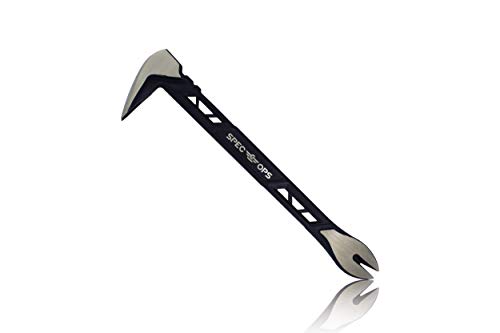 Spec Ops SPEC-D10CLAWCat's paw nail puller
 Estwing EWB-24Balanced forged demo bar
What a mini pry bar actually is
A mini pry bar is a short flat bar, usually somewhere between about 5 and 10 inches long. Most have a thin, beveled end for sliding into gaps and a second end with a curve or a notch for pulling nails. Many also have a flat edge that works as a scraper.
The idea is simple. A thin tip gets into a seam, and the bar acts as a lever to open that seam a little at a time. Because the bar is short, you get less leverage than you would from a full-size bar. That limit is also the benefit. You can feel what the material is doing, and you are less likely to crack or gouge it.
The jobs it does best
Mini bars shine on delicate work where a big bar would do damage. Here are the most common jobs:
- Removing baseboards, quarter round and other trim without splitting the wood.
- Lifting door and window casing so you can reuse it or reach what is behind it.
- Pulling small nails, tacks and staples, either with a nail slot or by prying the head up first.
- Scraping dried caulk, adhesive, paint and residue from glass, metal and other hard surfaces.
- Separating thin boards, slats or plywood that are lightly fastened.
- Popping off cover plates, access panels and tile edges when you are careful with the angle.
- Nudging parts into alignment in a workshop or garage, where you need a little push and not a lot of force.
Why small size helps
The biggest advantage is access. A thin, short bar slides behind trim, into corners and between boards where a long bar will not fit. If you only have an inch or two of working room, a mini bar can still get a grip.
Weight matters too. The Titan 11509 flat pry bar scraper in our demolition bar comparison is 9.25 inches long and weighs 0.1 lb. At that weight you can carry it in a pocket or tool pouch and use it with one hand for hours without tiring.
Small bars also lower the risk of damage. Finish work, like taking off baseboards you plan to put back, depends on gentle, controlled force. A short bar makes it harder to apply too much.
Where a mini bar falls short
A mini pry bar is not built for heavy work. Pulling a stuck 2x4, lifting subfloor or tearing out framing takes length and mass. Among the bars on our demolition page, the heavy forged options run up to 24 inches and 4.8 lb, which is a very different class of tool.
Thin steel can also bend or snap if you lean on it too hard. If you feel the bar flexing, stop and switch to something bigger. Forcing it is how tips break and hands get hurt.
Finally, most mini bars are not meant to be hit with a hammer. None of the ranked bars on that page list a strike cap, so check the product details before you tap one with a hammer. If you plan to drive a bar into a gap, a tool designed for striking is a better choice.
Mini bar sizes at a glance
The table below uses sizes from the products in our comparison data. Use it to match a size to the job. For a wider look at options, see our best pry bar comparison.
| Bar | Length | Weight | Good for |
|---|---|---|---|
| Mini bar in SHALL 4-piece set | 5.5 in | Not listed | Tight gaps, small trim |
| Nail remover in SHALL set | 7.5 in | Not listed | Nails and light lifting |
| Titan 11509 scraper bar | 9.25 in | 0.1 lb | Trim, scraping, tight spaces |
| Spec Ops cat's paw | 10 in | 0.7 lb | Pulling embedded nails |
| Spec Ops flat bar | 15 in | 1.68 lb | More leverage on boards |
How to use one safely
A small tool can still cause real injuries when it slips or snaps. Follow these steps:
- Wear safety glasses. Nails, splinters and chips of old paint can fly when something lets go.
- Wear work gloves, and keep your free hand out of the path the bar would take if it slipped.
- Turn off power at the breaker before prying near outlets, switches or walls that may hide wiring. Do not pry close to pipes or gas lines.
- Pry away from your body, and set your footing before you apply force.
- Work slowly along the seam. Lift a little in several spots instead of forcing one spot all the way.
- Slip a thin piece of wood or a putty knife under the bar to protect a surface you want to keep.
Choosing one that fits your jobs
Think about what you will do most. If it is trim and scraping, look for a thin beveled tip, a scraper edge and a body that resists rust. If it is nails, look for a nail slot or a cat's paw style with claws. Our best pry bar page lays these features side by side so you can compare length, weight and style.
Many people end up with two sizes: a mini bar for delicate work and a longer bar for stubborn jobs. A set can cover both. The SHALL 4-piece set in our data ranges from 5.5 inches to 15 inches, so one purchase spans several tasks.
Frequently asked questions
Can a mini pry bar remove nails?
Yes, if it has a nail slot or claws. Slide the slot under the nail head and rock the bar back, using a scrap of wood under it to protect the surface. Very long or deeply set nails may need a larger puller.
Is a mini pry bar the same as a flat bar?
Often, yes. Most mini bars are flat bars, meaning a thin, flat strip of steel with beveled ends. But flat bars come in larger sizes too, so a flat bar is not always mini.
Can I use a mini pry bar as a screwdriver or chisel?
No. The steel is thin and the tip is shaped for prying, not twisting or cutting. Using it that way can chip the tip or cause it to slip into your hand.
What is a mini pry bar not good for?
Heavy demolition, lifting framing and moving stuck structural parts. Those jobs need a longer, heavier bar with more leverage.