What Are the Modern Rules for Placing Cabinet Pulls?
Modern placement comes down to a few habits. Put door hardware on the side opposite the hinges, near the corner closest to the counter or floor. Center drawer pulls on the drawer front, and size them to about one third of the drawer width. Use two pulls on wide drawers, and keep every pull in the same spot from cabinet to cabinet.
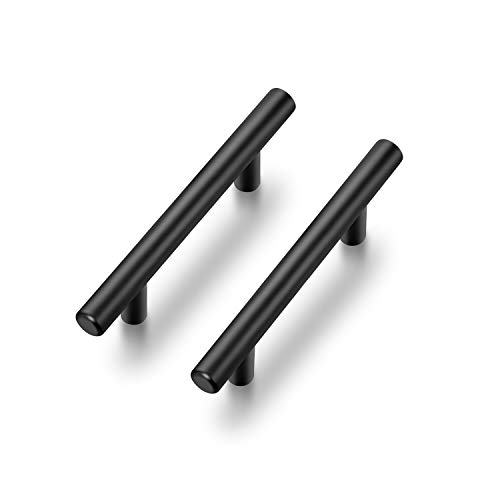 Ravinte Best overall
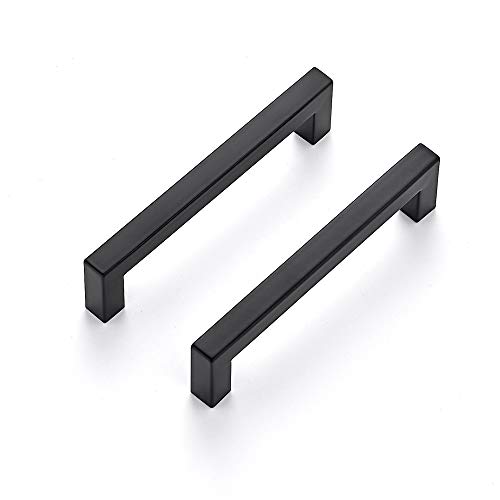 Ravinte JFX5HS30Deepest projection listed
 JOY DECOR JDKXYN1BSSingle-hole white knobs
The short version of the modern rules
Most of today's placement advice is about consistency and comfort. Your hand should land on the hardware without thinking, and the whole kitchen should look like one set of decisions.
Here are the rules most designers follow, which you can treat as a starting point rather than a law:
- Doors: place the pull or knob on the edge opposite the hinges.
- Upper doors: put hardware near the bottom corner, so you reach up and grab it naturally.
- Lower doors: put hardware near the top corner, so you do not have to bend down.
- Drawers: center the hardware side to side, and usually center it top to bottom as well.
- Wide drawers: use two pulls instead of one oversized pull.
- Repeat the same offsets everywhere, down to the fraction of an inch.
Placing pulls on doors
A door swings from its hinge side, so the handle belongs on the far edge. That gives you the most leverage and the widest opening arc.
Most kitchens set the hardware a couple of inches in from the edge and a couple of inches up or down from the corner. The exact numbers are a style choice. What matters is that you pick one pair of measurements and use it on every door of the same type.
Orientation is the other decision. Vertical pulls are the usual choice on doors, because they follow the line of the door's edge. A horizontal pull on a door can work on a slab style door, but it often looks busier. If you are choosing a style for flat doors, our best cabinet pulls page lists T-bar and square bar options side by side with their lengths and spacing.
Tall pantry and appliance-panel doors are the exception to the corner rule. Because the door is so tall, many people place the hardware at a comfortable grip height, roughly where your hand rests at your side, rather than at a corner.
Placing pulls on drawers and the 1/3 rule
Drawers are simpler. Find the center of the drawer front and mark it. Then decide whether the pull sits dead center vertically or slightly higher. Many modern kitchens with slab fronts place pulls closer to the top edge for a clean, streamlined line, while shaker style fronts often center the hardware inside the flat panel.
The 1/3 rule helps with size. It says a pull should be about one third of the drawer front's width. It is a guideline, not a requirement, but it is a quick way to avoid hardware that looks too small or too large.
Here is the math using lengths from our product data. A pull with 3 in hole spacing and a 5 in overall length, like the T-bar pulls on our comparison page, matches the 1/3 rule on a drawer about 15 in wide. A longer pull with 5 in spacing and a 6.4 in overall length suits a drawer closer to 19 in wide. Use overall length for this rule, not hole spacing.
Spacing still matters for the fit itself. Measure from the center of one screw hole to the center of the other, and match that number exactly, or you will be drilling new holes.
One pull or two on kitchen drawers?
Use one pull on narrower drawers and two on wide ones. A common cutoff is somewhere around 24 in wide, though it depends on how long your pulls are and how heavy the drawer will be when loaded with pots.
When you use two pulls, place each one roughly one quarter of the way in from each side, so they split the drawer front into even sections. This makes a wide pan drawer easier to pull straight, because you can use both hands or either hand without twisting the box.
Do not go the other way and stretch a single pull to cover a wide drawer. Pulls that are very long compared to the drawer can feel awkward, and they can crowd the edges of the front.
Knobs, pulls and mixing the two
Knobs and pulls are different parts, and a pull needs two holes while a knob needs one. If you are changing from one type to the other, plan on filling and redrilling.
A popular pairing is knobs on doors and pulls on drawers. It gives drawers a bigger grip for heavy loads and keeps doors visually light. If you do this, keep the finish identical so the two read as one set. A small round knob, such as the 1.18 in diameter white knobs in our data, is easy to line up because it has no spacing to match. Its position is a single point.
Knob placement on a door follows the same corner rule as a pull, and on a drawer it sits at the center of the front.
Comparing placement by cabinet part
Treat this table as a layout plan. Write your own measurements next to each row before you drill anything.
| Cabinet part | Where to place it | Orientation |
|---|---|---|
| Upper door | Bottom corner, opposite the hinges | Vertical pull or knob |
| Lower door | Top corner, opposite the hinges | Vertical pull or knob |
| Narrow drawer | Centered side to side | Horizontal pull or knob |
| Wide drawer | Two pulls, about 1/4 in from each side as a fraction of the width | Horizontal pulls |
| Tall pantry door | At comfortable hand height on the opening edge | Vertical pull |
How to mark and drill without mistakes
Safety notes: wear safety glasses when drilling, since chips and dust fly toward your face. Before you drill drawers or doors that sit near a sink or an appliance, make sure you will not hit a pipe or wire behind the panel. Unplug a corded drill when changing bits, and keep your fingers clear of the chuck.
Planning the quantity matters too. Pack sizes vary, and the packs on our comparison page range from 10 to 30 pieces, so count your doors and drawers (and add extras for wide drawers) before ordering.
- Choose the offsets for your doors and your drawers, and write them down.
- Make a template from stiff cardboard or buy a jig, marking the hole centers for your pull spacing.
- Tape the template to the first door, check it by eye, and then repeat it on every other door of that type.
- Drill a pilot hole from the front of the door, and place a scrap of wood behind it to prevent splintering on the back.
- Test fit one pull before you drill the rest.
- Check the screw length. Longer screws can poke through the inside of a thin door, so use the shorter size when the door is thin.
Frequently asked questions
What is the 1/3 rule for cabinet pulls?
It is a sizing guideline that says the pull's overall length should be about one third of the drawer front's width. For example, a 5 in long pull suits a drawer about 15 in wide.
Should pulls on upper and lower doors sit in the same spot?
No. Upper doors usually get hardware near the bottom corner, and lower doors get it near the top corner. Both sit on the edge opposite the hinges.
Can I run pulls horizontally on doors?
Yes, especially on flat slab doors, but vertical is the more common choice. Pick one orientation per door type and keep it the same across the kitchen.
Do I need a template if I only have a few cabinets?
A template is still worth making. It takes minutes and keeps every hole in the same position, which is what makes the finished kitchen look deliberate.