Ripping Bar vs Wrecking Bar: What Is the Difference?
A ripping bar (often called a ripping chisel) has a wide, flat chisel end made for splitting and tearing wood apart. A wrecking bar is a general demolition bar with a curved gooseneck and a slotted claw, so it pries, lifts and pulls nails. If your job is mostly pulling things apart at the joints, start with a wrecking bar. If you need to rip through boards or sheathing, a ripping bar does that part better.
 Titan 11509Lightest in the lineup
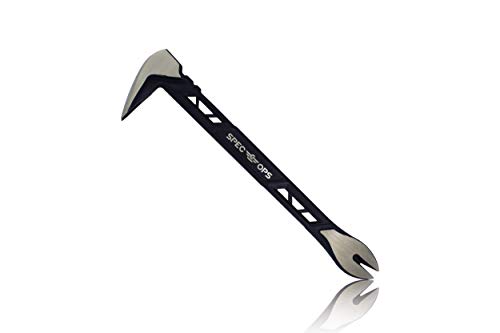 Spec Ops SPEC-D10CLAWCat's paw nail puller
 Estwing EWB-24Balanced forged demo bar
The short version of the difference
The two tools look alike at a glance. Both are long steel bars, and both are used for tear-out. The difference is in the working ends and in what each end is built to do.
A wrecking bar is the all-rounder. One end usually has a curved claw with a slot for nails. The other end is a beveled chisel tip. The bend near the claw, often called a gooseneck, gives you a fulcrum so you can lift and pull with leverage.
A ripping bar puts its effort into the chisel end. That end widens and flattens, which lets it bite into wood, push between layers and split material apart. It still pries, but its main job is ripping.
What a ripping bar is good at
Think of a ripping bar as a wedge on a handle. The wide, flat tip drives in between boards, trim or sheathing, then you lever it to open the gap. It can also be hammered in to split stubborn material, which is where a strike cap on the end would help.
Names are not always consistent. Some makers sell a ripping chisel, some a ripping bar, and a few use the terms loosely. Check the end of the tool in the listing photo rather than trusting the name alone. A wide, flat, chisel-like end points to a ripping tool.
- Splitting and tearing apart framing, subfloor and sheathing
- Getting a wide tip into a tight seam between boards
- Rough tear-out where you do not need to save the wood
What a wrecking bar is good at
A wrecking bar handles more kinds of work. The slotted claw grabs nail heads and pulls them. The gooseneck bend gives you a pivot, so a small movement at the handle creates a strong pull at the tip. The beveled chisel end gets under boards and trim.
It is also the more common tool, so you will find more models to compare. Our best demolition bar page covers several of them with length and weight listed, so you can see the trade-offs without guessing.
Side-by-side comparison
Here is how the two tools generally compare. These are typical traits, not exact specs for any one product.
Wrecking bar and crowbar are sometimes used as the same word. In general, a crowbar is a straighter, simpler bar with a curved claw at one end, while a wrecking bar adds the gooseneck and a more purpose-built claw and chisel.
| Feature | Ripping bar | Wrecking bar |
|---|---|---|
| Main job | Splitting and tearing wood apart | Prying, lifting and pulling nails |
| Working end | Wide, flat chisel tip | Beveled chisel tip plus slotted claw |
| Nail pulling | Limited | Built in, with a slotted claw |
| Leverage shape | Mostly straight pry | Gooseneck bend for a fulcrum |
| Best for | Rough tear-out through boards and sheathing | General demolition and salvage work |
| Gentle work | Poor fit | Better with a lighter, shorter model |
Real wrecking bar specs to compare
None of the ten products ranked on our demolition page is sold as a ripping bar, so we have no ripping bar numbers to quote. The wrecking bars do show how length and weight vary. All three below are forged in one piece, and none lists a strike cap.
A longer, heavier bar gives more leverage but is tiring to swing and hard to use in tight spots. The 18 in Olympia suits smaller jobs and confined areas. The 24 in Estwing bars give more reach for stuck framing.
| Bar | Length | Weight | Notes |
|---|---|---|---|
| Olympia Tools 18in Wrecking Bar | 18 in | 2 lb | Beveled chisel end and slotted claw |
| Estwing EWB-24 Gooseneck | 24 in | 3.6 lb | Slotted hook end, chisel end |
| Estwing EWB-24PS Gooseneck Pro | 24 in | 4.8 lb | Heaviest of the top five |
How to choose
Start with the work, not the name. Then check the shape of the working end and the build.
If you are stuck between the two, a wrecking bar is the safer first purchase because it covers prying and nails in one tool. Add a ripping bar later if you find yourself splitting wood often. For lighter jobs such as trim, a small flat pry bar may be a better match than either. Our best demolition bar list includes short, light options for that kind of work.
- Choose a wrecking bar for mixed tear-out, nail pulling and prying framing.
- Choose a ripping bar for splitting and tearing through wood where the material is scrap.
- Look for forged, one-piece steel so there is no weld to fail under load.
- Match length to the space. Longer gives leverage, shorter fits tight areas.
- Check for a strike cap if you plan to hit the bar with a hammer.
Safety notes
Demolition throws debris and loads tools suddenly. Wear safety glasses or goggles, since splinters and nail fragments can fly when a board lets go. Wear work gloves and sturdy boots.
If you hammer on a bar, use a hammer and a bar meant for it, and wear hearing protection for repeated strikes. Never hit a bar that is not designed for it.
Before prying into walls or floors, switch off power to that area and check for wires, pipes and gas lines. Cutting into a live line is serious. On ladders or raised surfaces, keep your footing stable, because a stuck board can release without warning and throw you off balance.
Frequently asked questions
Is a ripping chisel the same as a ripping bar?
Usually yes. Brands use both names for a tool with a wide, flat chisel end. Look at the working end to be sure.
Is a wrecking bar the same as a crowbar?
Not exactly. People often use the words interchangeably, but a wrecking bar typically adds a gooseneck bend and a slotted claw for better leverage and nail pulling.
Can I use a wrecking bar to rip boards apart?
Yes, for many jobs. Its chisel end can get under boards and pry them loose. It is just narrower than a ripping bar, so it is less efficient at splitting wide sections.
Does a heavier bar always work better?
No. Extra weight helps with stuck material, but it tires you faster and is harder to control. Pick the lightest bar that still gives you the leverage you need.