How to Use a Portable Jump Starter with an Air Compressor
Use the jump starter function first and the air compressor second, never both at once. Connect the clamps to the dead battery, power the unit on, start the engine, and disconnect. After that, switch the unit to compressor mode, attach the hose to the tire valve, and inflate to the pressure printed on the driver's door jamb label.
 birvsw DM1264
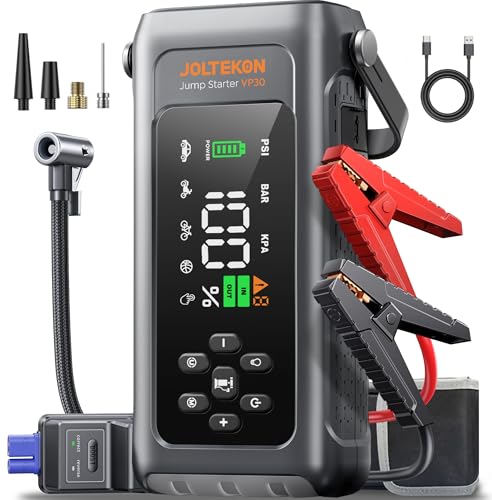 Joltekon VP30
 NACKEO N30Lightest in the lineup
What a combo unit actually does
A portable jump starter and air compressor combo packs two tools into one case. A lithium or sealed battery pack supplies high current for starting an engine, and the same pack also runs a small pump for tires.
Because both jobs draw from one battery, the unit can only do one thing at a time. That is why the order of use matters. Starting a stalled engine takes priority, since a running engine also gives you a safer place to stand while you handle the tire.
If you are still deciding which unit fits your vehicle, our best portable air compressor and jump starter comparison lays out the published specifications side by side.
Before you start: quick checks
Take a minute to read the manual for your specific unit. Button layouts, lights and modes vary by brand, and the manual tells you the correct sequence for yours. Also read your vehicle owner's manual for any notes about jump starting, since some cars have dedicated jump points under the hood.
- Make sure the jump starter has enough charge. Most units show a battery level indicator.
- Turn off the ignition, lights, radio and any accessories in the vehicle.
- Inspect the clamps, cables and hose for cracks, exposed wire or corrosion.
- Check that the unit is rated for your engine type and size. Larger engines, especially diesel, need more starting power.
- Find the battery and identify the positive (+, usually red) and negative (-, usually black) terminals.
Step by step: jump starting the car
Work in a well-ventilated area and keep sparks, flames and cigarettes away from the battery. Car batteries can release flammable gas. Remove loose jewelry, and wear safety glasses if you have them.
Follow these steps in order. Many units include reverse polarity protection, but do not rely on it as a reason to hurry.
- Make sure the jump starter is switched off before you connect anything.
- Clip the red clamp to the positive terminal of the dead battery.
- Clip the black clamp to the negative terminal, or to a bare metal part of the engine block or chassis away from the battery, if your manual allows it.
- Turn the jump starter on and wait for the ready or green indicator.
- Get in and start the engine. Do not crank for more than a few seconds at a time, and wait a minute between tries.
- Once the engine runs, switch the jump starter off and remove the black clamp first, then the red clamp.
- Let the engine run so the alternator can recharge the battery.
Step by step: inflating the tire
Once the engine is running and the clamps are off, you can switch to the compressor. Park on level ground, away from traffic, and turn on your hazard lights if you are near a road.
Check the correct tire pressure on the label inside the driver's door jamb or in the owner's manual. Do not use the number molded into the tire sidewall, because that is the maximum, not the recommended pressure.
- Unscrew the valve cap and keep it somewhere safe.
- Thread or press the compressor hose connector onto the valve stem, depending on the style.
- Set the target pressure if your unit has a preset function.
- Switch the compressor on. Expect some noise and vibration.
- Stop when the gauge reaches the recommended pressure, or check it with a separate gauge.
- Remove the hose quickly, replace the valve cap and repeat for any other tires.
Mistakes to avoid
The most common error is running the pump while the clamps are still attached to the battery. Always finish the jump start, disconnect, and only then use the compressor.
Another frequent problem is overheating. Small compressors are built for short bursts, so give the unit time to cool between tires if the manual calls for it. If the case feels very hot, stop.
Hearing protection is worth considering for longer inflation jobs, since compact pumps can be loud right next to you. Never leave a running compressor unattended, and keep the unit out of rain and standing water.
- Connecting clamps backward or letting the two clamps touch each other.
- Charging the unit too rarely. A stored pack can lose charge over time, so top it off on a regular schedule.
- Leaving the unit in a very hot or very cold car for long periods.
- Overinflating, which can be as unsafe as underinflating.
When a combo unit is not enough
A combo unit is ideal for roadside emergencies, quick top-ups and small jobs. It is not built for continuous work such as running air tools, spraying paint or filling large tires from empty again and again.
For that kind of use, a dedicated tank compressor is a better match. Our best air compressor for home garage page compares options for garage tasks, and if you plan to attach different tools, the best air compressor fittings guide helps you choose compatible connectors.
Keep your combo unit in the trunk for emergencies, and treat it as a backup rather than a workshop tool.
Simple summary
Think of the process as two separate jobs. Job one is the jump start: connect, power on, start, disconnect. Job two is the tire: attach, inflate, check, cap.
Keeping those jobs apart, and reading your unit's manual, covers most of what can go wrong.
Frequently asked questions
Can I use the compressor if my engine is off?
Yes, as long as the unit has enough charge and no clamps are connected to the battery. Running the engine is not required, though it can help if the unit is low on power.
How often should I recharge the jump starter?
Follow the schedule in your manual. As a general habit, check the charge level every few months and top it off after each use.
Why won't my engine start even with the jump starter connected?
Common causes include loose or dirty terminal connections, a unit with too little charge, or a problem other than the battery, such as the starter or fuel system. If a couple of short attempts fail, stop and call for help.
Is it safe to leave the unit plugged into the car's 12V outlet?
Check your manual. Some units can charge from the outlet, but leaving any device connected for long periods is not recommended unless the maker says it is fine.