How to Lower a Floor Jack Without Hassle
To lower a floor jack, take the weight off the jack stands, then turn the handle slowly counterclockwise to open the release valve. Open it only a little at a time so the car comes down in a steady, controlled way. If the jack won't go down, the cause is usually a closed valve, a stuck handle position or trapped air, and each one is easy to fix.
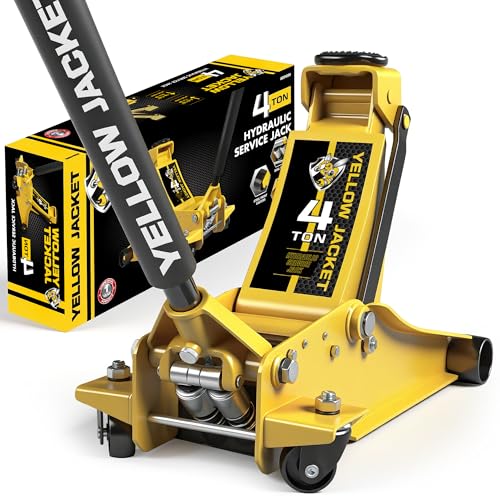 YELLOW JACKET AS84009Best overall
 BIG RED AT84007RBest heavy-duty steel
 SATA 3T AluminumBest aluminum jack
The basic way to lower a floor jack with the handle
Most hydraulic floor jacks lower the same way. The handle doubles as a wrench for the release valve, which sits at the base of the handle socket. Turning it counterclockwise lets fluid flow back into the reservoir, and the saddle sinks.
Go slowly. A quick, full turn can drop the car hard and shock the suspension and wheels. A small turn gives a gentle descent, and you can always open it a bit more.
- Clear tools, hands and feet from under and around the vehicle.
- If the car is resting on jack stands, pump the jack until it takes the weight, then remove the stands.
- Insert the handle into the socket and make sure it seats fully on the release valve.
- Turn the handle counterclockwise about a quarter turn. Do not spin it open in one move.
- Watch the car and keep your hand steady. Close the valve slightly if it drops too fast.
- Once the tire touches the ground, open the valve further until the saddle is clear, then roll the jack out.
Get the car off the jack stands first
If you used jack stands, which you should always do before going under a car, the jack may not be holding any weight. Opening the valve then does nothing, because the saddle is already below the frame. That is a common reason people think the jack is broken.
Pump the handle until the saddle lifts the car slightly off the stands. Pull the stands out, one side at a time, and set them aside. Then lower the car using the steps above.
Safety note: never rely on a floor jack alone to hold a car while you are underneath. Jacks are for lifting, and stands are for holding. Keep your body out from under the car while the jack is being lowered, and keep your hands clear of pinch points around the wheel and the stands.
How to lower a jack without the handle
If the handle is lost, bent or stuck, you can still work the valve. The release valve is a small screw-type stem, and many have a flat or hex end. A pair of adjustable pliers, a wrench that fits, or a flat screwdriver can turn it, depending on how the valve is made.
Turn it the same way, counterclockwise, and in very small steps. Without the leverage of the handle you have less feel, so stay cautious. Keep your face and hands away from the area under the saddle while the car comes down.
Do not use tools on the valve if the car is being held up only by the jack and you are underneath. Put the car on stands first, or remove yourself from the danger zone before you release it.
Some jacks have a detachable handle, such as the one on the Yellow Jacket Low Profile Floor Jack. That is handy for storage, but keep the handle with the jack so you always have the right tool for the valve.
What to do when the jack won't go down
A jack that will not lower is usually dealing with a simple issue. Work through the likely causes before you assume it needs repair. The table below lists the common ones.
| Problem | Likely cause | What to try |
|---|---|---|
| Valve turns but nothing happens | Weight is on the stands, not the jack | Pump up slightly, remove the stands, then release |
| Handle spins without effect | Handle not seated on the valve | Reseat it fully in the socket and try again |
| Saddle drops in jerks | Valve opened too far, or air in the system | Close and reopen in smaller steps; bleed the air as described below |
| Jack feels stiff | Dirty or dry pivots and wheels | Clean it and apply light oil to the moving joints |
| Saddle only sinks slowly | Low fluid or a sticky valve | Check the fluid level and condition, and clean around the valve |
Fix a jack that feels spongy or sticky
Air in the hydraulic system can make a jack lift unevenly or refuse to lower smoothly. A common fix is to open the release valve fully with no load on the jack, then pump the handle ten or so times. This pushes trapped air back toward the reservoir.
Close the valve again and test the jack with no load. If it still acts up, check the manual for the fill plug and the correct hydraulic jack oil. Do not use brake fluid or motor oil, because they can damage the seals.
A jack that leaks, sinks while holding a load or will not respond at all needs service or replacement. Do not keep using it under a car.
Pick a jack that lowers in a controlled way
Lowering control comes down to valve design and how the jack is built. Look at the listing details when you compare. For example, the SATA 3-Ton Aluminum Floor Jack lists a precision slow-release system for controlled lowering, which suits anyone who wants a gentler descent.
Weight matters too, because a heavy jack is harder to position and to roll away once the car is down. The Big Red 4 Ton Low Profile Floor Jack is 100.8 lb, while the Jack Boss 3 Ton Aluminum Low Profile Floor Jack is 58.5 lb. Our best aluminum floor jack page compares lighter options side by side.
If you work on lowered cars, minimum height counts as well. The antlevix 3-Ton Low Profile Hydraulic Floor Jack starts at 2.9 in, and our best low profile floor jack page lists others. For a broader look at capacity, pump type and safety ratings, see the best floor jack comparison.
Safe habits every time you lower a jack
A few habits make lowering routine and safe. Work on firm, level ground. Wear safety glasses, because fluid or debris can fall near the valve, and wear gloves if the jack is greasy.
Roll the jack back from the car once the tires are down, and store it with the saddle lowered. Keep the handle with it, and wipe off any oil you find on the frame, since a leak is a sign the jack needs attention.
Frequently asked questions
Which way do I turn the handle to lower a floor jack?
Counterclockwise opens the release valve and lowers the saddle. Clockwise closes it so the jack can lift again.
Why does my jack lift but never lower on its own?
A hydraulic jack holds its load until you open the valve, which is by design. If it will not go down even with the valve open, check that no stands are carrying the weight, and try bleeding the air.
Can I lower a floor jack too fast?
Yes. A fast drop can jolt the suspension and wheels and is a risk to anyone nearby. Open the valve in small steps.
Should I lower the jack all the way after use?
Yes, in most cases. Store it with the saddle lowered and the valve closed lightly, as the manual suggests.