How to Jack Up a Car With a Floor Jack
Park on hard, level ground, chock the wheels, and set the floor jack saddle under the lift point your owner's manual shows. Pump the handle until the tire clears the ground, then place jack stands under a solid support point and lower the car onto them. A floor jack is only for lifting. Never get under a car that is held up by the jack alone.
 SATA 3T AluminumBest overall
 YELLOW JACKET AS83003XL.Most compact footprint
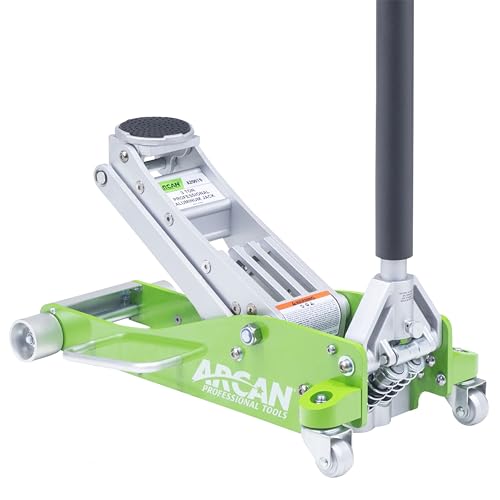 ARCAN A20019Lightest listed 3-ton
Get the setup right first
Most jacking problems start before the jack touches the car. The ground matters most. Use flat, solid concrete or asphalt. Soft dirt, gravel, grass and sloped driveways let the jack shift, and a shifting jack is how cars fall.
Read your owner's manual for the lift points and for the vehicle weight. Then make sure your jack's rated capacity is higher than the weight you plan to raise. Gather what you need before you start so you are not tempted to skip a step.
- Floor jack with a rated capacity above the load you will lift
- Two jack stands rated for your vehicle, or a pair for each end if you lift both
- Wheel chocks or sturdy wooden blocks
- Your owner's manual
- Work gloves and safety glasses
- Lug wrench if you are removing a wheel
Find the correct lift points
Cars are not built to be lifted anywhere you like. Floor pans, thin rocker panels, exhaust parts and oil pans can bend or crack under a jack. The manual shows where the reinforced points are. On many unibody cars these are pinch welds, which are the reinforced seams along the bottom edge behind the front wheels and ahead of the rear wheels. Some cars also have a central front or rear lift point on a frame member or cross member.
Trucks and body-on-frame SUVs usually have solid frame rails. Many have a solid rear axle housing, and the center of that housing is a common spot for the jack. Always confirm in the manual.
A rubber pad on the saddle protects the surface you lift. If you are using a pinch weld, a slotted pad or a grooved rubber block keeps the weld from being crushed. Skip any lift point you are unsure about and look it up first.
Raise the car step by step
Take your time with the lift. Smooth, slow pumping lets you watch the car and the jack the whole way up.
- Park on level ground, turn the engine off, set the parking brake, and put an automatic in Park or a manual in gear.
- Chock the wheels that will stay on the ground. If you are lifting the front, chock behind the rear tires on both sides.
- If you plan to remove a wheel, loosen the lug nuts about a half turn while the tire is still on the ground. Do not remove them yet.
- Roll the jack under the car and center the saddle under the lift point. The jack should sit straight, not at an angle.
- Close the release valve by turning the handle clockwise until it is snug. Pump the handle with steady strokes.
- Stop when the saddle touches the car, and check that it is still centered. Then keep lifting until the tire is just off the ground, or high enough to fit your stands.
- Watch the car and the jack as it rises. A floor jack rolls on casters, so the car may shift slightly. If anything leans, lower it and reset.
Add jack stands before you do any work
A hydraulic jack can leak down or be bumped. Jack stands are the part that holds the car while you work. Place a stand under a strong frame point or another spot the manual approves, next to the jack. Set the stand to a height that fits, with its locking pin or ratchet fully engaged, and make sure its base sits flat.
Then lower the car slowly by opening the release valve a little at a time until the weight rests on the stand. Leave the jack in place, snug under the car but not carrying the load, as a backup. Give the car a gentle push at the bumper to confirm it feels solid before you reach underneath.
If you lift one corner or one end, the car is not equally supported. Follow the same steps at each point, and use stands in pairs when lifting a whole end.
Lower the car safely
When the work is done, raise the car slightly to take the weight off the stands, then remove them. Make sure your hands, tools and any loose parts are clear of the car and the jack.
Open the release valve with slow, small turns. The car should come down gently. If the valve is opened too fast, the car may drop hard. Once the tire is on the ground, roll the jack out and finish tightening the lug nuts in a star pattern. Then remove the wheel chocks.
Pick a jack that fits your car
A jack that does not fit is a common source of trouble. Low cars need a jack with a low starting height. Our best low profile floor jack page compares models by minimum saddle height, so you can see which jacks will slide under a lower car. Among the aluminum jacks we compare, minimum saddle heights run from 3 in to 3.75 in.
If you move your jack often, weight matters too. Our best aluminum floor jack page lists jacks from 32.8 lb to 58 lb among the models that publish a weight. For a wider look at steel and aluminum options, see our best floor jack comparison.
Use this quick check before you buy.
| Check | Why it matters |
|---|---|
| Rated capacity | Should be higher than the weight you plan to lift |
| Minimum saddle height | Must be low enough to slide under your car |
| Maximum height | Must reach the lift point with room for a stand |
| Overload valve | Helps limit the load the jack can raise |
| Listed standard | Gives you something to verify, such as ASME |
A note on travel trailers
A floor jack can raise one side of a travel trailer, for example to change a tire, but the setup differs from a car. Park on firm, level ground, chock the wheels on the opposite side, and unhitch only if the manual says so. Lift under the axle or frame point your trailer maker lists, not the thin floor or a leaf spring perch.
Stabilizer jacks on a trailer are for steadying it, not for lifting. Do not use them to hold the trailer while you are under it. Place a rated jack stand and follow the trailer manual.
Frequently asked questions
Can I use a floor jack on a slope?
No. Even a slight slope can make the car roll or the jack slide. Move to a flat, hard surface first.
Do I need jack stands for a quick tire swap?
If you only need the tire off the ground to swap it and you stay clear of the underside, many people rely on the jack. Stands add a margin of safety, and you must use them for any work under the car.
Why does my floor jack not lift all the way?
Low fluid, trapped air or a partly open release valve are the usual causes. Check the valve is closed and read the jack's manual for refilling and bleeding steps.
Can I use a floor jack to raise a sagging house floor?
No. A floor jack is built for vehicles. A sagging floor in a home is a structural issue, so ask a qualified contractor.