How to Hand Plane a Board Flat
To hand plane a board flat, first find the high spots with a straightedge and winding sticks. Then plane across the width to remove the bulk, plane diagonally to refine the surface, and finish with long strokes along the grain. Check often with a straightedge and stop when the face is flat, not when it merely looks smooth.
 Jorgensen 70700Best overall
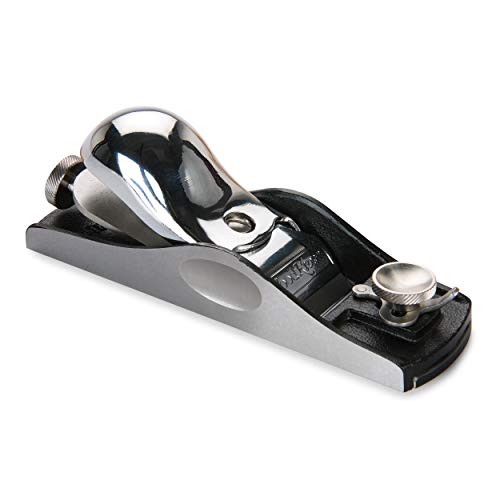
 Jorgensen PJ-70710Adjustable mouth block plane
 WOODRIVER 151125WWOODRIVER 151125W
Pick the right plane for the job
Flattening is a different task from smoothing. A flattening plane has a long sole that rides over small dips and shaves only the high spots. A short plane follows the dips in the board, so it can leave the surface wavy.
The planes on our best hand plane page run from 3.54 in to 10 in long. That makes them better suited to smoothing, trimming and light flattening than to dressing a wide, twisted board from rough. For a board that is only slightly uneven, a No. 4 bench plane can do the job if you check your work often.
| Plane from our page | Type | Length | Weight | Best use here |
|---|---|---|---|---|
| Amazon Basics DS-WPAMZ002 | No. 4 smoothing bench plane | 10 in | 3.82 lb | Final flattening and smoothing |
| Amazon Basics DS-WPAMZ001 | No. 4 adjustable bench plane | 9.8 in | 2.66 lb | Flattening and smoothing, with an adjustable mouth |
| KAKURI P-243 | Japanese kanna smoothing plane | 9.5 in | 1.46 lb | Pull-stroke flattening and smoothing |
| Jorgensen PJ-70710 | Low angle block plane | 6.25 in | 1.48 lb | Edges, end grain and small fixes |
Set up before you cut
Good flattening starts with a stable board. Clamp it against a bench stop or in a vise so it cannot slide or rock. If the board is cupped, support it so it does not flex under pressure. Wedges or thin shims under the low spots help.
Sharpen the blade before you start. A dull blade tears the grain and tempts you to push harder, which makes control worse. For a bench plane, set the blade for a fine shaving and adjust the mouth if yours has that feature. Both Amazon Basics planes on our page have adjusters, and the DS-WPAMZ002 uses a geared knob for small changes.
If you use a Japanese plane such as the KAKURI or SUIZAN, remember that it cuts on the pull stroke. The SUIZAN has no adjusting screws, so you set the blade by tapping it with a hammer. That takes patience, but it is a normal part of working with a kanna.
Find the high spots
You cannot fix what you have not found. Hold a straightedge across the board in a few places and along its length. Look for light under the edge. Rocking tells you the board is high in the middle or twisted.
Winding sticks help with twist. These are two straight sticks laid across each end of the board. Sight along them and see whether their tops line up. If they do not, the board is twisted and the high corners need to come down.
Mark the high spots with a pencil. Scribble light lines across the surface. As you plane, the pencil disappears from the high spots first, which shows you where the plane is cutting and where it is not.
Step by step: flatten one face
Work in this order. Each step removes less wood than the one before.
- Plane across the width. Angle the plane so it crosses the grain, and take strokes from one edge to the other. This removes the most wood fastest and takes down cupping. Use a bench plane with a slightly heavier cut for this stage.
- Check with the straightedge and winding sticks. Pencil any high spots again.
- Plane diagonally. Work at about 45 degrees in one direction, then switch to the opposite angle. This levels the surface and reduces the ridges left by the first pass.
- Plane along the grain. Take long, even strokes along the length of the board. Set the blade for a thinner shaving now.
- Check again. Repeat the diagonal and lengthwise passes until the straightedge shows no light and the board does not rock.
- Smooth the surface. Take a few light, full-length passes with a finely set blade to remove marks.
Hand planing long boards
Long boards are harder because it is easy to round the ends. When you start a stroke, press down on the front of the plane. Move pressure to the middle as the sole is fully on the board, then to the back as you leave the far end. This keeps the plane from dipping at either end.
Take overlapping strokes the full length of the board where you can. If the board is longer than your reach, work it in sections and blend each section into the next with a final pass. Move your feet as you go instead of stretching. Reaching makes the stroke wobble.
Support matters even more here. A long board that sags or bounces under the plane cannot be planed flat. Use extra supports along its length. A longer plane also helps. The longest plane on our page is 10 in, so for very long or wide boards you may want to check our hand plane comparison first and decide whether a bench plane covers your needs or whether you want something longer.
Common problems and fixes
Most trouble comes down to tear-out, ridges or a surface that is flat in one direction but not the other.
- Tear-out: Skew the plane a little, take a finer cut, or plane the other way along the grain. A sharp blade helps most.
- Ridges from the blade corners: Ease the corners of the blade slightly on a stone, and keep the plane flat on the board.
- Rounded ends: Keep pressure on the front at the start of each stroke and on the back at the end.
- A board that rocks after flattening one face: Check for twist with winding sticks and take down the high corners first.
- Plane skips or chatters: Check that the blade is tight and not sticking out too far.
Safety
Hand planes are quiet tools, but the blade is very sharp. Keep both hands behind the cutting edge. Never run your thumb across the blade to test it. Set the plane down on its side when you stop, so the edge does not touch the bench.
Wear safety glasses when you plane or sharpen. Wood chips and metal fragments can fly. Wear a dust mask with some woods, since fine dust can irritate the lungs. If you use a hammer to set a Japanese blade, wear eye protection for that too. Keep your workpiece clamped so it cannot move into your hands.
Frequently asked questions
How do I know the board is flat enough?
Lay a straightedge across and along the face and look for light underneath. If you see none and the board does not rock on a flat surface, it is flat enough for most furniture work.
Should I plane with or against the grain?
Plane with the grain where you can, since it gives cleaner shavings. Across the width is the exception, and it is only for the early rough stage.
Can a Japanese plane flatten a board?
Yes. A kanna cuts on the pull stroke and can smooth and flatten a surface. Expect some setup time, since the blade is adjusted by tapping it with a hammer.
Can I flatten a board with a block plane?
A block plane is too short for flattening a whole face. It suits edges, end grain and small corrections.