How Long Does a Glue Gun Take to Heat Up?
Most hot glue guns take about 3 to 5 minutes to reach working temperature. You will know yours is ready when the glue flows smoothly with only light pressure on the trigger. Give it the full warm-up time before you start, because glue that is not hot enough comes out thick and bonds poorly.
 ROMECH ROMECH - 119Best overall
 Surebonder CL-800FW-NCordless full-size option
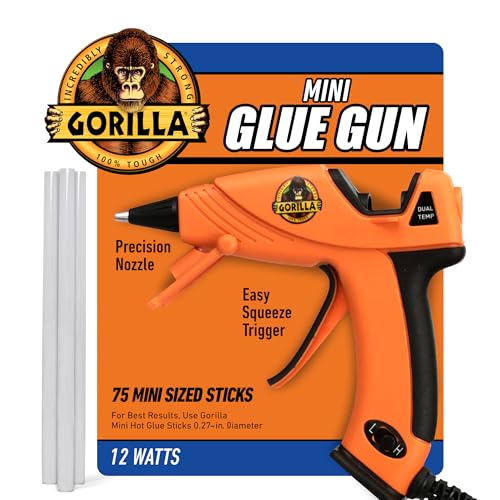 GORILLA 8401515Most sticks included
The short answer: 3 to 5 minutes
For most glue guns, plan on 3 to 5 minutes from the moment you plug it in. Some models are ready a little sooner and some take closer to five minutes, so the safest habit is to wait the full time the first time you use a new gun.
The heating element inside the barrel has to melt a solid glue stick into a liquid that flows through the nozzle. That takes a few minutes, and there is no shortcut. Pressing the trigger early will not speed it up.
How to tell your glue gun is ready
A timer is only a rough guide. The better test is how the glue behaves. Once the gun has been plugged in for a few minutes, squeeze the trigger gently. If glue flows easily with light pressure, the gun is ready.
If you have to push hard, or the glue comes out in a thick, stringy blob, wait another minute or two and try again. Forcing the stick can jam the feed or crack the glue stick inside the barrel.
- Glue appears at the nozzle tip within a moment of a gentle squeeze.
- The bead is smooth and shiny rather than lumpy.
- The trigger moves without much effort.
- The glue stretches into a thin string when you pull the nozzle away.
What changes the heat-up time
The 3 to 5 minute range covers most guns, but a few things can push you toward either end of it.
Room temperature matters. A gun that starts in a cold garage or a chilly craft room has more ground to cover than one sitting in a warm room. The glue stick also plays a part. A fresh stick loaded into a cold gun needs time to melt through, so loading it before you plug in is better than adding it halfway through the warm-up.
Gun design is the other factor. Guns made for light crafts and guns made for heavier jobs can differ in how quickly they get going. If you want to see how models compare, our best glue gun page lines them up side by side using their published specifications. Check the maker's manual for the warm-up time they list for your exact model.
How to warm up a glue gun safely
A glue gun is a small heater, so treat it like one. The nozzle and the melted glue are hot enough to burn skin, and the glue sticks to skin as it cools, which can make a burn worse.
Follow these steps each time:
- Load a glue stick into the back of the gun before you plug it in.
- Set the gun on its stand or on a heat-safe surface with the nozzle pointing away from you and away from paper, fabric or plastic.
- Plug it in and wait 3 to 5 minutes.
- Test with a gentle squeeze onto a scrap piece of cardboard.
- Never leave a plugged-in gun unattended, and unplug it when you are finished.
How long does hot glue take to dry?
Many readers searching for warm-up time also want to know how long the glue takes to set. Hot glue starts to cool the moment it leaves the nozzle, so it sets fast. Most of the bond forms in under a minute, which is why you need to press your pieces together quickly after applying the glue.
Full strength takes a little longer, so hold off on stressing a joint right away. Thicker beads stay hot and soft longer than thin ones. If you are choosing a gun mainly for decorating and small projects, our best hot glue gun for crafts page covers models suited to that work.
Glue guns versus heat guns
People sometimes mix up glue guns and heat guns because the names are close. A glue gun melts a stick of adhesive and applies it. A heat gun blows a stream of very hot air and is used for jobs like stripping paint, shrinking tubing or loosening adhesives. It is not a substitute for a glue gun.
Heat guns also reach much higher temperatures, so they need extra care, including eye protection and a clear work area. If that is the tool you are actually after, see our best heat gun comparison.
Quick reference
Here is a simple summary of what to expect and what to do at each stage.
| Stage | What to expect | What to do |
|---|---|---|
| 0 to 3 minutes | Glue stick is still melting; trigger feels stiff | Wait and keep the nozzle pointed away from you |
| 3 to 5 minutes | Glue starts to flow with light pressure | Test on scrap cardboard |
| Ready | Smooth, easy flow from the nozzle | Apply glue and press parts together quickly |
| Done | Nozzle and glue remain hot after use | Unplug and let the gun cool on its stand |
Frequently asked questions
Can I use a glue gun before it is fully heated?
It is better not to. Glue that is not fully melted is thick, hard to squeeze out and forms a weak bond. Waiting a couple more minutes is quicker than redoing a joint.
Why is my glue gun taking longer than usual to heat?
A cold room, a loose power connection or a damaged cord can slow things down. If the gun never gets hot enough, stop using it and check the cord and plug. Replace the gun if it seems faulty.
How long does a glue gun stay hot after I unplug it?
The nozzle and barrel stay hot for a while after unplugging, so let the gun cool on its stand before storing it. Keep it out of reach of children and pets during that time.
Should I keep the gun plugged in between small tasks?
For short pauses while you work, leaving it on its stand is fine as long as you stay nearby. For longer breaks, unplug it and let it cool, then allow a fresh warm-up when you return.