How Long Do Aluminum Floor Jacks Last?
A well-made aluminum floor jack can serve for many years, and no published spec gives an exact lifespan. What decides it is the hydraulic seals, how often you use it, how you store it, and whether it has ever been overloaded or dropped. Check it before every use and retire it at the first sign of a leak, bend or crack.
 SATA 3T AluminumBest overall
 YELLOW JACKET AS83003XL.Most compact footprint
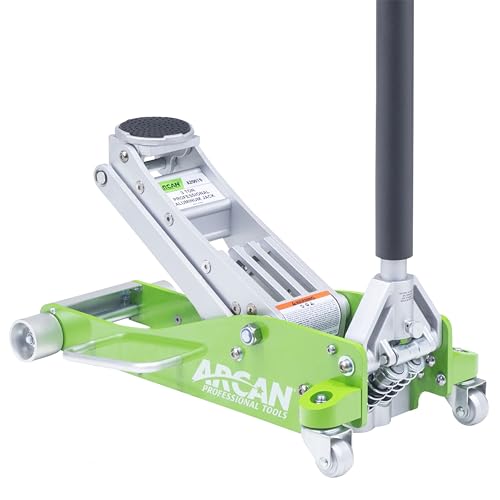 ARCAN A20019Lightest listed 3-ton
The short version on lifespan
Manufacturers do not publish a service life in years, so any single number you see online is a guess. What we can say is that the aluminum frame is rarely the first part to fail. The hydraulic system, meaning the seals, the fluid and the release valve, usually wears first.
A jack used a few times a year in a home garage will age differently from one used daily in a shop. Light use, dry storage and regular checks tend to extend its life. Heavy use, rough handling and overloading shorten it.
What actually wears out
Aluminum does not rust the way steel does, which is one reason people choose it. The listing for the SATA 3-Ton Aluminum Floor Jack, for example, describes its construction as corrosion-resistant. That helps the frame, but the jack has many other parts.
Here are the parts that tend to cause trouble, roughly in the order they show up:
- Hydraulic seals and O-rings: these harden or leak over time, and the wrong fluid can speed that up.
- Hydraulic fluid: low or contaminated fluid makes the jack lift poorly or drift down.
- Release valve: a worn valve can fail to hold the load.
- Casters and wheels: these wear or seize, especially with grit or dirt in the bearings.
- Saddle pad: the rubber can crack or tear, which affects grip on the vehicle.
- Frame and lift arm: bends, cracks or damaged welds are serious and usually mean the jack is done.
What helps a jack last longer
Most of the work is simple habits. None of it takes long.
Stay inside the rated capacity. Our best aluminum floor jack page shows that ratings in this group run from 1.5 ton to 3 ton, and the rating should exceed what you actually plan to raise. Overload valves are built to limit the load, but they are a backup, not a reason to push the limit.
Lift only on solid, level ground, and lower the jack fully when you finish. Keep the ram clean and wipe off dirt and moisture before storing it. Store the jack on a level surface in a dry spot, and keep it from being knocked over or dropped, since aluminum can dent or crack on impact.
Which features point to a longer-lived jack
Specs cannot predict lifespan, but some listed details show how a maker approached safety and quality. A listed standard, a warranty and an overload valve all give you something to verify. The table below uses only the details published for each jack.
Where a cell says Not listed, that product's data does not include the detail. It does not mean the jack lacks it.
| Jack | Rated capacity | Overload protection | Listed standard | Warranty listed |
|---|---|---|---|---|
| SATA 3-Ton Aluminum | 3 ton | Yes | Not in specs (listing says it exceeds ANSI/ASME requirements) | Not listed |
| YELLOW JACKET AS83003XL. | 3 ton | Yes | Meets ASME standard | Not listed |
| ARCAN A20019 | 3 ton | Yes | ASME PASE-2019 | 1 year |
| ARCAN A20017 | 2 ton | Yes | ASME PASE-2019 | 1 year |
| JEGS 555-80077 | 3 ton | Not listed | Not listed | Not listed |
| NOS NSJ0301 | 3 ton | Not listed | Not listed | Not listed |
| ARCAN A20006 | 1.5 ton | Not listed | Not listed | Not listed |
Weight, size and handling wear
A lighter jack is easier to move, but it still needs careful handling. Among the six jacks that list a weight, the range runs from 32.8 lb to 58 lb. The ARCAN A20006 is the lightest at 32.8 lb, though its 1.5 ton rating and 14 in maximum height limit which vehicles it suits.
Jacks that roll around a lot take more knocks. If you move your jack often, look at the casters and the handle design, and make sure you have room to store it without stacking things on top of it. For help comparing length, width and weight, see our aluminum floor jack comparison.
Signs it is time to replace the jack
Do not wait for a failure. Retire the jack if you notice any of the following:
- Fluid leaking from the ram, pump or release valve.
- The saddle slowly sinks while holding a load.
- The jack will not lift smoothly or will not reach full height.
- A bent, cracked or dented frame, arm or saddle.
- A jack that has been dropped hard or overloaded.
- A handle or wheel that is loose, seized or damaged.
Safety notes that matter at any age
A floor jack lifts a vehicle. It does not hold it safely for work underneath. Always support the vehicle on properly rated jack stands before you go under it, and never rely on the jack alone.
Work on flat, firm ground, set the parking brake and chock the wheels that stay on the ground. Keep your hands and body clear of the lift path. Wear safety glasses when working around hydraulic fluid or under a vehicle, since fluid and debris can drop or spray. If a jack shows any damage, stop using it and replace it.
Frequently asked questions
Do aluminum floor jacks wear out faster than steel ones?
Not necessarily. Aluminum resists rust, but it can dent or crack if dropped or overloaded. The hydraulic parts wear on both materials, so care matters more than the metal.
Can I rebuild a worn jack instead of replacing it?
Sometimes, if the problem is a seal or low fluid and replacement parts exist for your model. Use the fluid the maker specifies. If the frame is bent or cracked, replace the jack.
Does a warranty tell me how long the jack will last?
No. A warranty shows what the maker covers and for how long, but it is not a lifespan. Two of the jacks in our data list a 1 year warranty, and the others do not list one.
Should I keep the jack raised between uses?
No. Lower it fully when you finish and store it on a level surface. That keeps the ram protected and avoids stress on the system.