How Do I Know Which Scroll Saw Blade to Use?
Start with your saw's blade holder, because pinless and pin end blades are not interchangeable. Then match blade size to your wood's thickness and the tightness of your curves, and pick a tooth style for the finish you want. For most wood projects, a reverse tooth blade in a mid size like #3 or #5 is a sensible starting point.
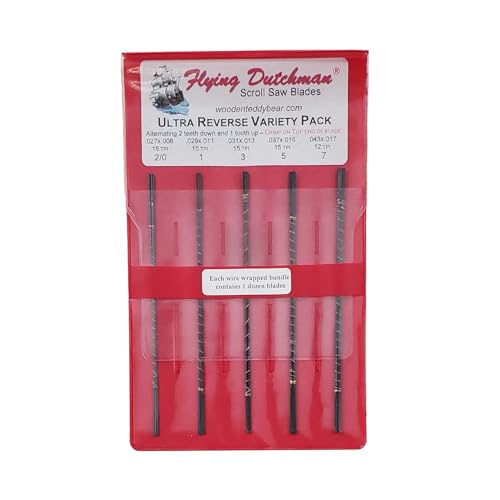 Flying Dutchman Flying Dutchman [unknown model number]Best overall
 Flying Dutchman UR-5Best single-size pack
 Flying Dutchman 191851222Clean bottom edges
Step 1: Check what your saw accepts
The first decision is not about wood at all. It is about how the blade attaches to your saw. Pinless (plain end) blades are held by clamps, while pin end blades have a small cross pin that sits in a slotted holder. If you buy the wrong type, it simply will not fit.
Most modern saws take pinless blades, and some older or entry level saws need pin end blades. Look at your blade holder or your manual before you shop. Length matters too. The blades in our comparison are all 5 inches long, which suits many saws, but some machines take other lengths, so confirm that as well.
So, to answer a common question: no, not all scroll saws use the same blades. End type and length both need to match your machine.
Step 2: Pick a size for your wood and your pattern
Blade sizes use a number system. Small numbers like #2/0 and #1 are thin and cut fine detail in thin wood. Mid sizes like #3 and #5 handle general work. Larger sizes like #7 cut thicker stock faster.
There is a trade-off. Thin blades turn tight corners and leave a narrow kerf, but they wander and break more easily in thick wood. Wider blades track straighter and last longer, but they cannot follow very tight curves. A common rule of thumb is to use the largest blade your pattern allows, since bigger blades are more durable.
- Fine fretwork and small inside corners in thin wood: #2/0 or #1
- General cutting, puzzles, signs and ornaments: #3 to #5
- Thicker boards and long gentle curves: #5 to #7 or heavier styles
Step 3: Choose a tooth style
Tooth style controls how clean the cut looks and how easily the blade follows curves. Here is what the main styles do, based on the descriptions in our blade data.
Reverse tooth blades have a few teeth pointing up near the bottom of the blade. They cut on the upstroke too, which reduces splintering on the underside of the work. The Flying Dutchman Ultra Reverse style reverses every third tooth, while the Scroll Reverse style has a few reversed teeth at the bottom. Both are good defaults for wood.
Spiral blades are twisted, so they cut in any direction without you turning the workpiece. That is handy for odd shapes, but the kerf is wider and the edge is rougher. The New Spiral design has teeth down both sides before it is twisted, which gives a smoother cut than a regular spiral.
Skip tooth blades have gaps between teeth that clear sawdust well. They suit plastics and acrylic, and the Polar skip tooth pack in our data lists wood, horn and bone, Corian and acrylic as suitable materials.
Which blade for hardwood?
Hardwoods like cherry, maple and oak resist the blade more, so they call for a sturdier size and a slower, steady feed. For thicker hardwood, a #5 or #7 blade is a common choice, while thin hardwood veneers and fine inlay work can go smaller.
A reverse tooth blade is a solid pick because hardwood can still tear out on the underside. If you want to see your options on one sheet, our best scroll saw blades page compares variety packs and single size packs side by side, including a heavy duty pack with five thicker blade styles to try.
If you cut a lot of the same board thickness, a single size pack makes sense. The 72 piece Ultra Reverse #5 pack is one example. If you are still learning what suits your saw, a variety pack covering #2/0 to #7 lets you test several sizes.
Quick reference chart
Use this table as a starting point, then adjust by feel. If the blade burns the wood, wanders or breaks often, change size or slow your feed.
| Job | Good starting blade | Why |
|---|---|---|
| Fine detail, thin wood | #2/0 or #1, reverse tooth | Narrow kerf turns tight corners |
| General wood projects | #3 to #5, reverse tooth | Balanced speed and finish |
| Thicker hardwood | #5 to #7 or heavy duty styles | Faster cutting and more durable |
| Odd shapes, no turning | Spiral | Cuts in every direction |
| Acrylic, Corian, plastics | Skip tooth | Clears waste well |
| Pin end saw | Pin end blades | Must match the holder |
Safety and setup tips
Blades are cheap to replace, so do not push a dull one. Dull blades make you press harder, which causes breakage and slips.
Always unplug the saw before changing a blade. Install it with the teeth pointing down toward the table, and tension it according to your manual.
- Wear safety glasses, because broken blade pieces can fly.
- Wear a dust mask, since fine sawdust and plastic dust are unhealthy to breathe.
- Use hearing protection if your setup is loud, especially with long sessions.
- Keep fingers clear of the blade and use the hold-down foot.
- Do not force the wood. Let the blade cut at its own pace.
Where other blades fit in
Scroll saw blades are a different tool category from the blades for other saws. If your project involves resawing lumber on a band saw, see our best band saw blade for resawing guide instead. Scroll saw blades are too thin and short for that job, and they will not interchange with those saws.
Frequently asked questions
Can I use pin end blades in a pinless saw?
Not directly. The holder must match the blade end. Some saws have adapters, so check your manual.
What does TPI mean on a blade pack?
TPI stands for teeth per inch. Higher numbers give finer, slower cuts, and lower numbers cut faster and rougher. Some packs, like the FOXBC sets in our data, list TPI instead of size numbers.
How do I know when to replace a blade?
Replace it when cutting slows, the wood burns, the blade drifts off the line, or the edge gets fuzzy. Blades also break with age and heat.
Should I start with a variety pack?
Yes, if you are unsure. A variety pack lets you compare sizes and tooth styles on scrap wood, then you can buy more of the one you prefer.