Are Portable Air Compressors Worth It?
For most drivers, cyclists and families with sports gear, yes. A portable air compressor, usually a compact tire inflator, saves trips to the gas station and can help in a roadside emergency. It is not the right tool if you want to run air tools or paint equipment, because those need a larger tank compressor.
 AstroAI AIRUN L7Best overall
 OlarHike TIC3V401Best dual power option
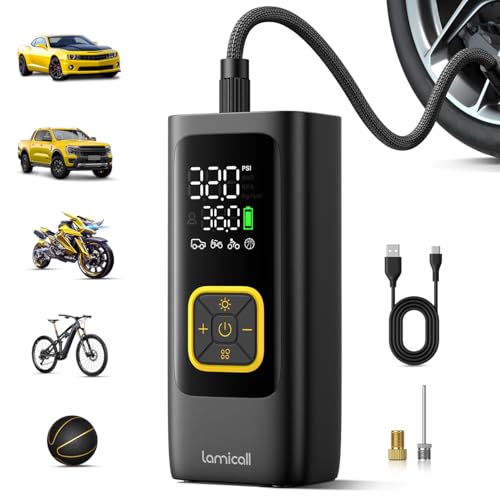 Lamicall VHEP02
The short answer: worth it for most people, with limits
A small portable compressor earns its place if you check tire pressure regularly, ride a bike, or keep balls and inflatables around the house. Having one in the trunk means you can fix a low tire at home, at a trailhead or in a parking lot, instead of hunting for a working gas station air machine.
The limits are real, though. These units are built for tires, bikes and sports equipment. They are not built for nail guns, impact wrenches or spray guns, and they are not meant for heavy-duty truck tires. If your needs are mostly tires, a compact inflator is a sensible purchase. If your needs are mostly tools, skip ahead to the section on tank compressors.
What a portable air compressor actually does
Most products sold as portable air compressors are tire inflators. A small motor drives a pump, a digital gauge shows pressure, and you set a target so the unit stops on its own. Our best portable air compressor page compares several of them on one spec sheet.
Power comes from one of three places: a built-in battery, your car's 12V socket, or both. Battery models are the easiest to grab and use anywhere. 12V models never go flat as long as the car is running. Dual-power models give you a backup if one source fails.
Who benefits most
The value depends on how you use it. Here is where a compact inflator tends to pay off:
- Daily commuters who want to keep tires at the right pressure without a special trip.
- Road trippers and campers who may be far from a service station.
- Cyclists and e-bike riders who want a quick top-up before a ride. Some units include bike modes and valve adapters.
- Parents with a pile of sports balls and pool toys.
- Owners of older cars or cars without a spare, where a slow leak can strand you.
Who should look elsewhere
If you plan to run air tools, blow out sprinkler lines or spray paint, a portable tire inflator will not keep up. Those jobs need a tank compressor that stores air and delivers it steadily. Our best portable air compressor for home garage page is a better starting point if you want something more capable around the house.
Also look elsewhere if you drive large vehicles. One OlarHike model in our data, the TIC3V401, notes it is not compatible with heavy-duty pickup trucks or RVs and can inflate car and pickup tires only up to 51 PSI. The AstroAI L7 notes it is not suitable for tires larger than 25 inches. Always read those limits on the product listing before you buy.
What the specs tell you
Published specs are the best way to judge whether a given model is worth it for you. The table below uses figures from the product data on our comparison page. Fill times refer to a standard 195/65R15 car tire as listed by each manufacturer, and brands may use slightly different pressure ranges, so treat the numbers as a rough guide rather than a head-to-head result.
| Model | Weight | Power | Listed fill time | Other notes |
|---|---|---|---|---|
| AstroAI L7 | 0.96 lb | Battery plus USB | 1.5 min (30 to 36 PSI) | 15 min use, then 10 min rest; up to 8 tires per charge |
| OlarHike TIC3V401 | 1.2 lb | Battery plus 12V/110V | 55 sec (30 to 35 PSI) | Up to 18 tires per charge |
| inzeetor ITI001 | 1.94 lb | Cord, per listing | 50 sec (30 to 36 PSI) | Can do all four tires without rest |
| OlarHike TIX7V101 | 3.2 lb | Battery plus 12V/110V | 20 sec (30 to 35 PSI) | Up to 44 tires per charge |
How to decide if one is worth it for you
Start with the speed you really need. If you only top up a few PSI now and then, a small and slower unit is fine. Faster units tend to be heavier, as the table shows, so you trade carry weight for speed.
Next, check the duty cycle. Small inflators can overheat, and some need a rest after continuous use. The AstroAI L7 lists a 10 minute rest after 15 minutes of use, while the inzeetor lists all four tires in a row with no rest. If you often fill several tires at once, that matters.
Finally, think about power. If you want one tool that also works as a backup in a dead-battery situation, look at our best portable air compressor and jump starter page, which covers combo units.
- Choose a battery model if you want to use it anywhere, including at a bike rack or campsite.
- Choose a 12V model if you want it to always be ready in the car.
- Choose dual power if you want a fallback.
- Look for auto shut-off and presets so you can set a pressure and walk away.
- Check the maximum pressure against your tires and your bike.
Safety notes
Treat compressed air with respect. Never exceed the pressure printed on the tire sidewall or in your owner's manual, and use a gauge or the auto shut-off to avoid over-inflating. A tire that fails under too much pressure can injure you.
Keep the unit away from water, and charge it only with the adapter the maker recommends. The OlarHike TIC3V401 listing, for example, calls for a 5V 2A or 5V 3A adapter. Use the inflator on level ground, set the parking brake, and stay out of traffic. In low light, use the built-in flashlight if there is one, and wear a reflective vest on busy roads. Some inflators are loud, so consider hearing protection if you use one in a closed garage for long periods.
Bottom line
A compact inflator is a small, practical addition to a car, garage or bike kit. It is worth it when your needs are tires, bikes and balls, and when you pick a model that matches your vehicle and how often you use it. It is not worth it if you really need a tank compressor for tools.
Frequently asked questions
Can a portable air compressor inflate a completely flat tire?
Many can add air to a flat tire that is still on the rim, but it may take longer and the unit may need a rest. If the tire is damaged or has lost its seal with the rim, air alone will not fix it. Check the maker's guidance.
Do I need to charge a battery inflator regularly?
Yes. Lithium batteries lose charge slowly when stored, so top it up now and then and before long trips. A model with a 12V cable gives you a backup if the battery is empty.
Is a digital gauge more accurate than a cheap analog one?
Not automatically. Accuracy depends on the sensor and calibration. Check the stated accuracy in the spec sheet, and compare against a gauge you trust if you can.
Can I use one for bike tires?
Often yes. Look for bike or preset modes and a valve adapter, such as Presta, in the kit. Bike tires need far less pressure than the maximum rating of the inflator, so set the target carefully.