Are Aluminum Floor Jacks Safe to Use?
Yes, aluminum floor jacks are safe when you use them within their rated capacity, on firm level ground, and only to lift. A jack is never meant to hold a vehicle while you work under it, so always add properly rated jack stands. The metal matters less than the rating, the build quality, and how you use the jack.
 SATA 3T AluminumBest overall
 YELLOW JACKET AS83003XL.Most compact footprint
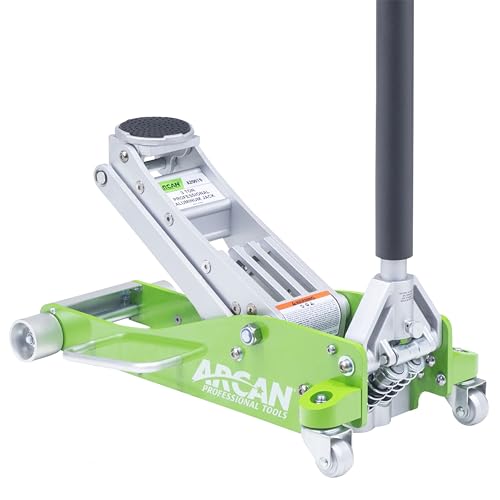 ARCAN A20019Lightest listed 3-ton
Safe for what, exactly?
A floor jack is a lifting tool. It raises one corner or one end of a vehicle so you can set stands or change a wheel. It relies on hydraulic pressure and a rubber seal to stay up, and seals can fail without warning. That is true of steel jacks and aluminum jacks alike.
So the honest answer has two parts. An aluminum jack is a safe way to lift when it is used correctly. It is not a safe thing to crawl under, ever, unless the vehicle is also resting on jack stands or another support rated for the load.
What aluminum changes and what it does not
Aluminum is chosen mainly for weight and corrosion resistance. Several of the listings on our comparison page describe the frame as lighter than a steel one, which makes the jack easier to move around a garage or toss in a trunk. Our spec sheet shows listed weights from 32.8 lb to 58 lb, so the savings vary a lot from model to model.
Aluminum does not make a jack weaker by default. A well-built frame is sized to carry its rating. What counts is the design, the quality of the welds and the hydraulics, and whether the maker follows a recognized standard. A poorly made jack in any metal is a risk, and a well-made one in any metal is fine within its limits.
One general difference is worth knowing. Aluminum can show cracks or deformation after hard knocks or overloading, and softer metal can gouge more easily. That makes a quick look before each use a good habit.
How to use an aluminum floor jack safely
Most jack accidents come from setup mistakes, not from the metal. Work through these steps every time.
- Park on a hard, level surface such as concrete. Avoid soft asphalt, gravel, dirt and slopes.
- Set the parking brake, put the car in park or in gear, and chock the wheels that stay on the ground.
- Find the manufacturer's lift points in your owner's manual. Do not lift on thin body panels or suspension parts.
- Center the saddle under the lift point and raise the vehicle slowly, watching for shifting.
- Place jack stands at the correct support points, then lower the vehicle onto them gently.
- Leave the jack lightly in place as a backup, but never rely on it alone.
- Before you lower, clear tools and people, then release the valve slowly.
What the spec sheet tells you about safety
Rated capacity should comfortably exceed the load you plan to raise. Our best aluminum floor jack page lists seven models: five rated 3 ton, one rated 2 ton and one rated 1.5 ton. Check your owner's manual for the vehicle weight and remember that a jack lifts only part of it.
Safety features are listed unevenly. An overload valve limits the load the pump can push, and a listed standard such as ASME gives you something to verify. Here is what the product data shows.
Note that the SATA entry comes from its listing text, which states that every unit is overload tested to 1.5 times its rating and exceeds ANSI/ASME requirements. We compare published specifications and have not verified those claims ourselves.
| Jack | Rated capacity | Overload protection | Listed standard |
|---|---|---|---|
| SATA 3-Ton | 3 ton | Yes | Listing cites ANSI/ASME |
| YELLOW JACKET 3T | 3 ton | Yes | Meets ASME standard |
| ARCAN A20019 | 3 ton | Yes | ASME PASE-2019 |
| ARCAN A20017 | 2 ton | Yes | ASME PASE-2019 |
| JEGS 555-80077 | 3 ton | Not listed | Not listed |
| NOS NSJ0301 | 3 ton | Not listed | Not listed |
| ARCAN A20006 | 1.5 ton | Not listed | Not listed |
Warning signs to stop using a jack
Inspect the jack each time you pull it out. It takes under a minute, and it catches the problems that lead to sudden drops.
Retire or have a jack professionally repaired if you see any of these:
- Oil leaking from the cylinder, pump or seals
- A saddle that sinks slowly while loaded
- Bent, cracked or twisted arms, frame or handle
- Damaged welds or a wobbling, loose wheel or caster
- A pump that feels spongy or will not build pressure
- Any drop in the jack after it was dropped or overloaded
What about aluminum jack stands?
The same logic applies. An aluminum jack stand can be safe if it is made to a recognized standard, rated for the load, and used on solid ground. Always use stands in pairs, match the rating to your vehicle, and never mix a worn stand with a new one.
Avoid any stand with cracks, bent legs, damaged locking pins or a ratchet that does not lock firmly. Do not stack stands, add blocks or use cinder blocks as a substitute. If you are not sure a stand is rated for your vehicle, do not use it.
Choosing a safer jack
Start with the rating, then check that the minimum saddle height fits under your vehicle. The jacks on our page start between 3 in and 3.75 in, which matters for low cars. Next, look at the safety rows. A listed standard and an overload valve are easier to trust than a headline capacity alone.
If you are comparing models, our aluminum floor jack comparison puts capacity, height range, weight and safety features in one place. Use it to narrow the list, then read the listing details before you buy.
Finally, wear safety glasses when working under or around a raised vehicle, since dirt, rust and fluid can fall. Gloves help with pinch points, and hearing protection is worth having if you are using an impact wrench.
Frequently asked questions
Is an aluminum jack as strong as a steel one?
It can be, if it is built to the same rating. Strength comes from design and manufacturing, not only the metal. Compare rated capacity and any listed standard rather than assuming one material is stronger.
Can I leave a vehicle on a floor jack overnight?
No. Seals can leak and the load can drop. Use jack stands for anything beyond a quick lift.
How often should I inspect my jack?
Look it over before every use, checking for leaks, cracks and bent parts. Check the hydraulic fluid and manual lubrication points as the manufacturer advises.
Can I use a 1.5 ton jack on an SUV?
Check your owner's manual first. A lighter rating and a maximum height of 14 in, as on the smallest jack on our page, may not suit taller or heavier vehicles.