Are Aluminum Floor Jacks Better Than Steel?
Aluminum floor jacks are better if weight matters to you, because they are easier to carry, roll and store. Steel jacks tend to suit rough, daily shop use and are easier to repair. For most home garages, a correctly rated aluminum jack is a sound choice, as long as you check capacity and minimum height first.
 SATA 3T AluminumBest overall
 YELLOW JACKET AS83003XL.Most compact footprint
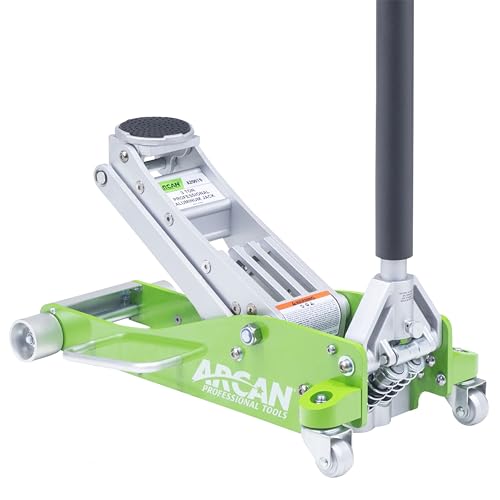 ARCAN A20019Lightest listed 3-ton
The short version: it depends on what you value
Neither metal is better in every way. Aluminum wins on weight and on resisting rust. Steel wins on toughness over years of hard use, and on how easily a damaged frame can be repaired or welded.
A floor jack's rated capacity is what keeps you safe, not the metal it is made from. A well-built aluminum jack and a well-built steel jack with the same rating are both designed to lift the same load. The difference shows up in how you live with the tool day to day.
If you move your jack often, keep it in a trunk, or have a garage where you roll it around a lot, aluminum makes sense. If it sits in a busy shop and gets dropped, dragged and overloaded, steel is the more forgiving choice.
Where aluminum comes out ahead
The biggest advantage is weight. Aluminum is a lighter metal than steel, so a jack with an aluminum frame is usually easier to lift into a trunk, slide under a car and pull back out. Some listings put a number on it: one says its jack is 30% lighter than traditional steel models, and another says 25% lighter. Those are manufacturer claims, so treat them as a rough guide and compare the listed weights yourself.
Aluminum also resists rust. A steel jack left in a damp garage or a car trunk can corrode if the paint wears through. Aluminum does not rust in the same way, which helps if you store your jack somewhere humid or take it outdoors.
Many aluminum jacks are also sold in low-profile designs with dual-piston pumps, which raise the saddle in fewer strokes. That feature is not exclusive to aluminum, but it is common on the models we compare on our best aluminum floor jack page.
Where steel still has the edge
Steel is more tolerant of abuse. It is generally better at handling repeated stress over time, which engineers call fatigue. Aluminum can also dent and gouge more easily than steel, so a jack that gets dropped on concrete or knocked around a shop may show more wear.
Repairs are another factor. Steel is simple to weld in almost any shop. Welding aluminum takes different equipment and more skill, so a damaged aluminum frame is often not worth fixing, and you should not trust a poorly welded jack under a vehicle anyway.
Steel jacks can also be less costly to make in heavy-duty sizes, which is why you see many steel options at high capacities. If you need a very large capacity for a heavy truck, you may find more steel choices.
What the specs show for aluminum jacks
Aluminum does not guarantee a featherweight jack. Among the six jacks on our page that list a weight, the range runs from 32.8 lb to 58 lb. The lightest is a 1.5 ton model, while the 3 ton models that list a weight sit between 56 lb and 58 lb. One 3 ton jack does not publish its weight at all.
That means you should read the listed weight before assuming a jack is easy to carry. If you are comparing against a steel jack, check that jack's published weight too, since a heavy-duty aluminum jack may not be dramatically lighter than a compact steel one.
| Jack | Rated capacity | Listed weight | Minimum height |
|---|---|---|---|
| SATA 3T Aluminum | 3 ton | Not published | 3.75 in |
| ARCAN A20019 | 3 ton | 56 lb | 3.75 in |
| YELLOW JACKET AS83003XL. | 3 ton | 57.8 lb | 3.75 in |
| JEGS 555-80077 | 3 ton | 58 lb | 3 in |
| NOS NSJ0301 | 3 ton | 58 lb | 3.7 in |
| ARCAN A20017 | 2 ton | 46.3 lb | 3.54 in |
| ARCAN A20006 | 1.5 ton | 32.8 lb | 3.5 in |
How to decide between aluminum and steel
Work through your own situation rather than picking a metal first. These checks matter more than the material alone:
- Capacity: pick a rating above what you plan to lift. Five of the seven jacks on our page are rated 3 ton, one is 2 ton and one is 1.5 ton.
- Ground clearance: the jacks listed here start between 3 in and 3.75 in. A low car may need the lower end of that range.
- Portability: if you carry or move the jack often, compare listed weights and consider aluminum.
- Durability: if the jack will be used hard in a busy shop, lean toward steel.
- Safety features: look for an overload valve and a listed standard such as ASME, and confirm they are actually listed.
- Storage: check length and width. Among the six jacks that list sizes, lengths run from 25.6 in to 32 in and widths from 12.6 in to 16 in.
Safety rules that apply to both metals
The material does not change the most important rule: a floor jack lifts a vehicle, it does not hold it. Once the car is raised, set jack stands under solid frame points before you go under it, and never rely on the jack alone.
Work on flat, hard ground, chock the wheels that stay on the floor, and use the lift points in your owner's manual. Do not exceed the rated capacity, and stop if the jack leaks, jerks or will not hold pressure. Wear safety glasses when working under a vehicle, since dirt and rust often fall as you lift.
Inspect any jack before use, whether aluminum or steel. Look for cracks, bent parts, fluid leaks and damaged wheels. Retire a jack that looks damaged. To compare models with these points in mind, see our best aluminum floor jack comparison.
Frequently asked questions
Do aluminum floor jacks lift less than steel ones?
Not by default. Lifting ability comes from the rated capacity, and aluminum jacks are sold at 1.5, 2 and 3 ton ratings among the models we compare. Always match the rating to your vehicle.
Do aluminum jacks rust?
Aluminum does not rust the way steel does, which is why listings often mention corrosion resistance. Its seals, pins and any steel parts can still wear, so keep the jack clean and dry.
Can I use a floor jack instead of jack stands?
No. A floor jack is for lifting only. Always support the vehicle with properly rated jack stands before working underneath.
Is an aluminum jack a good choice for a low car?
It can be, if the minimum saddle height is low enough. The jacks we compare start between 3 in and 3.75 in, so check your car's clearance against the listed figure.