Are 1/2 or 1/4 Router Bits Better? Shank Size Explained
Neither shank is better in every case. A 1/2 in shank is stiffer, vibrates less and suits larger cutters and deeper cuts, while a 1/4 in shank fits compact and trim routers and works well for lighter jobs. The best choice is the one your router's collet accepts, so check that first.
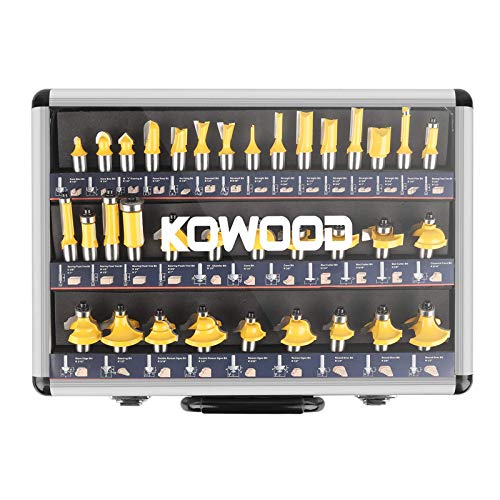 KOWOOD USK0006Best overall
 Freud 99-036Adjustable tongue and groove
 Hiltex 10108Itemized profiles, labeled case
What shank size actually means
The shank is the smooth round post at the top of a router bit. It slides into the router's collet, which clamps it in place while the cutter spins. The two common sizes are 1/4 in and 1/2 in, measured across the diameter of that post.
The size matters because the shank carries all the force of the cut. A thicker shank has more metal, so it flexes less and passes less vibration to the cutter. A thinner shank is lighter and fits smaller tools, but it bends more under load.
1/2 in shanks: stiffer and steadier
A 1/2 in shank is the better pick when you run large cutters, make deep passes or cut dense hardwood. The extra stiffness helps reduce chatter, which tends to leave a cleaner edge. It also lowers the chance of the shank bending or snapping under heavy load.
The catch is that you need a router with a 1/2 in collet. Many full-size routers have one, and some come with both collet sizes. Our best router page lists the specs, so you can check collet size before you commit to a bit set.
On our best router bit set page, the top-ranked KOWOOD 35-piece set uses a 1/2 in shank with carbide-tipped cutters and an aluminum case. The Freud adjustable tongue and groove set is also 1/2 in, and it cuts one joint rather than a range of profiles.
1/4 in shanks: lighter and more widely compatible
A 1/4 in shank fits compact and trim routers, and most larger routers can take it too if a 1/4 in collet or adapter sleeve is available. Small bits for roundovers, chamfers, flush trimming and light grooves work well on this size.
Because the bits are smaller, sets tend to be lighter. In our data, the Hiltex 24-piece set on a 1/4 in shank weighs 2.25 lb, and the Newdeli 35-piece set weighs 3.95 lb. The KOWOOD 35-piece set on a 1/2 in shank weighs 5.93 lb. Piece count and bit size also affect weight, so shank size is not the only factor.
Keep cuts shallow with 1/4 in bits. Take several light passes instead of one deep one, and avoid very large cutters on a thin shank.
Side-by-side comparison
Here is how the two sizes compare on the points that usually decide the choice.
| Factor | 1/4 in shank | 1/2 in shank |
|---|---|---|
| Stiffness | More flex under load | Stiffer, less vibration |
| Router needed | Compact, trim and most full-size routers | Routers with a 1/2 in collet |
| Best for | Light edge work, trimming, small profiles | Large cutters, deeper cuts, hardwood |
| Cutter size | Small to medium | Medium to large |
| Set weight (our examples) | Hiltex 2.25 lb, Newdeli 3.95 lb | KOWOOD 5.93 lb |
How to choose
Start with the router you own or plan to buy, then match the bit to it. These steps work for most people:
- Check the collet size printed in the manual or on the collet nut.
- If your router only takes 1/4 in, shop 1/4 in sets and keep cuts shallow.
- If your router takes 1/2 in, choose 1/2 in bits for larger profiles and heavier work.
- If you own a router that takes both, buy 1/2 in for big cutters and 1/4 in for small detail work.
- Check the profile list, because a high piece count can include repeated sizes.
Sets that cover both sizes
If you are unsure, a mixed approach can help. The Bosch 10-piece set on our router bit set comparison lists both 1/4 and 1/2 in shanks, with micrograin carbide tips and a wooden case with a clear top.
Do not mix up collets and shanks. Never force a bit into the wrong collet size, and never use an adapter that does not fit snugly, because a loose bit can fly out while spinning.
Safety notes
Unplug the router before changing a bit. Insert the shank fully, then back it out slightly so it does not bottom out, and tighten the collet firmly.
Wear eye protection and hearing protection every time you route. Secure the workpiece with clamps, and keep your hands clear of the cutter path. Let the bit reach full speed before it touches the wood.
Frequently asked questions
Can I use 1/4 in bits in a 1/2 in router?
Often yes, if the router comes with a 1/4 in collet or a matching reducer sleeve. Check your manual, and make sure the bit grips tightly before you switch the router on.
Can a 1/2 in bit go in a 1/4 in collet?
No. The shank is too thick for the collet and will not fit. You need a router with a 1/2 in collet.
Do 1/2 in bits always give a better finish?
Not always. Stiffness helps on larger cutters and deeper cuts, but sharp carbide, a steady feed and the right speed matter just as much for a clean edge.
Is a bigger piece count better?
Not necessarily. Some sets repeat sizes, so read the itemized profile list to see what you actually get.