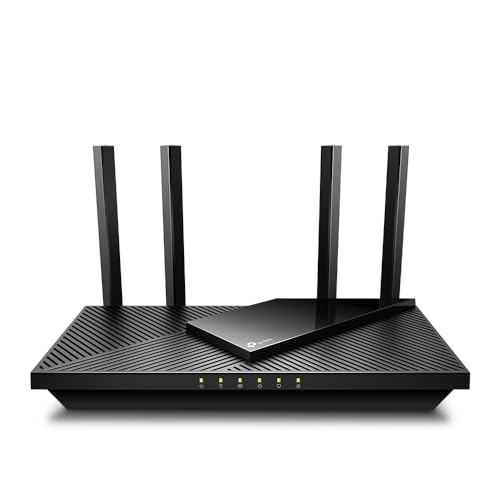
#1
NETGEAR RS700S-100NASNETGEAR Nighthawk RS700S WiFi 7
Tri-band WiFi 7 with 3500 sq ft coverage and a 10 Gbps Ethernet port.
- WiFi standard
- WiFi 7
- Combined max speed
- 19.0 Gbps
- Rated coverage
- 3500 sq ft
A good router is judged on three things: the WiFi generation, how far the signal reaches, and how fast it runs in real use. Newer WiFi 7 models add bands and channels for busy homes. Coverage ratings and antenna counts hint at reach, while Ethernet port speed matters for wired gear. Maker speed figures are combined across bands, so read them as capacity, not per-device speed. We put 8 products on one spec sheet so you can compare them side by side.
Quick answer
Ranked from 8 wifi routers that met our standard, compared on WiFi standard, coverage area, and total speed.
As an Amazon Associate I earn from qualifying purchases. Links to retailers on this site are affiliate links; we may earn a commission at no extra cost to you.
Tri-band WiFi 7 with 3500 sq ft coverage and a 10 Gbps Ethernet port.

Quad-band WiFi 7 rated at 30 Gbps combined, the top figure on the page.

Lists 5764 Mbps on 5 GHz, the highest among models that list it.
| Spec | ||||||||
|---|---|---|---|---|---|---|---|---|
| Best Scoreout of 100 | 73 | 69 | 61 | 57 | 51 | 48 | 44 | 38 |
| WiFi standard | WiFi 7 (best in row) | WiFi 7 (best in row) | WiFi 7 (best in row) | WiFi 7 (best in row) | WiFi 7 (best in row) | WiFi 6E | WiFi 6 | WiFi 6 |
| Band configuration | Tri-band | Quad-band (best in row) | Dual-band | Tri-band | Dual-band | Tri-band | Dual-band | Dual-band |
| Combined max speedGbps | 19.0 Gbps | 30.0 Gbps (best in row) | 6.5 Gbps | 9.7 Gbps | 3.6 Gbps | 5.4 Gbps | 1.8 Gbps | 6.0 Gbps |
| 5 GHz max speedMbps | — | — | 5764 Mbps (best in row) | 2882 Mbps | 2882 Mbps | 2402 Mbps | 1201 Mbps | 4804 Mbps |
| Fastest Ethernet portGbps | 10.0 Gbps (best in row) | 10.0 Gbps (best in row) | 2.5 Gbps | 10.0 Gbps (best in row) | 2.5 Gbps | 2.5 Gbps | 1.0 Gbps | 2.5 Gbps |
| LAN ports | 3 | — | 4 (best in row) | 4 (best in row) | 4 (best in row) | 3 | 4 (best in row) | 4 (best in row) |
| Rated coveragesq ft | 3500 sq ft (best in row) | 3500 sq ft (best in row) | 2400 sq ft | 2600 sq ft | 2000 sq ft | — | — | — |
| Antennas | 8 (best in row) | 8 (best in row) | 6 | 6 | 4 | — | 4 | 4 |
| USB port | — | Yes | Yes | Yes | Yes | Yes | — | Yes |
| Mesh support | — | Yes | Yes | Yes | Yes | Yes | Yes | — |
| Built-in VPN support | Yes | Yes | Yes | Yes | Yes | Yes | Yes | Yes |
| Weightlb | 3.6 lb | 4.4 lb | 1.4 lb | 1.7 lb | 1.2 lb | 1.5 lb | 1.1 lb (best in row) | 1.7 lb |
| Release year | 2023 | 2023 | 2025 (best in row) | 2025 (best in row) | 2024 | 2022 | 2020 | — |
We reviewed 8 wifi routers and kept only the 8 that pass every check below. Those are ranked by a Best Score built from spec fit for this job, sales rank.
These reviews are based on specifications and listing information only. Each one looks at what the numbers mean for finding a strong all-round router.
Tri-band WiFi 7 with broad coverage and 10 Gbps wired
The Nighthawk RS700S leads our ranking for a broad all-round pick. It uses WiFi 7 on a tri-band design, which adds a third band so busy homes spread devices out. NETGEAR lists a combined speed of 19 Gbps. That figure is the sum across bands, not what one device will get.
Coverage is rated at 3500 sq ft, tied for the highest on our page with the ASUS GT-BE98. It has eight antennas, also the top count shared with that model. More reach matters in larger or multi-story homes. The listing notes that walls, floors, and interference can cut range.
Wired speed is strong too. The fastest Ethernet port runs at 10 Gbps, which suits a multi-gig modem. It has three LAN ports, the lowest count among the models that list it, tied with one other model, so a switch may help with many wired devices. VPN support is built in. It weighs 3.61 lb.
VerdictA strong all-round pick for big homes that want WiFi 7 speed and a 10 Gbps wired port.
Quad-band WiFi 7 with the highest combined speed
The GT-BE98 Pro ranks second on our list and has the highest combined speed here at 30 Gbps. It is a quad-band WiFi 7 router, so it has four bands to share among devices. Combined speed adds up all bands, so no single device reaches 30 Gbps. Still, the headroom helps in crowded homes.
It is rated for 3500 sq ft and has eight antennas, matching the NETGEAR on both counts. The listing says external dual-feeding antennas raise signal strength. It also lists mesh support, so you can add nodes later if one router does not reach every room. Multi-Link Operation joins bands at the same time for steadier connections.
Wired options are broad. The listing cites dual 10G ports and quad 2.5G ports, and the top port speed is 10 Gbps. It has a USB port and built-in VPN support. At 4.4 lb it is the heaviest of the eight, so plan for a shelf or desk rather than a tight spot.
VerdictThe speed leader for demanding homes, though it is heavier and more than a small place needs.
Compact dual-band WiFi 7 with a 2.5 Gbps port
The Archer BE400 ranks third. It uses WiFi 7 on two bands, which keeps the combined speed at 6.5 Gbps. Its 5 GHz speed is 5764 Mbps, the highest 5 GHz figure among the models that list it. That band carries most phones, laptops, and TVs, so the number matters for everyday speed.
Coverage is rated at 2400 sq ft with six antennas. That fits a mid-size home better than a large one. The listing says it handles up to 90 devices. It also lists mesh support, which gives a path to add reach later. The weight is 1.37 lb, so it is easy to place.
Wired speed tops out at 2.5 Gbps, with four LAN ports. The listing describes one 2.5 Gbps WAN/LAN port, one 2.5 Gbps LAN port, and three 1 Gbps LAN ports. That is fine for gigabit internet. A multi-gig plan above 2.5 Gbps would outgrow the wired side. It has a USB port and built-in VPN support.
VerdictA balanced WiFi 7 pick for mid-size homes that do not need tri-band or 10 Gbps ports.
Tri-band WiFi 7 with a 10 Gbps port in a lighter body
The Archer BE600 ranks fourth. It is tri-band WiFi 7 with a combined 9.7 Gbps. The listing gives 5,765 Mbps on 6 GHz, 2,882 Mbps on 5 GHz, and 1,032 Mbps on 2.4 GHz. More bands mean devices can spread out instead of competing for airtime.
Coverage is rated at 2600 sq ft with six antennas, and the listing says it handles up to 120 devices. That is more reach than the BE400 and less than the top two. The weight is 1.7 lb. Mesh support is listed, so a larger home can add to it. Multi-Link Operation combines bands into one stream.
Its fastest Ethernet port is 10 Gbps, tied with the NETGEAR and ASUS, and it has four LAN ports. The listing adds a 2.5 Gbps port and three more 2.5 Gbps LAN ports. That suits multi-gig wired setups. USB and built-in VPN support are listed. At 1.7 lb it is the lightest of the three models with a 10 Gbps port.
VerdictA well-rounded tri-band pick for mid-size to larger homes that want a 10 Gbps port.
Entry WiFi 7 for smaller homes and modest plans
The Archer BE230 ranks fifth, and it fits best in a smaller home. It is dual-band WiFi 7 with a combined 3.6 Gbps. The 5 GHz band tops out at 2882 Mbps. The listing notes that dual-band routers do not support 6 GHz. Its rated coverage is the lowest among the models that list it.
Coverage is 2000 sq ft with four internal antennas, and the listing says it handles up to 60 devices. That suits an apartment or a modest house. A 2.0 GHz quad-core processor is listed to keep throughput steady. EasyMesh is supported, so you can add compatible routers or extenders if a room stays weak.
Wired speed tops out at 2.5 Gbps. It has four LAN ports, and the listing mixes 2.5 Gbps and 1 Gbps ports. That works for gigabit internet and a few wired devices. It has a USB port and built-in VPN support. At 1.21 lb it is light, and it was released in 2024.
VerdictA modest WiFi 7 option for small spaces, but it trails the four models ranked above it.
Best among the reviewed tools
WiFi 7 is the newest generation on this page, followed by WiFi 6E and WiFi 6. Your devices must support a generation to use it, but older devices still connect. WiFi 7 gives the most room to grow as you replace phones and laptops over the next few years.
Rated coverage is a best-case figure. Walls, floors, and interference cut range, as the NETGEAR listing notes. The top two models here list 3500 sq ft. If your home is larger or has several floors, look for mesh support so you can add reach later.
Combined speed adds every band together, so it is a capacity figure. Check the 5 GHz speed for a closer look at what most devices use. Your actual speed also cannot exceed your internet plan, as several listings state.
A 10 Gbps Ethernet port only helps if your modem or wired gear can use it. Count LAN ports for consoles and PCs. USB ports, built-in VPN support, and mesh support are worth checking against how you plan to use the router.
On our spec score, the NETGEAR Nighthawk RS700S leads, followed by the ASUS GT-BE98 Pro and the TP-Link Archer BE400. All three use WiFi 7. The right pick depends on your home size, wired needs, and how many devices you run.
WiFi 7 adds wider channels and Multi-Link Operation, which joins bands for steadier connections. You need WiFi 7 devices to get the full benefit. Older devices still connect and work. If you plan to keep the router for years, WiFi 7 is the safer choice.
It can, but reach is the limit. The dual-band WiFi 7 models here are rated at 2400 sq ft and 2000 sq ft. For larger homes, a tri-band or quad-band model rated at 3500 sq ft, or a mesh setup, is a better fit.
Only if you have a multi-gig modem or fast wired gear such as a NAS. Three models here list a 10 Gbps port. Most others top out at 2.5 Gbps or less, which already covers gigabit internet with room to spare.
Your own selection is kept in the link, so friends see the same side-by-side.