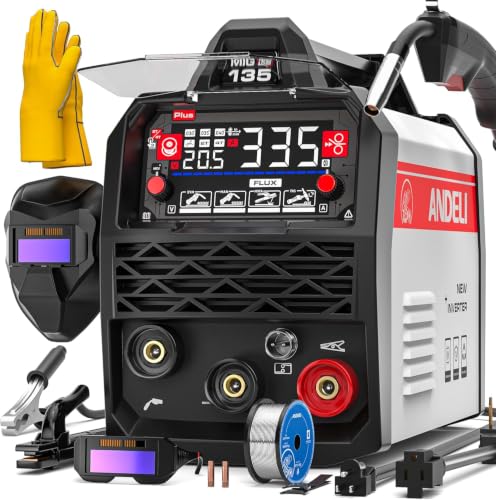
#1
YESWELDER MIG-205DS PROYESWELDER MIG-205DS PRO 5-in-1 MIG Welder
Publishes a 58 to 858 in/min wire feed range and adds -3V to 3V voltage trim.
- Max output current
- 205 A
- Input voltage
- 110V/220V dual
- Number of processes
- 5
Welding exhaust tubing is mostly a heat-control job. The walls are thin, so a machine that runs smoothly at low settings with a slow wire feed will prevent burn-through better than one with a big top output. Look for published low-end wire feed speed, synergic control with fine voltage trim, and Gas MIG or TIG for cleaner beads. Weight matters too if you weld under a car. We put 37 welding machines on one spec sheet so you can compare these numbers side by side.
Quick answer
Ranked from 37 welding machines that met our standard, compared on Low-amperage control, minimum wire feed speed, MIG/TIG process support.
As an Amazon Associate I earn from qualifying purchases. Links to retailers on this site are affiliate links; we may earn a commission at no extra cost to you.
Publishes a 58 to 858 in/min wire feed range and adds -3V to 3V voltage trim.

Stores 10 parameter sets per welding mode for recalling thin-tubing setups.

Adds MIG inductance control and 250 A output at 21.49 lb.
| Spec | ||||||||||
|---|---|---|---|---|---|---|---|---|---|---|
| Best Scoreout of 100 | 85 | 74 | 71 | 64 | 67 | 59 | 60 | 58 | 59 | 52 |
| Max output currentA | 205 A | 200 A | 250 A (best in row) | 200 A | 165 A | 250 A (best in row) | 160 A | 135 A | 145 A | 250 A (best in row) |
| Input voltage | 110V/220V dual | 110V/220V dual | 110V/220V dual | 110V/220V dual | 110V/220V dual | 110V/220V dual | 110V/220V dual | 110V/220V dual | 110V/220V dual | 110V/220V dual |
| Welding processes | Gas MIG, Flux Core MIG, Spool Gun MIG, Lift TIG, Stick | Gas MIG, Flux Core MIG, Stick, Spot, Lift TIG | Gas MIG/Flux Core MIG/Spool Gun MIG/Lift TIG/Stick/Spot | Flux MIG, Gas MIG, HF TIG, Stick, Spot, Plasma cut | Gas MIG, Flux Core MIG, Lift TIG, MMA/Stick | Gas MIG, Flux Core MIG, Stick, Spot, Lift TIG | Gas MIG, Flux Core MIG, Lift TIG, Stick | Pulse flux-cored MIG, gasless MIG, Lift TIG, MMA | Gas MIG, Gasless MIG, Stick, Lift TIG | SYN MIG/MAN MIG/Flux MIG/Gas MIG/Pulse MIG/Stick/Lift TIG |
| Number of processes | 5 | 6 (best in row) | 6 (best in row) | 6 (best in row) | 4 | 6 (best in row) | 4 | 4 | 4 | 6 (best in row) |
| Duty cycle% | 60 % | 60 % | 60 % | 60 % | 60 % | — | — | — | — | — |
| Max mild steel thicknessin | 0.50 in | — | 0.38 in | — | 0.19 in | 0.55 in (best in row) | — | 0.19 in | 0.12 in | — |
| Wire feed speedin/min | 58–858 | — | — | — | — | — | — | — | — | — |
| Aluminum welding (spool gun) | Yes | Yes | Yes | Yes | — | Yes | — | — | — | Yes |
| Synergic control | Yes | Yes | Yes | Yes | Yes | Yes | Yes | Yes | Yes | Yes |
| Digital display | Yes | Yes | Yes | — | Yes | Yes | Yes | Yes | Yes | Yes |
| Built-in plasma cutter | — | — | — | Yes | — | — | — | — | — | — |
| Weightlb | 22.7 lb | 28.2 lb | 21.5 lb | 42.0 lb | 12.1 lb | — | 19.4 lb | 9.0 lb (best in row) | 11.6 lb | 29.8 lb |
| Warrantyyears | — | — | — | — | — | 2 years | — | 3 years (best in row) | — | — |
We reviewed 50 welding machines and kept only the 37 that pass every check below. Those are ranked by a Best Score built from spec fit for this job, sales rank.
These reviews cover the top five models on our ranking for exhaust work. They are based on specifications and listing information.
A 58 in/min wire feed start suits thin exhaust tubing
Exhaust tubing is thin, so the setting that matters most is how low a welder can go, not how high. YESWELDER lists a wire feed speed range of 58 to 858 in/min. That 58 in/min floor is the only low-end feed number published by any ranked model here, which makes it easier to judge for tacking and stitching thin pipe.
Synergic control sets a matching voltage when you change wire speed, and the listing says you can trim that voltage between -3V and 3V. On thin tubing, that small trim helps cool the puddle without starting over. A manual mode is also listed, and the digital display shows real-time current while you weld.
It runs on 110V/220V dual input, offers five processes including Lift TIG and spool gun MIG, and weighs 22.7 lb. The TIG torch and spool gun are extra purchases. It leads our ranking, and its 205 A top output and 0.5 in steel rating leave room for brackets and hangers too.
VerdictFor thin exhaust work, this is the easiest pick to justify on paper because it publishes the slow wire feed numbers others leave out.
Saves 10 presets per mode for repeat exhaust jobs
Exhaust shops weld the same tubing sizes again and again. The MIG200 can store 10 groups of settings for each welding mode, so a dialed-in setup for thin pipe can be recalled instead of rebuilt. It also lists burn-back adjustment, adaptive crater and pre-flow/post-flow gas control, which help clean starts and stops on short exhaust seams.
Synergic mode picks current and wire speed once you set wire diameter and gas, and you can adjust current by hand. It runs .023 in solid wire, a small size often chosen for thin metal, though that roller is sold separately. ARCCAPTAIN does not publish a wire feed speed range or a maximum steel thickness.
It offers six processes, tied for the most on our page, including spot and Lift TIG, with 200 A output, a 60% duty cycle and 110V/220V input. At 28.2 lb it is heavier than the top pick. It ranks second on our list.
VerdictA sensible choice for anyone welding the same exhaust sizes often, though buyers who want published low-end numbers will find fewer here.
Inductance control gives thin exhaust seams a softer arc
Raw power is not the goal for exhaust, but the BILT HARD has a feature that helps on thin pipe: adjustable inductance in MIG mode. Inductance changes how the arc behaves, and turning it up generally gives a wetter, smoother puddle with less spatter. Burn-back adjustment is also listed, which helps keep the wire from sticking to the tip after short tacks.
Its synergic system sets voltage and feed speed from the amperage you choose, and the display shows voltage, current and wire feed speed live. It accepts .023 in solid wire for thin work. BILT HARD does not publish its minimum amperage or wire feed range, so the low end is harder to judge from the listing.
Its 250 A output ties for the highest on our page, with a 60% duty cycle and a 0.375 in steel rating. At 21.49 lb it is lighter than our top pick. It ranks third and covers six processes.
VerdictA capable thin-pipe option for buyers who like tuning the arc, with spare output for heavier repairs later.
HF TIG and a plasma cutter for stainless exhaust builds
This is the only ranked model listing high-frequency TIG, and that matters for exhaust. HF start strikes the arc without touching the tungsten to the work, which helps on thin stainless tubing where a stuck tungsten can mark the pipe. A TIG torch with consumables is in the box, unlike the Lift TIG models that need one bought separately.
It is also the only ranked model with a built-in plasma cutter, useful for cutting out old pipe and trimming new sections. An air filter regulator is included, but you need compressed air. Synergic MIG with a manual option is listed too. FEMEROL does not list a digital display, wire feed range or maximum steel thickness.
The tradeoff is weight. At 42 lb it is the heaviest of the five reviewed here, so it suits a bench more than a creeper. It offers 200 A, a 60% duty cycle and six processes, and ranks fourth.
VerdictBest suited to buyers building stainless exhaust systems who want TIG starts and pipe cutting from one machine, provided weight is not a concern.
A 12.1 lb MIG sized for thin steel, not thick plate
Exhaust tubing never calls for heavy plate capacity, and the BESTMIG 165S is built around lighter work. Its rated maximum is 0.19 in mild steel with 165 A of output, which is modest next to the 250 A models above but matches the thin material in a typical exhaust job. Gas MIG is supported for cleaner beads than flux core.
Synergic control sets voltage and wire speed from your amperage, with a listed voltage trim of plus or minus 3V. A manual mode lets you set voltage and current separately. The 2T and 4T trigger modes help here: 2T for tacking pipe sections, 4T for longer seams. BESTMIG does not publish a wire feed range or minimum amperage.
At 12.1 lb it is the lightest of the five reviewed, easy to carry to a car on stands. It has four processes and no spool gun or aluminum support listed. It ranks fifth.
VerdictA good fit for a home garage doing occasional exhaust repairs, where light weight and simple setup count more than plate capacity.
Best among the reviewed tools
Exhaust tubing has thin walls, so burn-through is the main risk. A machine that runs a stable arc at low settings matters more than its top amperage. Few makers publish minimum amperage, so check for a listed wire feed range and the lowest feed speed it supports.
Gas MIG gives cleaner, flatter beads than flux core on thin tubing, with less slag to clean inside joints. TIG gives the most heat control for stainless systems. Check whether a TIG torch is included, since many Lift TIG models sell it separately.
Synergic control sets voltage and wire speed for you, which helps beginners. On thin pipe, a voltage trim, inductance adjustment, burn-back control and 2T/4T trigger modes give you more ways to keep the puddle small and tack short sections without blowing holes.
Exhaust work often happens under a car on stands or a lift, so a lighter welder is easier to move around. Among the reviewed models, weight runs from 12.1 lb to 42 lb. Heavier units may add features such as a plasma cutter.
Gas MIG is the most common choice for mild steel exhaust because it is fast and leaves clean beads. TIG gives finer heat control and suits stainless systems. Flux core works but runs hotter and leaves slag, which makes thin tubing harder to weld neatly.
Yes. Exhaust tubing is thin, so it needs low heat rather than high power. Every ranked model here accepts 110V/220V dual input, and 110V is enough for typical exhaust tubing. Save 220V for thicker brackets, hangers or other heavier repairs.
Use the lowest setting that still fuses the metal, a slow wire feed and thin wire. Weld in short stitches or tacks and let each cool before moving on. A clean, tight fit-up also helps, since gaps make burn-through more likely.
Usually not. Most exhaust systems are mild steel or stainless steel. Aluminum support with a spool gun is useful if you also work on intercooler piping or other aluminum parts, and several models here, including our top-ranked pick, list it.
Your own selection is kept in the link, so friends see the same side-by-side.