Why Won't My Garage Power Strip Work? Causes and Fixes
Most dead garage power strips come down to a tripped breaker, an overloaded circuit, a worn-out surge protection part, or a dead wall outlet feeding the strip. Check the reset button on the strip first, then the outlet and the household breaker, then the load you have plugged in. If a strip keeps failing, it is usually the wrong strip for the job, not bad luck.
 GE 54638Best overall
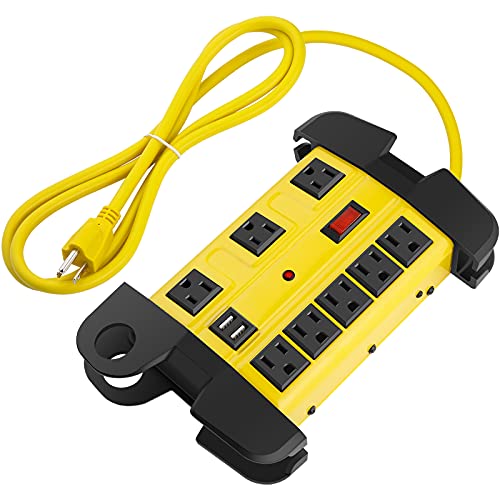 CCCEI CC-02-8U-03Metal strip with 2700 J
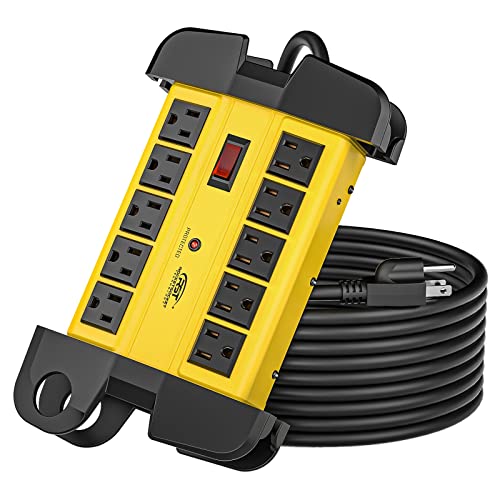 CRST LTS-10TSTied for longest cord
Start with the quick checks
Before you blame the strip, confirm it is getting power. Plug a lamp or phone charger into the same wall outlet. If that does not work either, the problem is the outlet or its circuit, not the strip.
Garage outlets are often on a ground fault circuit interrupter (GFCI), and one GFCI button can control several outlets, sometimes including ones on an outside wall. Look for a TEST and RESET button on the outlet, or on another outlet nearby, and press RESET. Then check your home's breaker panel for a switch sitting in the middle or off position.
Next, look at the strip itself. Many have a reset button for the built-in circuit breaker and an indicator light. On the GE 6-outlet models on our comparison page, the listing describes a circuit breaker with a reset switch and a protected light that confirms surge protection is active. If that light is off, the strip may still pass power, but the surge protection is no longer working.
- Test the wall outlet with a different device.
- Press RESET on any GFCI outlet in the garage and check the panel.
- Press the reset button on the strip and check its indicator light.
- Unplug everything from the strip, reset it, then add devices back one at a time.
Overload is the most common cause
Power tools, shop vacuums, air compressors, and space heaters can draw a lot of current, especially when they start up. A strip that cuts out as soon as a tool spins up is probably being overloaded, and that is its breaker doing its job.
The strips on our best power strip for garage page are all rated for 1875 W, which comes from a 15 amp, 125 volt rating. Add up the wattage of everything you run at once and stay under that number. Adding more outlets does not raise the limit. A 12-outlet strip and a 4-outlet strip share the same ceiling.
Heavy loads such as compressors and heaters are better plugged straight into a wall outlet or a properly rated extension cord. A strip is built for lighter, mixed loads like chargers, a radio, a work light, and a handheld tool.
- Find the wattage on each device label, or multiply amps by volts.
- Add the loads you run at the same time.
- If the total is near or above 1875 W, split the devices across two outlets or circuits.
Why garage strips keep breaking
A strip that works for a while and then fails is often worn out, not defective. Surge protection parts inside the strip absorb spikes and wear down over time. After a big storm or a few power events, the strip can still give you power while no longer protecting anything. A dark protected light is the usual sign.
The garage is also a tough place. Dust, sawdust, damp air, temperature swings, and knocks all take a toll. Cords get pinched by car tires or a closing door, and plugs get yanked sideways when a tool is moved.
Some designs fight these problems better than others. Twist-to-close covers on unused outlets, as listed for the GE models, keep dust out. Metal housings, such as the ones on the CCCEI 8-outlet and CRST 10-outlet strips, take knocks better than thin plastic. Mounting slots let you keep the strip off the floor, which avoids stepped-on cords and puddles.
Quick troubleshooting table
Use this table to match what you see with the most likely cause.
| What you see | Likely cause | What to do |
|---|---|---|
| No power, indicator light off | Dead outlet or tripped GFCI or breaker | Test the outlet, press RESET, check the panel |
| Cuts out when a tool starts | Overload tripping the strip breaker | Reduce the load, reset the strip, move heavy tools to a wall outlet |
| Works but protected light is dark | Surge protection is worn out | Replace the strip |
| Works only when the cord is moved | Damaged cord or loose plug | Stop using it and replace it |
| Warm or hot plug or cord | Overload or bad connection | Unplug it and reduce the load |
| Buzzing, burning smell, or scorch marks | Internal fault | Unplug it if safe and discard it |
If it is plugged into a garage door opener
Many readers ask about a strip on the garage door opener. If the opener is dead, the strip may be switched off or its breaker tripped. Plug a lamp into the strip to see if it has power.
Opener makers often recommend plugging the opener directly into a wall outlet instead of a strip. A strip adds another point that can fail or be switched off by accident. A surge or outage can also make an opener behave oddly until the power is cycled.
If the door seems to open by itself, a power strip is rarely the cause. More likely culprits are a remote button stuck down in a pocket or car, a faulty wall button or wiring, or a setting in a connected app. Remove the remote batteries and see if the problem stops, which points you toward the remote.
Safety notes
Electricity and garages are a risky mix, so keep these points in mind. Never bypass or tape down a reset button, and never remove the ground pin from a plug. If a strip, cord, or outlet is hot, smells burnt, or shows scorch marks, unplug it only if you can do so safely and stop using it.
Do not daisy chain strips by plugging one into another. Do not run cords under rugs or through door tracks. Keep strips off damp floors, and use a GFCI outlet in a garage.
If the problem is the wall outlet or wiring, call a licensed electrician. Garage door springs and cables are also under high tension, so leave adjustments to a professional, and use a stable ladder if you must reach the opener.
Choosing a replacement
If your strip has failed, match the new one to how you use the garage. For tools, look first at the circuit breaker and cord gauge. AWG is wire thickness, and a lower number means thicker wire. Among the models on our page that list a gauge, 12 AWG is the thickest and 14 AWG the most common.
Check for a safety certification such as ETL, and skip strips that list none. Also look for wall mounting, since every ranked strip lists it.
Surge ratings run from 800 J to 4800 J among the strips we compare. The CCCEI 4-outlet model lists 4800 J and a 12 AWG cord, but has only 4 outlets and a 4 ft cord. For longer reach, the CRST lists a 15 ft cord with 10 outlets. Compare them side by side on our garage power strip comparison, where we also show which specs makers leave unpublished.
Frequently asked questions
Can I reset a power strip that keeps tripping?
Yes, if it has a reset button, press it after unplugging the extra devices. If it trips again with a light load, the strip or an appliance may be faulty.
Does a dead protected light mean the strip is broken?
Not always. It often means the surge protection has worn out, though the outlets may still deliver power. Replace the strip if you rely on it for electronics.
Can I use a regular household strip in a garage?
It may work, but garages are harder on gear. A strip with a breaker, thicker cord, sturdy housing, and mounting slots is a better fit.
Why does my strip work in the house but not in the garage?
The garage outlet may be on a tripped GFCI or a separate breaker. Check those before assuming the strip is at fault.